
Livraison le jour même ou le lendemain

Qualité garantie

Débloquez vos offres de bienvenue: Livraison GRATUITE | Jusqu'à -80 % | 30 jours d'essai gratuits à JoyPlus
Téléchargez l'application
Choosing the right food storage container? It sounds simple enough. But in reality, who hasn't cursed at a lid that warped in the dishwasher, a dish that cracked straight out of the freezer, or a bag soaked by a sauce from a supposedly “?airtight?” container? With an overwhelming number of options on the market, it’s easy to be misled and turn a promising purchase into future landfill.
As the Equipment Editor at Joybuy, I test and select products to help you avoid these disappointments. My goal is to help you find solutions that are genuinely practical and durable. This guide gets straight to the point: we’ll break down the essential criteria for choosing containers that will live up to their promises, whether you're looking for your next lunch box or want to streamline your pantry.
Marketing is notoriously good at making promises that evaporate with use. Here are the three most common traps to avoid.
To make the right choice, there are three technical points to check. These are what make all the difference in the quality and lifespan of your containers.
The choice of material depends entirely on how you’ll use it.
The effectiveness of an airtight food container depends on its lid.
Before investing in a food storage container set, think about your cupboards. Square or rectangular containers are much easier to store than round ones. Check if the containers nest inside each other and if the lids allow for stable stacking in the fridge or cupboards.
Rather than an endless list, we’ve selected products that check all our boxes for specific needs.

Why it’s a great choice: Its 630 ml size is perfect for a single serving. Designed to go from the freezer to the microwave (without the lid), it radically simplifies weekly meal prep. It's the ideal lunch box for the office.
Its borosilicate glass body handles thermal shock without flinching, so you can forget about cracks. Its clip-lock system is built to last, avoiding the “false airtight” trap.
Versatility and durability: oven, microwave, freezer, dishwasher—it does it all. Its clip-lock system is a safe bet.
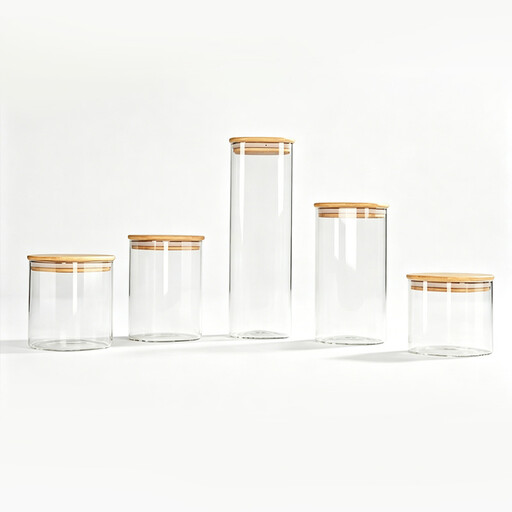
Why it’s a great choice: This set is designed for organisation and aesthetics. The different sizes (from 750 ml to 2300 ml) are perfect for storing dry goods, from cereal to pasta, while creating a clean, visual appeal on your shelves.
It avoids the “catch-all set” trap by offering genuinely useful and complementary sizes for bulk foods, instead of a collection of mini-jars that will never be used.
The design, with its wood-finish lid and transparent glass body, turns storage into a decorative element. Functional and elegant.

Why it’s a great choice: This set combines two highly functional sizes: 5 large 1040 ml containers for leftovers or family-sized meals, and 5 small 370 ml containers for sauces, side dishes, or kids' snacks. The borosilicate glass guarantees a healthy and long-lasting solution.
This set focuses on useful sizes in multiple quantities, thus avoiding the trap of mismatched and impractical bundles. The choice of borosilicate glass is a true mark of long-term quality.
A coherent and ultra-versatile kit, perfect for batch cooking and managing weekly meals, with the peace of mind that comes from high-quality glass.
Explore our full selection of products that meet our quality charter and all current safety standards.
Absolutely not—it's a classic mistake! Only dishes made of borosilicate glass are designed to withstand high oven temperatures and thermal shock. A standard glass dish (soda-lime glass) is likely to crack or even shatter. Always check the manufacturer's instructions before using it in the oven. And of course, the plastic lid should NEVER go in.
To ensure a lasting seal, the secret is to remove the silicone seal from the lid before each wash. A simple hand wash with soapy water, followed by completely air-drying it before putting it back, is all it takes. This is the best way to prevent residue and mould buildup while extending the life of the seal.
Glass remains the champion of neutrality: it's completely inert, meaning it won't leach any substances, stain, or retain odours. Certified “BPA-free” plastic is a safe, regulated alternative in Europe, and is popular for its light weight. As a precaution, however, many users still prefer to use glass for reheating food in the microwave, especially if it's greasy or acidic.