
Same-day & Next-day Delivery

Quality Guaranteed

Unlock Your Welcome Offers: FREE Delivery | Up to 80% OFF | Free 30-day JoyPlus trial
Download the APP
Switching from plastic to glass for food storage has become a go-to move for many, whether for health or environmental reasons. But when faced with a jungle of products making tempting promises, how do you make the right choice? Our mission at Joybuy is to guide you through this world. Let's break down the pitfalls to avoid and the criteria that really matter to find THE perfect glass food storage container for your needs.
To prevent a well-intentioned purchase from turning into a cupboard nightmare, here are the three most common disappointments.
To avoid falling into these traps, here are the technical points you absolutely must check before heading to the checkout.
This is THE deciding factor if you plan on reheating your meals.
The entire effectiveness of an airtight glass jar or a glass meal prep container comes down to its lid.
Think about your habits. Do you need a single glass food container for your daily lunch, or a complete arsenal for your weekly "meal prep"? Square or rectangular shapes are king for optimising space in a bag or refrigerator. And if they're stackable, you've hit the jackpot for saving space.
Let's get practical. Here is our selection of products that check all the right boxes, each meeting a specific need.

Why we love it: Its 630 ml size is perfect for a single serving. Being rectangular, it slides easily into a bag. In short, it does everything you ask of it: safely transporting, storing, and reheating your lunch.
Its borosilicate glass withstands thermal shock, so goodbye to the risk of cracking in the microwave. Its clip-on lid guarantees a truly reliable seal, putting an end to the "not-so-airtight" seal issue.
Versatility: freezer, microwave (without the lid), and dishwasher safe. One container to do it all.

Why we love it: This set is the ultimate organisational ally. With five large containers (1040 ml) and five smaller ones (370 ml), it covers all your needs: prepping meals for the week, separating mains from sides, or storing leftovers for the whole family.
No more "mismatched set" trap! Here, you get two genuinely useful sizes, with multiple units of each. The combination of borosilicate glass and "snap-lock" lids is a guarantee of durability and reliability.
A complete and coherent system for a perfectly organised fridge and hassle-free "meal prep" sessions.
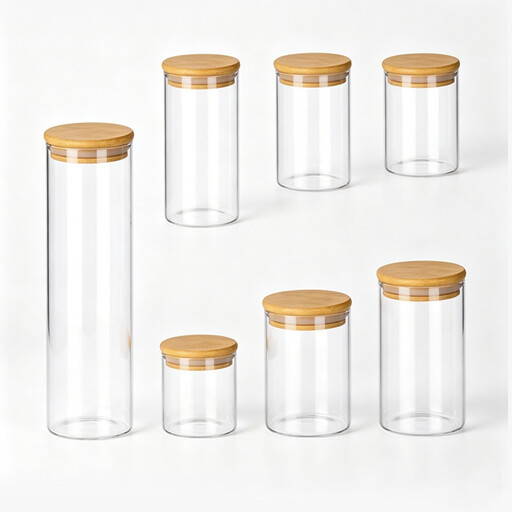
Why we love it: This set is designed for storing dry goods (pasta, rice, lentils, flour...). Its seven sizes can accommodate all your pantry staples, while adding an aesthetic and organised touch to your kitchen or pantry.
No false promises here: its mission isn't to transport liquids, but to perfectly preserve dry foods. Its sealed lid is a barrier against moisture and pests.
A stylish and complete set to optimise vertical storage and intelligently manage your stock of dry goods.
We have put together a complete selection of products that meet our demanding specifications for quality and safety.
It all depends on the type of glass. Only containers made of borosilicate glass are designed to withstand such thermal shock. With other types of glass, or simply as a precaution, it's better to let the dish rest for a few minutes at room temperature before reheating. In any case, the plastic lid must be removed, or at the very least just placed on top of the dish (without being clipped on) to allow steam to escape.
To prevent the growth of mould or bacteria, it's crucial to remove the seal from the lid after each use (if the model allows it, of course). A hand wash with hot, soapy water and letting it air dry completely is all it takes before putting it back. A spotless seal is the guarantee of healthy food storage.
Absolutely. Glass is an inert and non-porous material. In practical terms, it doesn't absorb odours or food colours (goodbye to that Tupperware stained orange by tomato sauce!). Most importantly, there's no risk of it leaching any chemicals into your food, even when heated. While "BPA-free" plastics are a real step forward, glass remains the number one choice for complete peace of mind, especially with hot or acidic foods.