
Same-day & Next-day Delivery

Quality Guaranteed

Unlock Your Welcome Offers: FREE Delivery | Up to 80% OFF | Free 30-day JoyPlus trial
Download the APP
Switching to glass food storage containers is an excellent idea. It's a healthy, sustainable, and far more stylish solution than plastic. Glass doesn't retain odours or stains, is guaranteed BPA-free, and lets you see at a glance what's left of last night's casserole. However, not all models are created equal. Between marketing promises and daily reality, the wrong choice can quickly turn a good investment into a headache. Before you stock your cupboards, here are the pitfalls to watch out for.
The first and most frustrating pitfall: the lid that is airtight in name only. A product sold as an airtight glass jar with a poor-quality or ill-fitting silicone seal is a recipe for a guaranteed vinaigrette leak at the bottom of your bag. The second issue: false versatility. The "oven-safe" claim is often misleading: it only applies to the glass container, never its plastic lid. Forgetting this detail means risking a melted lid and a ruined meal. Finally, beware of supposedly "stackable" models that, in practice, create unstable piles and turn your cupboards into a precarious Leaning Tower of Pisa.
To make the right choice, you just need to check a few technical details that make all the difference in daily use.
Not all glass is created equal when it comes to heat. The main distinction is between soda-lime glass (standard) and borosilicate glass.
The seal of a glass dish with a lid depends entirely on one thing: its locking system. The most reliable system remains the four-clip lid, equipped with a removable silicone seal. This guarantees a leak-proof seal, which is essential for transporting a saucy dish without making a mess in your bag. For storing dry goods, screw-on lids are a good alternative, but they are often less effective against liquid leaks. Make sure the seal is thick, flexible, and, most importantly, removable. This is crucial for a deep clean that will prevent the build-up of residue and mould.
Whether you're lining up a kitchen storage jar on a shelf or saving space in the fridge, a good stacking system is non-negotiable. Well-designed models have lids and bases crafted to nest perfectly, ensuring rock-solid stability. Our advice: opt for a set of glass food containers from the same brand. This ensures perfect compatibility and storage that is as organised as it is secure. For space optimisation, square or rectangular shapes reign supreme, allowing you to maximise space far more efficiently than round formats.
Rather than an endless list, we've selected models that excel in specific situations. The goal: to help you find the product that truly fits your lifestyle.

Why we love it: Perfect for prepping your meals for the week. Its 630 ml size is just right for a single portion. The borosilicate glass allows it to go directly from the fridge to the office microwave. So practical.
Its 4-clip locking system with a silicone seal guarantees a flawless seal. No more leaks in your bag! The borosilicate glass handles the thermal shock of reheating without flinching.
Absolute versatility: cooking, storing, and transporting. One container to do it all, which radically simplifies meal logistics.
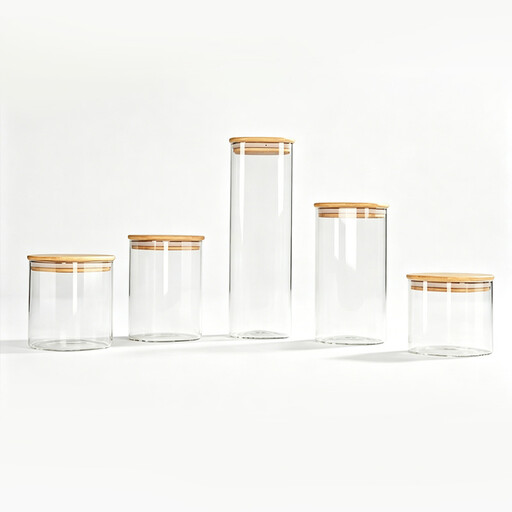
Why we love it: This set is a turnkey solution for organising your dry goods with style. The different sizes (from 750 ml to 2.3 L) are perfect for storing pasta, rice, or cereal. The decorative touch? The very well-done wood-effect lids.
Here, aesthetics haven't sacrificed function. The lids are truly airtight and effectively protect against moisture and pests, unlike many purely decorative jars.
A cohesive set that combines a perfect seal with a polished design. The result: a pantry that is as beautiful as it is well-organised.

Why we love it: Its generous 2-litre capacity makes it the ultimate family dish. Ideal for a potato gratin, storing leftover Sunday roast, or marinating meat. It's a true oven dish that doubles as a storage container.
Its borosilicate glass is designed to withstand oven temperatures up to 400°C (without the lid, of course). This eliminates any risk of breakage due to heat, the classic trap of ordinary glass dishes.
Its large volume and extreme heat resistance. A single dish to bake, serve, store, and reheat. Less washing up, more space.
Explore our full selection of products that meet our quality criteria and current safety standards.
Absolutely not! A plastic lid would not survive the heat of the oven: it would warp or melt. The "oven-safe" label only applies to the glass container. For the microwave, it's best to remove the lid or simply rest it on top without clipping it shut, allowing steam to escape.
This is a common problem with tomato sauces or curry. The solution: remove the seal from the lid and wash it separately with hot, soapy water. If the odour lingers, let it soak for an hour in a mixture of warm water and white vinegar, then rinse thoroughly. Guaranteed to work.
It's all about resistance to thermal shock. Borosilicate glass is engineered to handle large and rapid temperature changes, making it safe for the oven, microwave, and freezer. Regular glass (soda-lime) is much more fragile: a sudden temperature change can cause it to shatter. For versatile use that includes cooking, borosilicate isn't an option—it's a necessity.