
Livraison le jour même ou le lendemain

Qualité garantie

Débloquez vos offres de bienvenue: Livraison GRATUITE | Jusqu'à -80 % | 30 jours d'essai gratuits à JoyPlus
Téléchargez l'application
Want to mount a letterbox, a wall light, or a decorative plaque outdoors without taking out the drill? The promise is tempting. Exterior mounting adhesive presents itself as the go-to solution for bonding without drilling. Yet, how many DIYers have found their object peeling off by the first winter, or an adhesive that stubbornly refuses to stick to the surface? The problem: the market is flooded with products making enticing marketing claims, but which hide deal-breaking flaws for outdoor use.
As a Product Specialist at Joybuy, my mission is to help you decode the labels and identify the criteria that truly make a difference. Let's review the most common traps and the criteria to inspect to choose a fixing adhesive that will deliver on its promises long-term.
waterproof adhesive will eventually degrade, lose its bonding power, and cause your installation to fail.Multi-Material Adhesive: The "bonds anything to anything" argument is convenient, but often misleading. Most standard adhesives struggle to bond durably to so-called "closed" or non-porous surfaces like PVC, aluminium, or certain notoriously difficult plastics (PE, PP, PTFE). Using an unsuitable adhesive on these materials almost always results in failure, especially under the effect of temperature fluctuations that cause expansion and contraction.To avoid making a mistake, forget the marketing slogans and focus on the product's technology. Two parameters are decisive for a heavy-duty exterior adhesive.
Not all adhesives are created equal. Their chemical composition is the true guarantee of their flexibility, strength, and longevity.
exterior mounting adhesive that won't let you down.Before any purchase, meticulously inspect the list of compatible materials and exclusions on the packaging.
Rather than an exhaustive list, we have targeted products that meet specific needs. The goal: to help you find the perfect adhesive for your project.
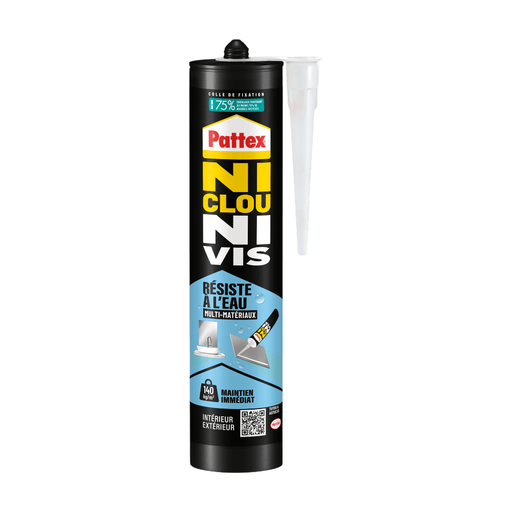
Why we chose it: It's the reliable solution for a multitude of projects, both indoors and out. From fixing a skirting board in a damp room to installing a house number on a rendered wall, its versatility makes it a true Swiss Army knife.
This product is based on Flextec hybrid polymer technology. It is therefore truly waterproof and not just "water-resistant," which guarantees its performance against the elements. It adheres to most materials, including temporarily damp surfaces.
Solvent-free formula, repositionable for 10 min, resists UV and temperatures from -30 °C to +80 °C. Can be painted after curing for a flawless finish.
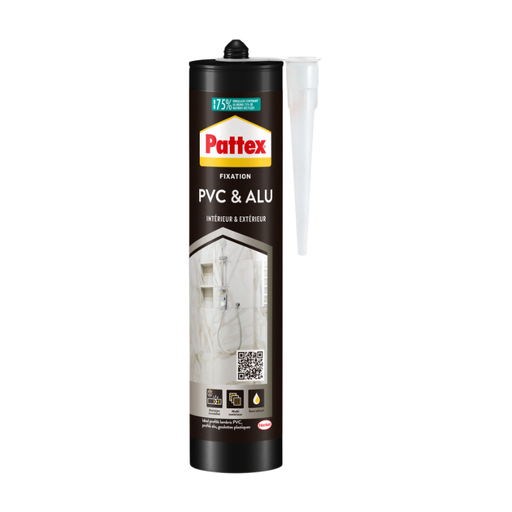
Why we chose it: Essential for projects involving non-porous materials outdoors, such as fixing PVC electrical trunking to a concrete wall or assembling aluminium components.
It debunks the "multi-material" adhesive myth by being specifically formulated for high-performance adhesion on closed surfaces like PVC and aluminium, where standard adhesives throw in the towel.
Flextec technology for a bond that is both flexible and durable. Resistant to extreme temperatures (-30 °C to +90 °C) and moisture. High load capacity, stated by the manufacturer as up to 25 kg/cm?.
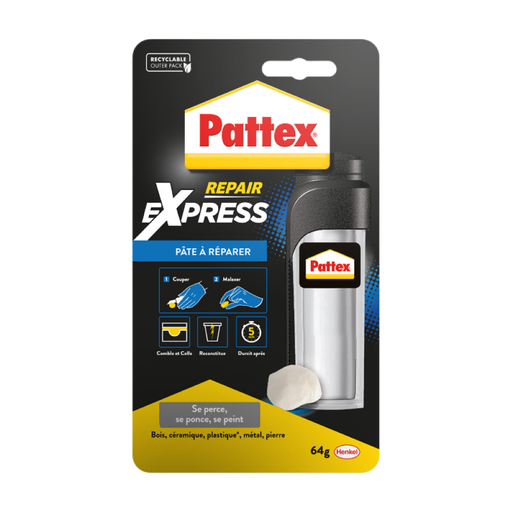
Why we chose it: For those who need more than just an adhesive. Perfect for filling a hole in a wall, rebuilding a broken piece of wood on a garden bench, or sealing a crack before painting.
This is not a simple fixing sealant, but a two-part epoxy putty. It avoids the classic mistake of using a liquid adhesive to fill a void, which would lead to significant shrinkage and low structural strength.
Kneadable, it can be shaped by hand to fit any form. After hardening (sets in 5 min), it can be sanded, drilled, and painted. It resists grease, solvents, and temperature variations.
We have compiled a complete and up-to-date selection of products that meet our strict selection criteria and UK standards.
The longevity of a fixing depends on a trio of factors: the quality of the product, the preparation of the surfaces, and the exposure to the elements. A bond made by the book with a hybrid polymer adhesive on sound surfaces can last for many years. Conversely, a low-end acrylic adhesive on a south-facing wall may show signs of weakness in less than two years.
In theory, yes, but the condition of the surface is the ultimate test. The adhesive will bond perfectly... to the outermost layer of the wall. If that layer is flaking paint or a crumbling render, it's that layer that will fail, not the adhesive. Therefore, ensure the surface is sound, clean, and stable before any application. The weight of the object to be fixed, of course, remains a limiting factor that should never be overlooked.
Removing an object bonded with a high-performance sealant is a delicate operation, as these products are designed to last. The most common method is to slide a thin cutting wire or a fine saw blade behind the object to shear the adhesive layer. Heating the area with a heat gun can help soften some sealants, but be careful not to damage the surface. In most cases, touch-ups (sanding, filling, painting) will be unavoidable on the wall after removal.