
Livraison le jour même ou le lendemain

Qualité garantie

Débloquez vos offres de bienvenue: Livraison GRATUITE | Jusqu'à -80 % | 30 jours d'essai gratuits à JoyPlus
Téléchargez l'application
Ever felt lost in the adhesive and sealant aisle?? Packaging competes with promises: instant adhesion, rock-solid strength, absolute versatility... These claims are often misleading. Yet, the wrong choice can quickly turn a DIY project into a total nightmare. As a product expert for Joybuy, my mission is to help you see things more clearly. Let's break down the most common pitfalls together so you can choose the perfect product for your needs.
The first pitfall: believing in a universal adhesive. A multi-material adhesive might seem like a miracle solution, but it will quickly show its limits on difficult plastics like polyethylene (PE) or polypropylene (PP). The second classic mistake: confusing "instant grab" with "final strength". A product might hold an object in place for a few seconds, but it won't support its final weight until after 24 to 48 hours of full curing. Applying stress to the bond too early is the most frequent cause of failure. Finally, underestimating the application environment is a rookie mistake: a standard sealant used on a facade or in a bathroom will degrade at lightning speed if it's not specifically formulated to resist water, UV rays, and temperature changes.
To avoid these pitfalls, you just need to ask the right questions. Three essential criteria will guide your choice of construction adhesive or sealant.
This is the essential starting point. A material is considered porous if it absorbs liquids (raw wood, plaster, brick, concrete). A non-porous material is smooth and impermeable (glass, tile, metal, PVC).
The environment and mechanical stresses are decisive for the long-term durability of your bond.
To give you concrete guidance, here is our selection of products, each meeting a specific need and avoiding the pitfalls we've just discussed.
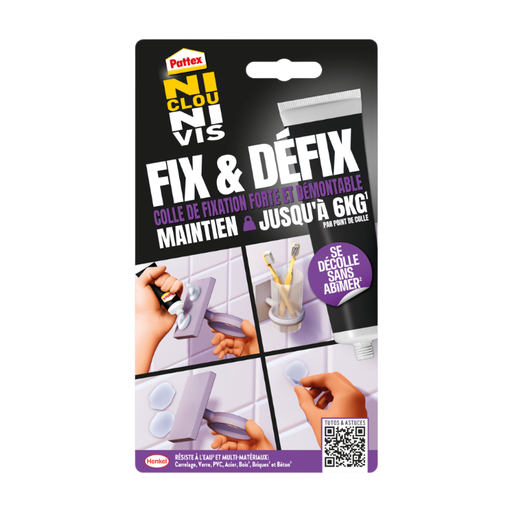
Why it's the right choice : Ideal for small fixtures that aren't meant to be permanent. Perfect for renters who want to mount light objects (up to 6 kg per pad) on smooth surfaces (tile, glass) without drilling or making a long-term commitment.
This adhesive doesn't claim to be universal. It targets a very clear use case: non-porous surfaces. Its main advantage is that it's removable, which prevents the unpleasant surprise of an unwanted permanent bond.
It can be removed without a trace using a simple spatula. Being water-resistant, it's perfectly suited for small bathroom accessories.
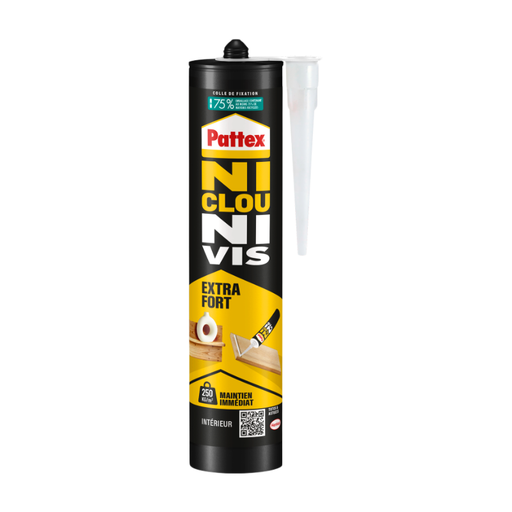
Why it's the right choice : This is the go-to adhesive for heavy-duty interior fixtures: skirting boards, battens, shelves, panelling... Its solvent-free formula is optimised for maximum adhesion on porous materials.
The instructions are very clear about its main usage requirement: "One of the two materials must be porous." This makes it impossible to go wrong and apply it to two smooth surfaces, where adhesion would be almost non-existent.
Its initial grab is very high, which makes positioning easy. Its solvent-free formula is much more pleasant to use indoors.
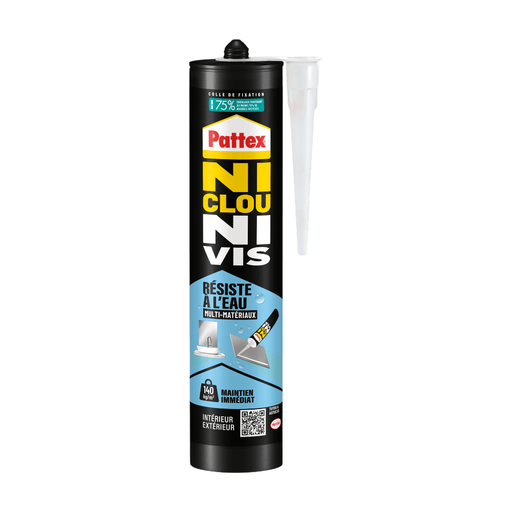
Why it's the right choice : This is the solution for all indoor and outdoor fixing projects, including in areas with the highest water exposure. Its Flextec technology gives it excellent versatility and durability against the elements.
This product directly addresses the environmental pitfall. It is explicitly formulated to resist water, humidity, and UV rays, ensuring a reliable bond where a standard adhesive would have already failed.
It can be applied to most materials, even when damp. It remains flexible after curing and can be painted.
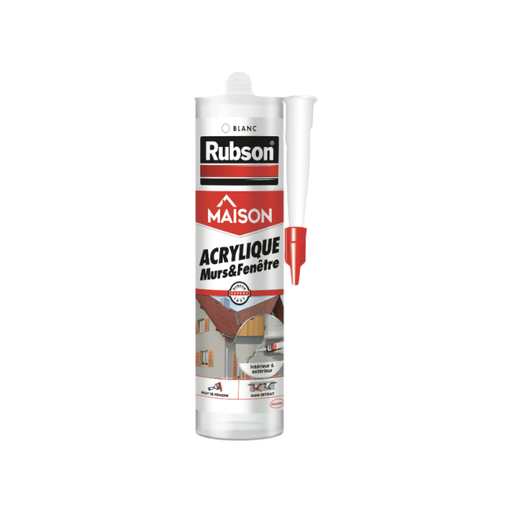
Why it's the right choice : This is the ultimate finishing product. It's ideal for filling cracks in walls and ceilings, or for creating flawless sealant joints around doors and windows before painting.
This acrylic sealant is specifically designed to be painted, unlike most silicone sealants. It ensures a clean, durable finish that won't yellow or crack.
Its lasting elasticity allows it to accommodate structural movement without cracking. It can be painted with any type of paint for a completely invisible finish.
We have put together a complete selection of products that meet these demanding selection criteria and comply with the highest industry standards.
To put it simply, a construction adhesive is designed to weld two surfaces together with maximum bonding strength. Its goal: to ensure nothing moves again. A sealant, on the other hand, is primarily used to fill a gap or create a waterproof seal. While it also adheres, its primary quality is its flexibility, which allows it to absorb expansion and vibrations without breaking.
This is an absolutely crucial point. The "instant grab" or "initial tack" (a few seconds at most) is only for positioning the object without needing to hold it. The final strength is only achieved after a full cure, also known as "curing through". This period varies from 24 to 72 hours depending on the product, the thickness of the adhesive, the temperature, and the ambient humidity. It is therefore imperative to read the instructions and respect this timeframe before putting any stress on the fixed object.
Absolutely not, and this is a very common mistake! Acrylic sealants are specifically designed to be painted after curing, making them the champions of interior finishing. Conversely, paint will not adhere to most silicone sealants: it will peel off in record time. For a joint that is intended to be painted, always check for the "paintable" label on the packaging.