
Livraison le jour même ou le lendemain

Qualité garantie

Débloquez vos offres de bienvenue: Livraison GRATUITE | Jusqu'à -80 % | 30 jours d'essai gratuits à JoyPlus
Téléchargez l'application
A strong adhesive lets you quickly repair a broken item, attach a shelf or join several materials without getting out your entire toolbox. However, not all adhesives are equal, and they are not designed for the same conditions. Instant adhesive is suitable for a small, clean break, while a no-nails, no-screws adhesive should be chosen according to the surface, the weight it needs to support and the surrounding environment.
Before placing your order, three common mistakes are worth avoiding:
Surface compatibility is the first thing to check. A cyanoacrylate adhesive, also known as super glue or instant adhesive, generally works on metal, wood, ceramic, porcelain, rubber and certain plastics.
Take the time to read the packaging, however. PE, PP and PTFE are often incompatible with standard instant adhesives. To repair a difficult-to-bond plastic, a formula supplied with an activator may be a better choice.
For wall mounting, the surface also plays a crucial role. The Pattex No Nails No Screws Extra Strong formula featured here requires at least one of the two surfaces to be porous, such as wood, brick, stone or plaster.
An instant adhesive sets in a few seconds, but the assembly may not be ready to bear a significant load immediately afterwards. Some formulas reach their maximum strength after several minutes, or even after 24 hours in the case of a mounting adhesive. Always follow the time specified by the manufacturer.
For a bathroom, kitchen or item that is washed regularly, look for a water-resistant adhesive and check its usage limitations. Being water-resistant does not necessarily mean that it can withstand permanent immersion.
Items exposed to impact, twisting or flexing — soles, flexible pipes, balls or seals — generally need a rubber-enriched gel adhesive. For a shelf or skirting board, the contact area, the weight to be supported and the drying time are the main considerations.
The labelling and safety instructions should also be clear: the presence of cyanoacrylate, precautions in the event of contact with skin or eyes, ventilation requirements and storage instructions. This information depends on the product data sheet and label, not on a general promise that applies to all adhesives.
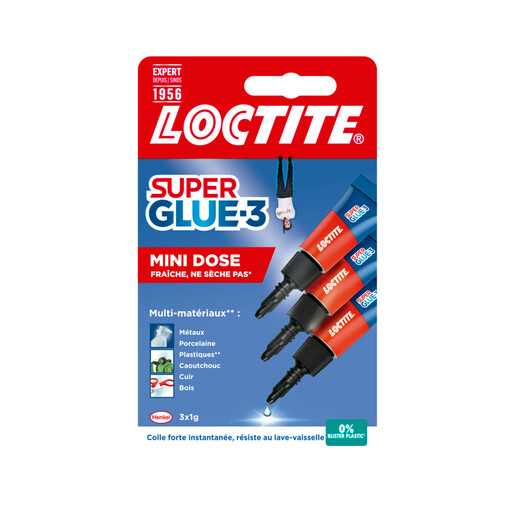
Why this choice suits this profile : The three individual doses are ideal for occasional repairs to everyday items made from porcelain, wood, rubber or leather.
The small format reduces waste and prevents a large tube from drying out between uses.
Three 1 g doses, a transparent formula and fast setting on several materials listed by the manufacturer.
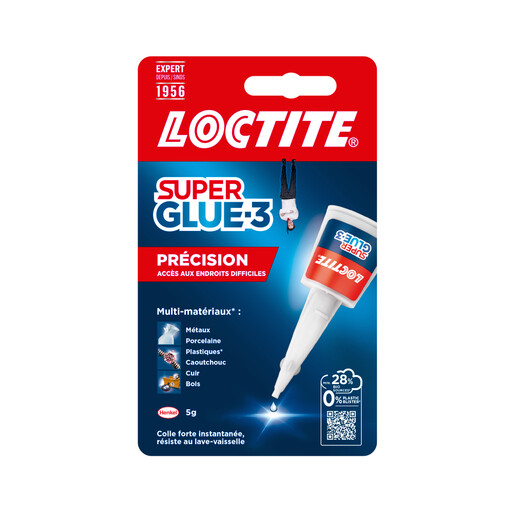
Why this choice suits this profile : Its elongated nozzle lets you apply a drop into a narrow corner. This is a real advantage for visible items, arts and crafts, and precise assemblies.
The precision nozzle reduces the risk of applying too much adhesive, dripping or leaving visible marks on small surfaces.
Long nozzle, drop-by-drop application, transparent finish and water resistance stated on the product data sheet.
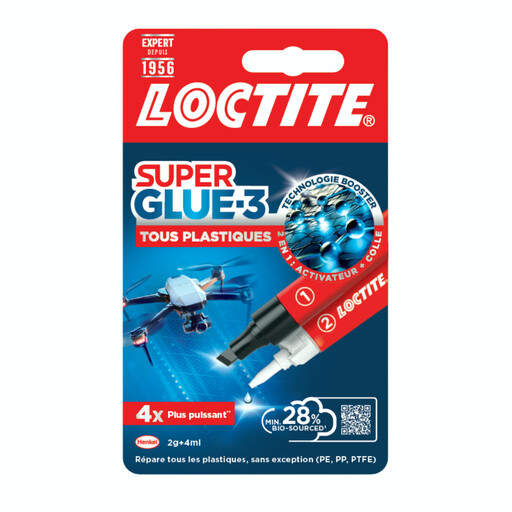
Why this choice suits this profile : Its duo of a 2 g tube and activator pen is designed for plastic repairs, particularly when the type of surface is difficult to identify.
The activator prepares difficult-to-bond plastics and prevents standard adhesive from being applied to an incompatible surface.
A two-step system, a transparent adhesive and a nozzle suited to targeted repairs.
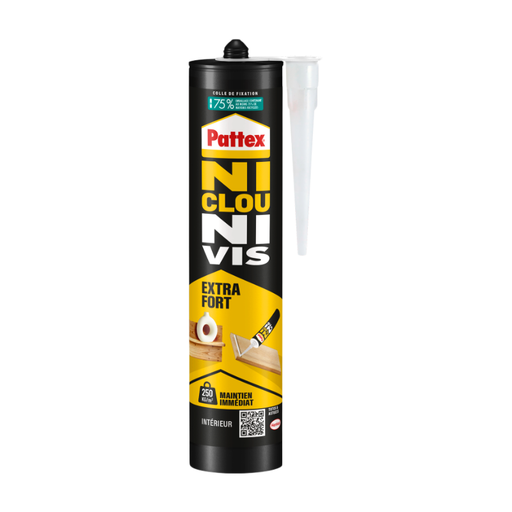
Why this choice suits this profile : This mounting adhesive is designed for indoor work on walls or ceilings, for installing skirting boards, hooks, battens or shelves.
The product data sheet specifies that one of the surfaces must be porous and excludes surfaces exposed to permanent moisture.
A solvent-free formula, a 380 g format and full curing stated to take place after 24 hours, according to the instructions provided.
We have put together a complete, real-time updated list of products that meet these strict selection criteria, as well as European safety regulations.
Wear suitable gloves and work in a properly ventilated room. Cyanoacrylate adhesives can bond skin and eyelids in a matter of seconds. If the product comes into contact with your eyes, rinse thoroughly with water and seek medical advice promptly. Always keep the product out of the reach of children.
Start by identifying the type of plastic. PE, PP and PTFE are often incompatible with standard cyanoacrylate adhesive. A product with an activator, such as the Loctite Super Glue-3 All Plastics system, may be suitable if the data sheet confirms compatibility with the surface in question. Testing it on an inconspicuous area is still strongly recommended.
It depends on the format, how securely it is closed and the storage conditions. Replace the cap immediately after use, then store the tube in a cool, dry place away from heat and sunlight. Mini-doses help reduce waste when repairs are occasional. A blocked nozzle or thickened formula generally indicates that the product is no longer particularly practical to use.
It may be suitable for some indoor fixings, but first check the porosity of the surfaces, the weight of the shelf and its contents, the contact area and the curing time. For a substantial load or an installation subject to repeated movement, compare the manufacturer’s recommendations with the actual constraints of the wall and the item before ruling out screws or wall plugs completely.