
Livraison le jour même ou le lendemain

Qualité garantie

Débloquez vos offres de bienvenue: Livraison GRATUITE | Jusqu'à -80 % | 30 jours d'essai gratuits à JoyPlus
Téléchargez l'application
Choosing a cooker hood can quickly become a headache. Between marketing promises, complex spec sheets, and a multitude of designs, it's easy to make a purchase you'll regret. A hood that's too noisy, ineffective, or difficult to clean can turn the joy of cooking into a daily frustration.
As a product expert at Joybuy, my mission is to help you see things more clearly. Let's forget the jargon and focus on what's essential. This guide breaks down the pitfalls to avoid and the criteria that truly matter, ensuring your choice meets your real needs—not the siren song of marketing.
Before comparing models, it's best to know the most common mistakes that prove costly (in both money and peace of mind).
To avoid these pitfalls, focus on three fundamental parameters that will make all the difference in your daily use.
This is the most crucial criterion. Your choice will depend entirely on your kitchen's layout.
Most modern models are versatile and offer both installation modes.
The airflow rate, measured in cubic metres per hour (m?/h), should be proportional to your kitchen's volume. A simple rule helps estimate your needs:
Kitchen Volume (L x W x H) x 10 = Minimum Required Airflow Rate (in m?/h)
For example, for a 12m? kitchen with a 2.5m ceiling height (a volume of 30m?), a hood with an airflow rate of around 300m?/h will be more than sufficient for everyday use. There's no need to aim for 700m?/h if your space is small.
A quiet cooker hood makes all the difference, especially in an open-plan kitchen. The noise level is expressed in decibels (dB) at maximum speed.
Check this data on the energy label. A high-performance model isn't necessarily a noisy one.
To help you see how these criteria apply in practice, here are a few models that cater to distinct user profiles.
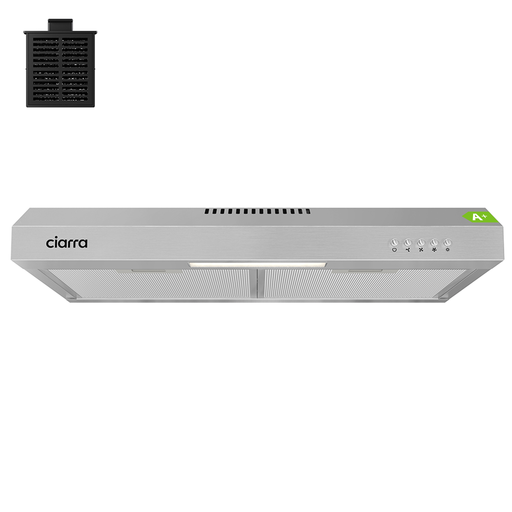
Why this model is a great fit: Ideal for studios or small kitchens, this built-in hood fits neatly under a wall cabinet, freeing up maximum space. Its standard 60cm width and stainless steel finish integrate easily into any design.
It avoids being oversized with an airflow rate suited for small spaces and offers the flexibility of recirculating or ducted installation, eliminating any risk of incompatibility.
Ultra-slim design for maximum discretion. A+ energy rating for controlled consumption.
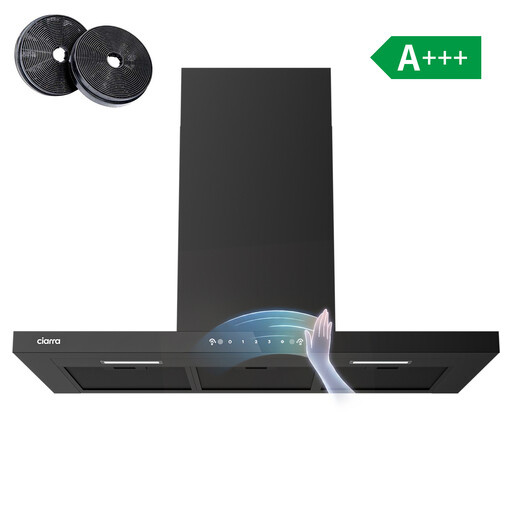
Why this model is a great fit: For those looking for a centrepiece in their kitchen. This 90cm wall-mounted hood combines a modern aesthetic with high performance (650m?/h), making it ideal for large spaces and open-plan kitchens.
It balances power and comfort with a 59dB noise level and an A+++ rating, sidestepping the "powerful but noisy and energy-hungry" trap. Its glass surface is smooth and easy to clean.
"Wave Control" gesture commands for hygienic use. Ultra-slim 40mm design for an elegant integration.
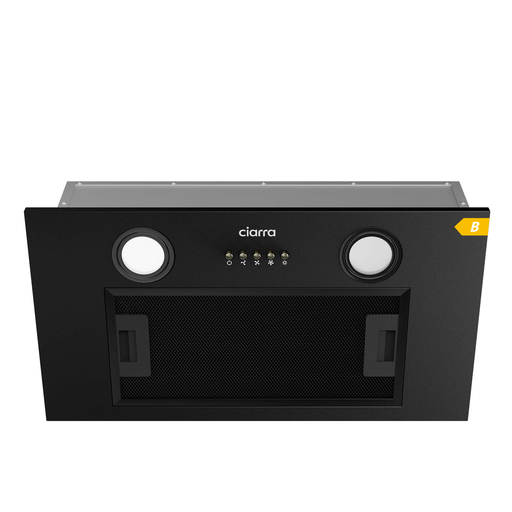
Why this model is a great fit: Designed for minimalist kitchens where appliances should disappear. This model is completely concealed within a wall cabinet, offering an effective and discreet extraction solution.
It solves the "design versus practicality" dilemma by being completely invisible. Maintenance is focused on the removable grease filter, with no need to worry about the external appearance.
Fully integrated for a clean look. Durable and simple-to-use push-button controls.
Explore our full selection of cooker hoods that meet our criteria for performance and reliability.
The lifespan of an active charcoal filter depends on your usage frequency and cooking style. On average, it's recommended to replace it every 3 to 6 months. Some newer filters are washable and reusable, which represents a significant long-term saving. A saturated filter becomes completely ineffective against odours.
The golden rule is to choose a hood that is at least as wide as your hob. A 60cm hood is suitable for a standard 60cm hob. For a wider hob or for better smoke capture at the sides, a 90cm hood is a more comfortable option.
For a stainless steel hood, the secret is to use a soft microfibre cloth and a suitable cleaning product. Avoid abrasive sponges that could scratch the surface. For a natural clean, a mixture of warm water and white vinegar works wonders. Always wipe in the direction of the stainless steel's grain for a flawless finish.