
Livraison le jour même ou le lendemain

Qualité garantie

Débloquez vos offres de bienvenue: Livraison GRATUITE | Jusqu'à -80 % | 30 jours d'essai gratuits à JoyPlus
Téléchargez l'application
Choosing a cooker hood can quickly become a headache. Between the advertised airflow rates, noise levels, and different installation types, it's easy to get lost and make the wrong choice. Yet, selecting the right hood is the key to a healthy kitchen, free from stubborn cooking odours. Before you decide, be aware of some common pitfalls that can turn a useful investment into a daily nightmare.
The 3 pitfalls to avoid when buying a kitchen hood?:
To ensure you make the right choice, let's review the key technical specifications that make all the difference in the performance and user comfort of your future cooker hood.
Expressed in cubic metres per hour (m?/h), the airflow rate indicates the volume of air the hood can process. It's the core of its performance. A simple calculation can help you estimate the power needed for your kitchen?:
Kitchen Volume (L x W x H) x 10 = Minimum Required Airflow Rate in m?/h
This is the crux of the matter, especially in open-plan kitchens. Indicated in decibels (dB) on the energy label, the noise level is a key indicator. Here are some benchmarks to help you?:
The model you choose will depend entirely on your kitchen's layout and your personal taste.
In terms of dimensions, the most common widths are the 60 cm hood, suitable for standard hobs, and the 90 cm hood, essential for range cookers or extra-wide hobs.
To guide you, here is our selection of models that meet specific needs while avoiding the classic pitfalls.
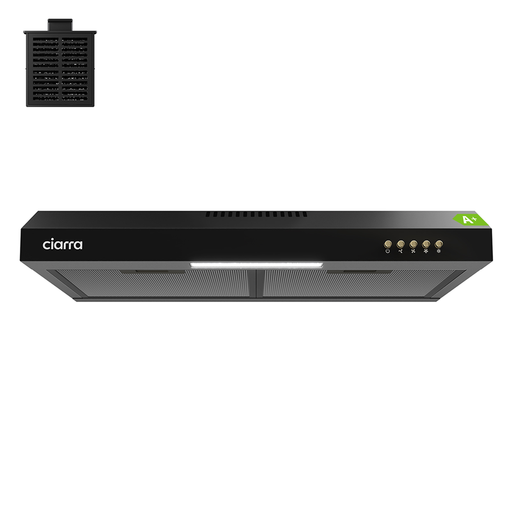
Why it's a good choice ? Perfect for small kitchens, studios, or flats where every square inch is precious. Its format as a built-in hood under a wall unit makes it almost invisible.
With an airflow rate calibrated for small spaces, it avoids the losing trio: oversizing, excessive noise, and overconsumption. Its versatility (ducted or recirculating) is a real plus.
Its compact and discreet design. Its metal grease filters are dishwasher-safe, simplifying maintenance. Its A+ energy rating ensures controlled consumption.
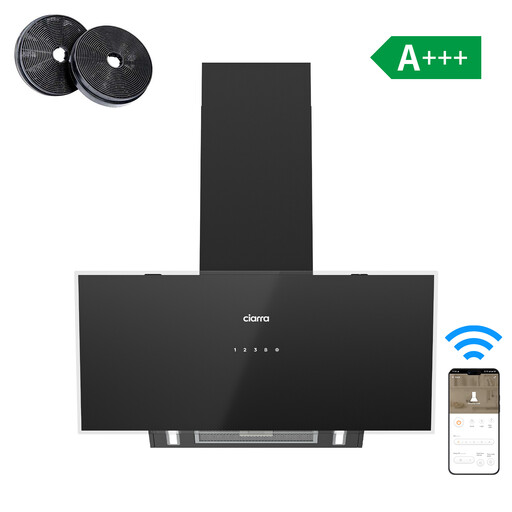
Why it's a good choice ? The perfect choice for modern kitchens that open onto the living room. Its angled hood design in black glass is not only elegant but also frees up visual space above the hob. Its 90 cm width easily covers large hobs.
This model balances a bold design with top-tier performance (A+++ class) without sacrificing acoustic comfort (60 dB max). Its 650 m?/h flow rate is powerful but perfectly adjustable with its 4 speeds and app control.
Its high airflow, optimised by a dual intake system. Its touch control, supplemented by remote management via Wi-Fi. Its A+++ energy class, synonymous with savings.
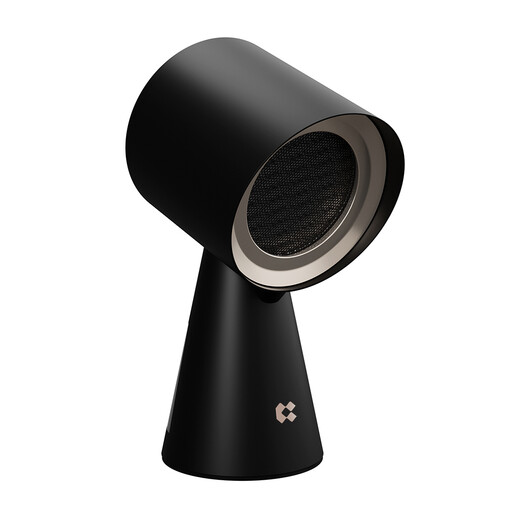
Why it's a good choice ? This is THE solution for anyone who can't (or doesn't want to) install a fixed hood: renters, secondary kitchens, or even for a raclette night or a grill on the balcony. It's the epitome of the ductless hood, with zero installation hassle.
This model completely bypasses the problem of installation and ducting. 100% recirculation, just place it on the worktop next to your cooking appliance (plancha, fondue set, etc.) to capture the fumes.
Its total mobility: you place it, plug it in, and use it. No works required. Its multi-layer filtration system is effective against grease and odours.
Explore our full selection of hoods that meet our performance criteria and safety standards.
Let's take a concrete example: for an enclosed kitchen of 15 m? with a ceiling height of 2.5 m, the volume is 37.5 m?. The minimum required airflow for a ducted hood is therefore 375 m?/h (37.5 x 10). If you opt for a recirculating hood, aim for a model offering between 450 and 500 m?/h to compensate for the power loss due to filtration.
The replacement frequency of the charcoal filter depends on how intensively you use it. On average, changing it every 4 to 6 months is a good rule of thumb. Some more sophisticated models include a saturation indicator to alert you. Remember: a saturated filter no longer filters anything and makes your hood completely ineffective against odours.
Absolutely, provided you choose it well and maintain it scrupulously. Its effectiveness relies on a duo of filters: the grease filter (usually metallic and washable) which traps greasy particles, and the charcoal filter which absorbs odours. For optimal performance, there are two golden rules: choose a sufficient airflow rate (following our advice above) and replace the charcoal filter as soon as it is saturated.