
Livraison le jour même ou le lendemain

Qualité garantie

Débloquez vos offres de bienvenue: Livraison GRATUITE | Jusqu'à -80 % | 30 jours d'essai gratuits à JoyPlus
Téléchargez l'application
Choosing a cooker hood can quickly become a headache. Between the eye-catching designs, confusing power figures, and different operating modes, it's hard to know where to start. The wrong choice is a recipe for daily disappointment: a kitchen that smells of fried food, the noise of a jet engine, or an appliance that completely clashes with your decor.
To help you see things more clearly, our editorial team has broken down the topic, identifying the pitfalls to avoid and the essential criteria to check before you buy.
The 3 classic mistakes when choosing a hood:
To avoid these traps, focus on a few key technical specifications. They are your best compass for objectively comparing models.
Expressed in cubic metres per hour (m?/h), airflow measures the hood's capacity to renew the air in the room. If it's too low, goodbye to efficiency: cooking vapours and odours will settle in for good.
How to calculate it? The calculation is simple: calculate your kitchen's volume (length x width x height) and multiply that number by 10. Example: for a 12 m? kitchen with a 2.5 m ceiling height, the volume is 30 m?. The minimum recommended airflow would therefore be 300 m?/h.
This calculation provides a baseline. For an open-plan kitchen or if you're a fan of frying and simmering dishes, don't hesitate to aim for a higher airflow for extra peace of mind.
This is the crucial choice that depends entirely on your home's layout.
Good to know: many models today are convertible and allow for both types of installation.
A quiet cooker hood is a game-changer in the kitchen. The noise level, expressed in decibels (dB), is usually indicated for the maximum extraction speed.
Also, remember to check the energy label. A quiet, A+++ rated cooker hood is the holy grail: it combines performance, acoustic comfort, and savings on your electricity bill.
To put this advice into practice, here are a few models that tick all the right boxes for different needs and budgets.
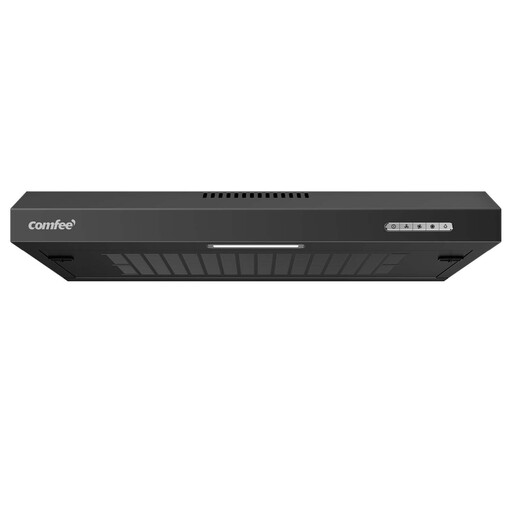
Its Profile: Perfect for studios, kitchenettes, or small kitchens where every inch and every penny counts. Its visor hood design integrates discreetly under a wall unit. A simple, effective, and no-frills solution.
This model gets straight to the point: an affordable, functional solution for moderate use. No false performance promises, which avoids the disappointment of a stylish but useless appliance.
Its ultra-compact size and easy under-cabinet installation free up maximum space. Its stainless steel body can be cleaned with a single wipe.
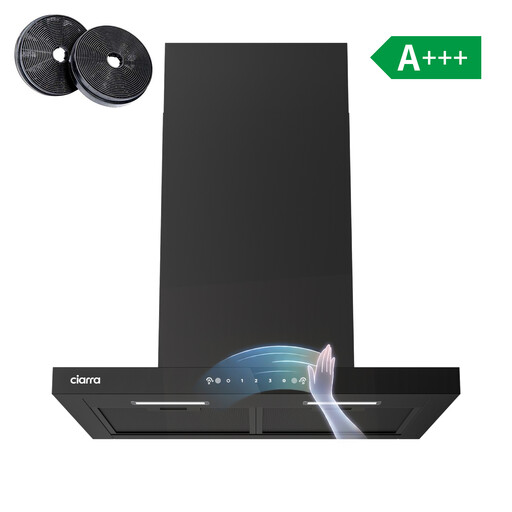
Its Profile: The perfect combo for those who want a 60 cm hood that combines a minimalist design (black hood with an ultra-slim panel) and solid performance (A+++ class, 650 m?/h airflow).
This model proves that design can go hand-in-hand with silence and power (only 59 dB). It shatters the stereotype of the "beautiful but noisy" hood by offering a perfect balance between aesthetics and efficiency.
Its "Wave Control" gesture system allows you to operate it with a simple hand movement, without ever touching it. Hygienic and a little bit magical. Its very low energy consumption (12 kWh/year advertised) is the icing on the cake for your wallet.
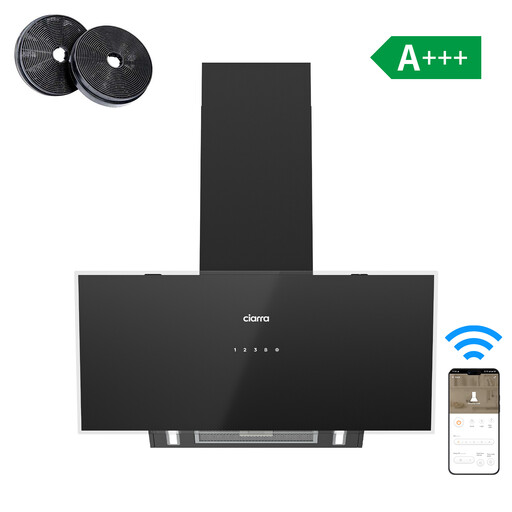
Its Profile: This 90 cm wall-mounted hood, with its angled design, completely frees up the line of sight and space above the hob. No more bumping your head! Its black glass look is ideal for contemporary and open-plan kitchens.
It reconciles the best of both worlds: a space-saving design without sacrificing an ounce of performance. With 650 m?/h under the hood and an A+++ rating, it combines ergonomics and efficiency.
Its Dual Intake system captures fumes with formidable efficiency. We also love its touch controls and Wi-Fi connectivity for control via your smartphone.
Discover our full selection of models that meet our selection criteria and current safety standards.
To keep it simple, calculate your kitchen's volume (surface area in m? x ceiling height) and then multiply the result by 10. This will give you the minimum airflow (in m?/h) for peace of mind. If you have an open-plan kitchen or love grilling, consider a safety margin by choosing a slightly more powerful model.
Yes, a recirculation hood is very effective, on one condition: impeccable maintenance. Everything depends on its filters. The metal grease filter must be cleaned often (a spin in the dishwasher will do the trick), and the charcoal filter, which absorbs odours, must be replaced every 4 to 6 months. For very intense cooking (frying, wok cooking...), an extraction hood will always have the edge.
It's simple, but crucial for efficiency.