
Livraison le jour même ou le lendemain

Qualité garantie

Débloquez vos offres de bienvenue: Livraison GRATUITE | Jusqu'à -80 % | 30 jours d'essai gratuits à JoyPlus
Téléchargez l'application
A good kitchen hood is your guarantee of healthier air and a living space free from unpleasant odours. However, with the overwhelming number of models available, choosing the right one can be a real headache. The risk? Ending up with an investment you'll quickly regret: a hood as loud as a jet engine, a model incapable of tackling frying smells, or a design that, while elegant, is a nightmare to maintain.
Our mission? To help you make an informed decision. Let's cut through the marketing jargon and incomprehensible spec sheets to focus on what truly matters. Here are the two classic mistakes to avoid at all costs and the key criteria for finding the 60cm cooker hood that genuinely meets your needs.
Pitfall #1: Sacrificing silence for power. A hood promising record-breaking airflow might seem tempting. But if it exceeds 65 decibels (dB) at full speed, it will turn your open-plan kitchen into an airport runway. Acoustic comfort isn't an optional extra; it's a factor just as crucial as extraction efficiency.
Pitfall #2: Underestimating the choice of installation type (ducting or recirculation). Buying a ducting hood without an external vent is a costly rookie mistake. Conversely, a recirculation hood may struggle in a large kitchen where you cook frequently. This purely technical choice is what determines the entire effectiveness of your future setup.
To avoid buying blind, there are three technical indicators you need to decode. The real-world performance, user comfort, and compatibility of the hood with your kitchen all depend on them.
Airflow, expressed in cubic metres per hour (m?/h), represents the volume of air the hood can refresh. If it's not powerful enough, smoke and cooking odours will inevitably linger in the room.
How to calculate it? The rule is simple: multiply the volume of your kitchen (length x width x height) by 10.
For an open-plan kitchen connected to the living room, don't hesitate to aim for a higher airflow rate to compensate for the larger total volume of the living space.
This is arguably the most critical decision, as it depends entirely on your home's layout.
The good news is that most recent models, whether a wall-mounted hood or an angled hood, are hybrid and compatible with both installation modes.
Your daily comfort is directly linked to the noise the appliance produces. A silent hood isn't a luxury; it's a necessity, especially in an open-plan kitchen.
Finally, take a look at the energy label. A hood with an A rating (or better, A+ and above) is a guarantee of controlled electricity consumption. This detail will impact your bill in the long run.
To illustrate these criteria in practice, here is a selection of models, each catering to a specific need and budget.
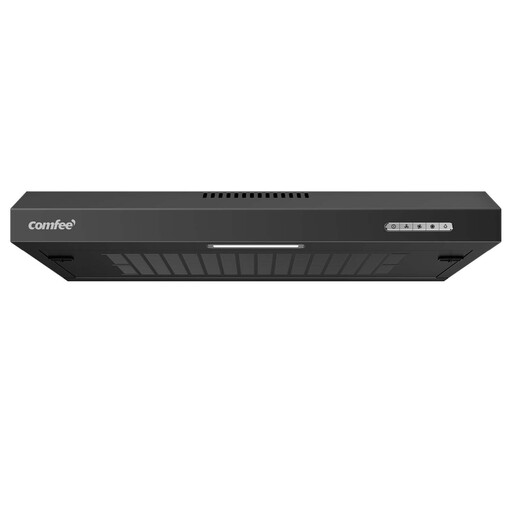
Editor's Verdict: Perfect for studios, kitchenettes, or managed budgets. This visor hood (or canopy hood) discreetly fits under a wall unit, optimising space while delivering the essentials. Its 200 m?/h airflow is sized for smaller areas.
This model gets straight to the point and avoids the trap of being over-specced. It focuses on one mission: effective extraction, without superfluous gadgets that would drive up the price. Its compatibility with both modes (ducting and recirculation) is a plus.
Its ultra-compact design and incredibly simple installation. Dishwasher-safe aluminium grease filter. A versatile and durable stainless steel hood finish.
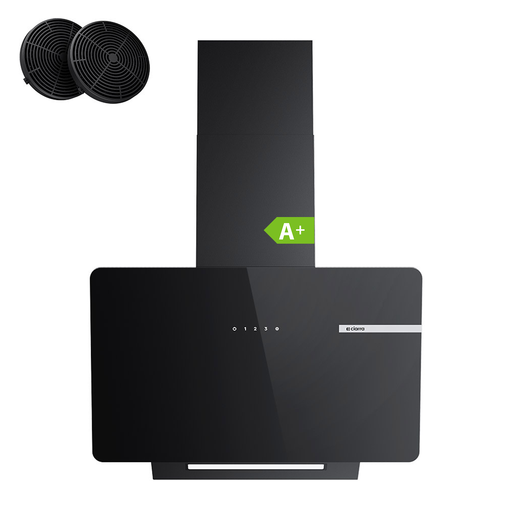
Editor's Verdict: With its black glass angled hood design, this model is tailor-made for contemporary kitchens. Its sleek look frees up visual space above the hob and prevents bumped heads. The perfect blend of aesthetics and performance.
It avoids the classic "style over substance" trap. Behind its elegant black hood design lies a powerful motor (580 m?/h airflow) and an excellent A+ energy rating, which guarantees controlled consumption.
Its very modern angled design, touch controls, dual compatibility (ducting/recirculation), and excellent energy efficiency (A+).
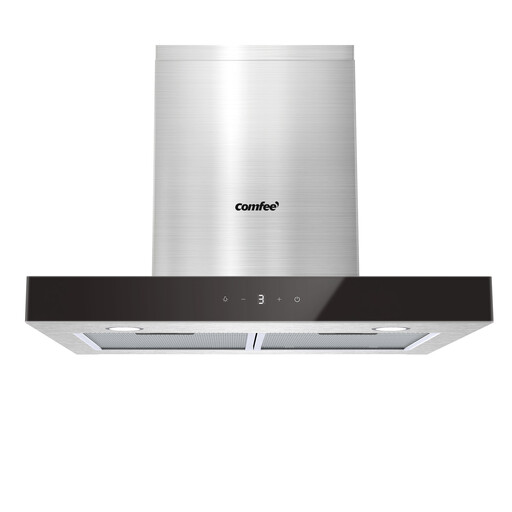
Editor's Verdict: The model of choice for those who cook intensively and need maximum extraction power. Its 650 m?/h airflow is calibrated to handle the most demanding cooking sessions (frying, grilling, etc.). The bonus feature? Gesture control, which allows you to operate the hood with a simple hand movement, even with greasy fingers.
It solves the age-old "power versus silence" dilemma. Despite its very high airflow, its noise level remains contained at 60 dB. Its A+++ energy rating, the best possible, protects you from a hefty electricity bill. It's the perfect combination of performance and long-term savings.
Very high extraction power (650 m?/h), record-breaking energy efficiency (A+++), gesture and touch controls, 5-layer dishwasher-safe filter.
Discover our full range of cooker hoods, all tested and approved by our experts according to strict performance and safety criteria.
The power doesn't depend on the width of the hood, but on the volume of your kitchen. For a standard kitchen (around 10-12 m?), an airflow of 300 to 400 m?/h is a good starting point. For an open-plan kitchen or if you're a fan of frying and grilling, don't hesitate to aim for 500 m?/h or more.
Yes, provided its filters are high-quality and well-maintained. A modern recirculation hood is very effective at capturing grease and neutralising odours. The active charcoal filter does all the work on the odours, so it's crucial to replace it regularly (usually every 3 to 6 months) to maintain maximum efficiency.
The grease filter (the metal grille) should be cleaned every 2 to 4 weeks, depending on your usage. The good news is that most are now dishwasher-safe, which makes maintenance much easier. For hoods in recirculation mode, the charcoal filter cannot be washed; it must be replaced every 3 to 6 months.