
Livraison le jour même ou le lendemain

Qualité garantie

Débloquez vos offres de bienvenue: Livraison GRATUITE | Jusqu'à -80 % | 30 jours d'essai gratuits à JoyPlus
Téléchargez l'application
Choosing coloured pencils for artistic drawing isn’t just about counting the shades in a set. A lead that crumbles too easily, a barrel that doesn’t sit comfortably in your hand, or an unbalanced palette can quickly limit your creative possibilities. Whether you’re an art student, an illustrator, a parent, or a creative colouring enthusiast, the right choice depends above all on how you plan to use them, the surface you’ll be working on, and the level of precision you’re after.
A set of 72 colours might look comprehensive, but it doesn’t always beat a smaller, better-thought-out selection. To get started, 12 to 24 shades are more than enough to learn layering, blending and gradients. A larger palette becomes worthwhile for portraits, landscapes, or illustrations that demand very specific nuances.
So take the time to examine what’s actually in the set: does it include light, dark and neutral tones, as well as several skin colours, greens and blues? The number of pencils alone tells you nothing about their quality or versatility.
Wax-based coloured pencils generally offer a smooth, generous application. Oil-based ones are better suited to building up multiple layers, with a firmer texture. As for watercolour pencils, they can be used dry or worked with a damp brush.
A soft lead makes it easy to create expressive areas of colour, but it also wears down more quickly. A firm lead is more comfortable for details and outlines. The key is to choose a formulation that suits your technique, rather than chasing some supposed one-size-fits-all feature.
A lead that breaks often increases how quickly you go through pencils and turns sharpening into a chore. Its strength depends on its diameter, how well it’s bonded to the wood, and how the pencils are transported.
A metal tin or a well-organised case protects the tips and makes working in the studio, at school, or on the go much easier. For a large collection, a wooden box or a roll can also make your colours more accessible. Just make sure you have a storage solution that works for you.
For coloured pencils, look for a clear indication of the lead base: oil, wax, or water-soluble pigment. Watercolour pencils should state whether they can be activated with water and used on suitable paper. This feature doesn’t, however, turn ordinary paper into watercolour paper: a sufficient weight and good moisture resistance are essential to prevent warping.
The diameter is also worth your attention. The models featured in this selection offer, depending on the reference, leads of 2.8 mm, 3 mm, 3.8 mm or 4.2 mm. A thick lead is better for covering large areas and withstands moderate pressure more effectively, while a fine lead makes precision work easier.
Graphite pencils and drawing pencils use grades such as H, HB or B. H grades are harder and produce lighter lines. B pencils are softer and allow you to achieve deeper shadows. A set that includes several grades is particularly useful for sketching pencils, technical drawing, and value studies.
Mechanical pencils with 0.5 mm leads and clutch pencils with 1.8 mm leads offer a consistent point, but they feel different in the hand compared to a wooden pencil. They are best suited to precise lines, sketches, and small details.
A triangular barrel can help stabilise your grip, especially for children. Ergonomic pencils for children should be chosen according to age, dominant hand, and the child’s ability to use a sharpener safely. Small parts and sharp points pose a risk for children under 3; adult supervision is therefore essential.
For products intended for school or craft activities, check the packaging and any compliance information provided. Where toy safety standards are mentioned, they should be verifiable on the product page.
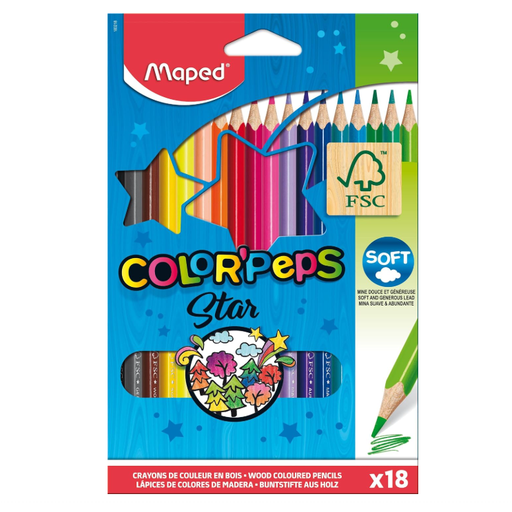
Why this choice suits this profile: With its 18 colours, triangular barrel and 2.9 mm lead, this set is ideal for first drawings, homework and creative activities at home.
The triangular shape stops the pencil rolling off the table and encourages a stable grip. With 18 shades, the palette is still easy to get to grips with as a beginner.
18 assorted colours, triangular barrel, FSC-certified wood as stated in the description, and a durable 2.9 mm lead.
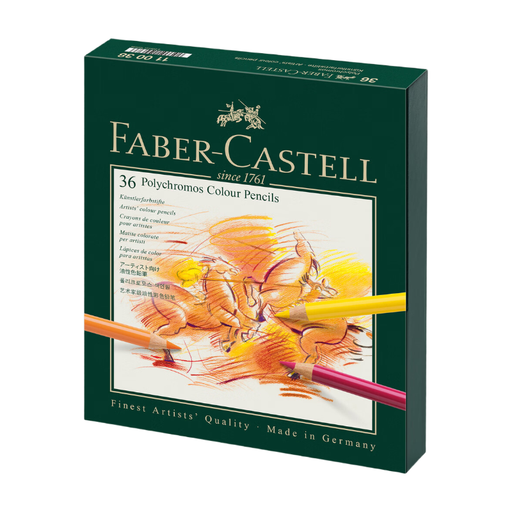
Why this choice suits this profile: This box of 36 pencils is aimed at illustrators and artists who want to work on layering, transitions and details with an oil-based lead.
With 36 shades, the palette offers real richness of nuance without multiplying pencils unnecessarily, while still going further than a starter set.
36 colours, 3.8 mm lead, oil-based binder, lightfast pigments as stated, and Atelierbox storage case.
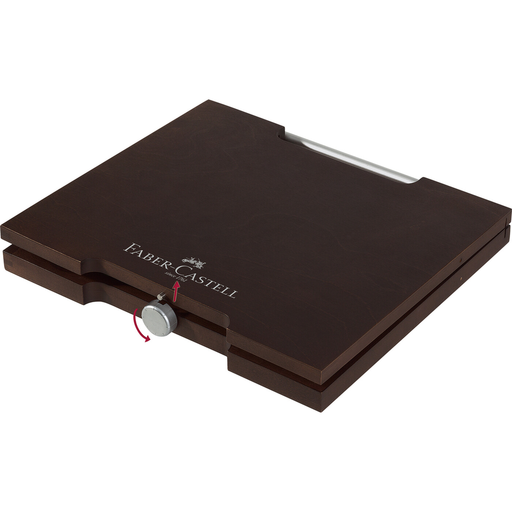
Why this choice suits this profile: Artists who switch between dry drawing, washes and blending can take advantage of an extensive palette and activate the pigments with water.
Its watercolour formulation meets a very specific need, rather than passing off a standard pencil as a tool suitable for all techniques.
72 shades, 3.8 mm lead as stated, wooden storage box, and can be used dry or with water on suitable paper.
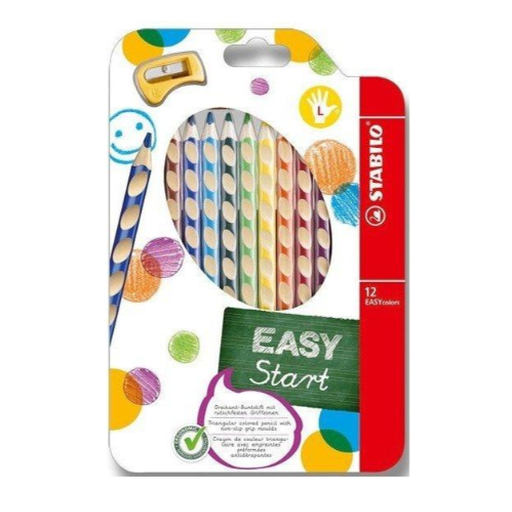
Why this choice suits this profile: This left-handed version combines a triangular barrel, finger placement zones, and a 4.2 mm lead suitable for school colouring.
Make sure you check the difference between the left-handed and right-handed versions before buying, so the grooves match the hand being used.
12 colours, triangular barrel, grip grooves, name label area, and 4.2 mm lead.
We’ve put together a comprehensive list, updated in real time, of products that meet these strict selection criteria and European safety regulations.
A set of coloured pencils with 12 to 24 shades is an ideal foundation for learning blending and gradients. Larger sets become worthwhile once you know which colour families you use most.
Standard pencils generally stay dry on the paper. Watercolour pencils contain water-soluble pigments: a damp brush can turn the line into a wash. However, you need to use a sufficiently robust surface and control the amount of water.
It all depends on how often you use them, the pressure you apply, and your sharpening method. A thick lead and protective storage can help reduce breakage, but a pencil used every day for large areas of colour will naturally wear down faster than one reserved for details.