
Livraison le jour même ou le lendemain

Qualité garantie

Débloquez vos offres de bienvenue: Livraison GRATUITE | Jusqu'à -80 % | 30 jours d'essai gratuits à JoyPlus
Téléchargez l'application
Bridging the gap between drawing and painting, watercolour pencils promise the best of both worlds: the precision of a line and the fluidity of watercolour. But be warned, the market is flooded with products whose marketing claims are often exaggerated. Make the wrong choice, and your creative experience can turn into a nightmare, with dull colours, unusable materials, and guaranteed frustration.
To avoid buyer's remorse, here are the most common pitfalls to be aware of?:
To ensure you invest in a set of watercolour pencils that meets your ambitions, here are the technical points to check.
The richness of the colours and the longevity of your creations depend directly on the quality of the pigments.
The lead is the heart of the pencil. It dictates the comfort of use and the precision of your strokes.
This is the ultimate test?: the transformation from line to wash must be flawless. A good watercolour pencil dissolves completely and instantly upon contact with a wet brush. It should allow you to create smooth transitions and subtle gradients without leaving any grainy residue.
The perfect pencil doesn't exist, but there is certainly a model that matches your practice and your creative goals. Here are our recommendations.
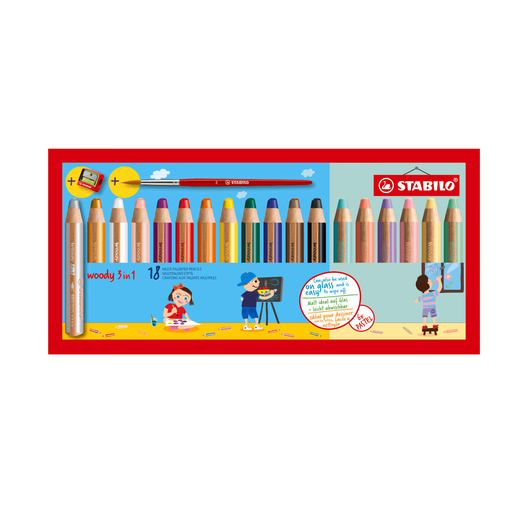
Why we love it : Perfect for small hands, this 3-in-1 pencil is a coloured pencil, wax crayon, and watercolour pencil all in one. Its chunky barrel ensures a good grip, and its XXL lead is virtually indestructible, even when faced with the most... energetic artists.
With its 10 mm XXL lead, it's virtually unbreakable. No more nightmare of the lead shattering under the slightest pressure, a classic issue with children.
Its 3-in-1 versatility and ability to write on almost anything (paper, glass, metal...) make it the ultimate fun and creative tool.
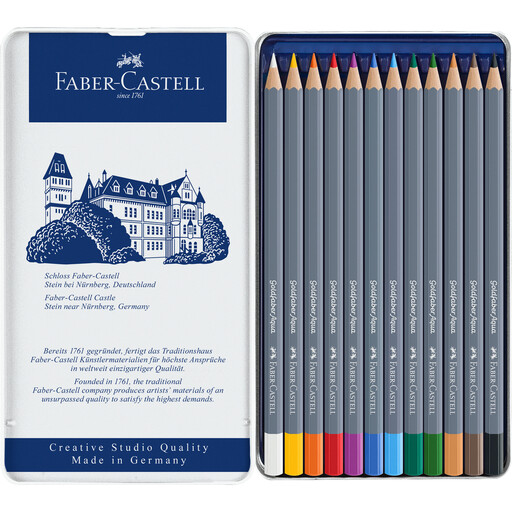
Why we love it : The Goldfaber Aqua range strikes the perfect balance between quality and price. It's an excellent starting point for art students or hobbyists who want to get serious about the beginner watercolour pencil technique with reliable materials.
Its high-quality pigments ensure colours stay vibrant after dilution, without the "chalky" effect of low-end products. Its solubility is impeccable, delivering a true watercolour finish.
Unbeatable value for money from a benchmark brand. The lead is durable enough to withstand regular use without issue.
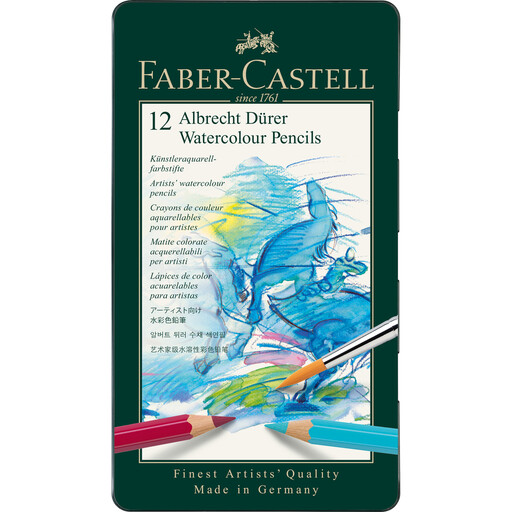
Why we love it : This is simply the gold standard for professional watercolour pencils. The Albrecht Dürer range is for artists who accept no compromises. Intense pigmentation, exceptional lightfastness : it has it all.
It checks all the boxes and avoids every pitfall : its high pigment concentration delivers brilliant colours, its 3.8 mm bonded lead (SV process) is incredibly robust, and its solubility is total for a flawless watercolour effect.
Professional-grade performance with excellent lightfastness for artworks that will stand the test of time. The full range extends to 120 colours.
We've put together a complete selection of products that meet our strictest selection criteria.
The entire difference lies in the lead's binder. For a watercolour pencil, it's water-soluble. In practice, a stroke of a wet brush on your drawing is enough to dissolve the pigments and create a watercolour effect. Conversely, classic pencils (which are wax- or oil-based) are permanent and do not react to water.
The choice of paper is crucial to prevent it from buckling. Opt for a dedicated watercolour paper. A weight of 200 gsm (cold or hot press) is a good start. The ideal choice remains a paper of 300 gsm or more?: it will absorb water without warping or tearing, even if you apply multiple layers of colour.
A few simple steps will extend their lifespan. Store them in their metal tin or case, away from moisture and direct sunlight. Invest in a good, consistently sharp pencil sharpener to avoid mangling the leads. Finally, if you've dipped the tip directly in water (a technique for more intense colours), let it dry completely before putting the pencil away.