
Livraison le jour même ou le lendemain

Qualité garantie

Débloquez vos offres de bienvenue: Livraison GRATUITE | Jusqu'à -80 % | 30 jours d'essai gratuits à JoyPlus
Téléchargez l'application
Choosing a set of coloured pencils might seem straightforward. Yet between leads that snap, shades that are too similar and boxes that are awkward to carry, the wrong choice can quickly become frustrating. For a child, a school pupil, a student or a drawing enthusiast, the right materials depend mainly on how often you'll use them, the level of precision you need and how the pencils will be stored.
Here are the criteria to consider before buying coloured pencils for children, pencils dedicated to drawing or a set designed for more creative techniques.
A set of 48 coloured pencils offers more shades than a box of 24, but that doesn't necessarily mean it will be better suited to your needs. For homework, everyday colouring or first drawings, 24 well-chosen shades are usually sufficient. Larger palettes really come into their own for creating gradients, portraits, illustrations or compositions with several closely related shades.
A fine pencil is precise for details, but it can become less comfortable for young children or during long sessions. Conversely, a thick lead allows you to fill large areas quickly, provided you have a compatible sharpener. The shape of the barrel also plays a role: a triangular body helps position the fingers, while a hexagonal body makes it easier to stop the pencil from rolling off the table.
The mention "break-resistant" is a real plus, but it doesn't make the pencil unbreakable. A drop, too much pressure or an unsuitable sharpener can still damage the lead. To limit unpleasant surprises, check the core diameter, the recommended type of sharpener and the sturdiness of the box.
A metal box generally protects pencils better during transport than a soft pouch. It also allows you to put each pencil back in its place after use. For gifting a set, an illustrated box can add a nice aesthetic touch, without changing the performance of the contents.
Ergonomic coloured pencils often feature a triangular body or a specific grip area. This design can help children position their fingers better and maintain a stable hold. For small hands, a thick body is generally easier to grasp. For detailed work, a standard diameter offers more control over fine lines.
Also remember to check the safety instructions provided with the product. Several sets presented here are not suitable for children under 3 years old, particularly because of the points, shavings or small parts. For younger children, adult supervision is strongly recommended.
Watercolour pencils can be used dry, like standard pencils. By then running a damp brush over the drawing, you can achieve a softer, watercolour-like effect. This technique does require sufficiently thick paper and a suitable brush. It adds an interesting creative possibility, without replacing all the equipment needed for watercolour painting.
For school use, a dry lead is often the simplest solution. For illustration, creative journaling or experimentation, a water-soluble lead opens up more possibilities.
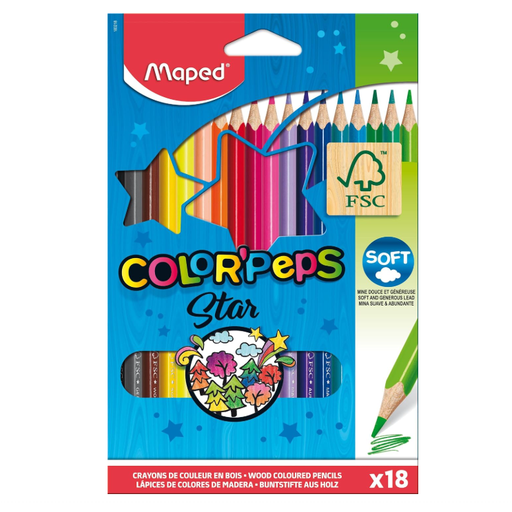
Why this choice suits this profile: with its 18 colours, this set is ideal for first drawings, creative activities at home and school supplies that need to stay compact.
Its triangular shape and 2.9 mm lead promote a stable grip, without cluttering the pencil case with shades that would rarely be used.
Triangular body, FSC-certified wood as stated by the manufacturer and lead advertised as break-resistant.
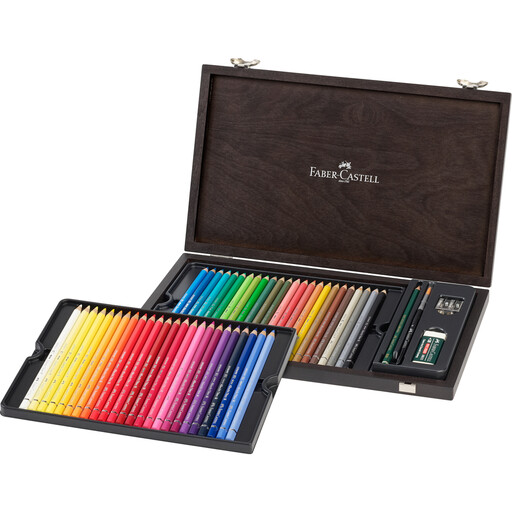
Why this choice suits this profile: this set is designed for those who want to alternate between dry drawing, colour layering and watercolour effects, all with neat storage.
Its extensive palette and water-soluble leads offer a much wider range of techniques than a standard 24-shade set.
48 colours, 3.8 mm water-soluble leads and wooden case according to the product sheet.
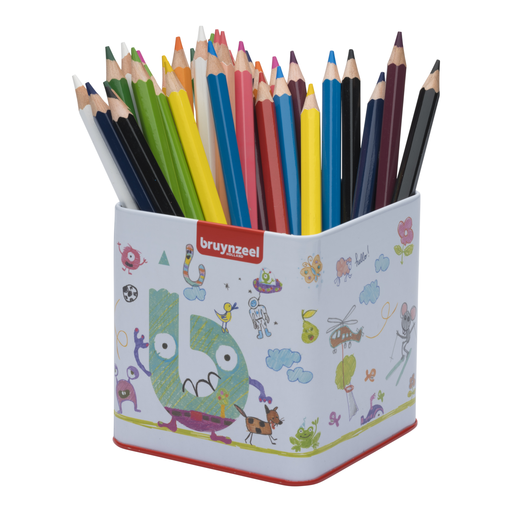
Why this choice suits this profile: its 4 mm core is designed for colouring that covers large areas, group workshops and regular use.
The clearly stated diameter allows you to choose a compatible sharpener, rather than risking damaging the lead with a standard model.
48 shades, extra-thick 4 mm lead and metal tin suitable for storage.
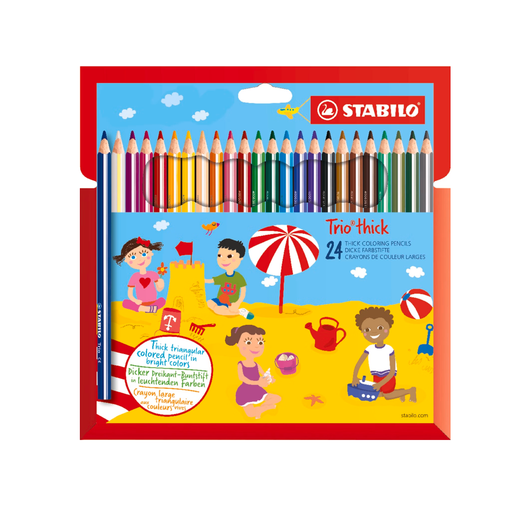
Why this choice suits this profile: its thick triangular body and 4.2 mm lead make it easy to grip while speeding up the filling of large areas.
The lead diameter and barrel designed for small hands meet a real need, rather than relying solely on a promise of vibrant colours.
24 pencils, triangular body and thick 4.2 mm lead advertised as break-resistant.
We've put together a complete selection, updated in real time, of products that meet these demanding criteria as well as European safety standards.
To make your coloured pencils last longer:
A metal box protects the materials well during transport, but it can quickly become noisy in a school bag. For school, a compartmentalised pencil case can complement storage at home.
A set of 18 or 24 colours is generally suitable for first drawings, school activities and everyday colouring. By layering colours, you can already create many shades without investing in a large palette straight away.
They can be suitable for sufficiently independent children, provided an adult supervises the use of water and the brush. Allow for suitable paper and respect the recommended age stated on the packaging. As with any material that has points or small parts, supervision remains essential.
Choose pencils advertised as break-resistant, use a suitable sharpener and avoid dropping them. A rigid box, put back in place after each use, also limits knocks during transport.