
Same-day & Next-day Delivery

Quality Guaranteed

Unlock Your Welcome Offers: FREE Delivery | Up to 80% OFF | Free 30-day JoyPlus trial
Download the APP
A leak appearing on your RV roof just before the big trip, a gutter dripping after a downpour, or that icy draft seeping through a poorly insulated window... These are all situations that demand a fast, reliable solution. Butyl sealant tape is often presented as the miracle cure, but be warned: not all rolls are created equal. Making the wrong choice is not only money down the drain but also risks making the damage worse.
As the head of product selection at Joybuy, my mission is to guide you through this jungle of options to find a truly effective product. Let's break down the common pitfalls and essential criteria for a repair that lasts.
The market is saturated with products making tempting promises. Here are the most common mistakes that lead to disappointing repairs:
To guarantee a reliable and durable seal, focus on these three non-negotiable technical specifications.
The heart of the product is its adhesive mass. Opt for tapes made from pure butyl, which offers far superior flexibility and adhesion compared to blends containing fillers. A thickness of at least 1?mm is an excellent indicator of quality. It ensures the tape can properly fill gaps and absorb slight material expansion, a crucial feature for a high-performance exterior sealant joint.
The tape's exposed face is its first line of defense. A simple plastic film isn't enough. An aluminum butyl tape, featuring an aluminized PET (polyethylene terephthalate) sheet, offers far more effective protection. It reflects UV rays, prevents the butyl from drying out, and provides mechanical resistance against abrasion. This is a decisive factor for a roofing sealant adhesive or any application in direct sunlight.
Always check the list of compatible materials (metal, glass, wood, concrete, EPDM, PVC). A good tape must also withstand a wide temperature range, for example, from -40°C to 80°C. This feature ensures that your boat sealant or RV repair tape will maintain its adhesive properties and elasticity, whether you're in the mountains in winter or on the coast in the middle of summer.
Rather than a generic list, here are targeted options for specific user profiles, taking into account the performance criteria we've just reviewed.
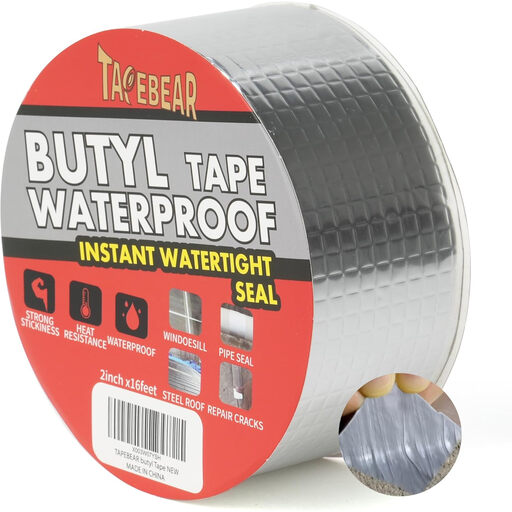
Why we chose it: Its 50 mm width is perfect for common repairs: sealing a leak on a PVC pipe, waterproofing the perimeter of a window, or fixing a small crack in a gutter. It's the convenient format to always have in your toolbox for unexpected issues.
It features a PET aluminum protective film, which effectively shields it from UV rays and weather, unlike low-end tapes that visibly degrade outdoors.
Its pure butyl composition ensures strong adhesion on multiple surfaces (metal, tile, wood, fiberglass) and excellent flexibility to conform to the most complex shapes.
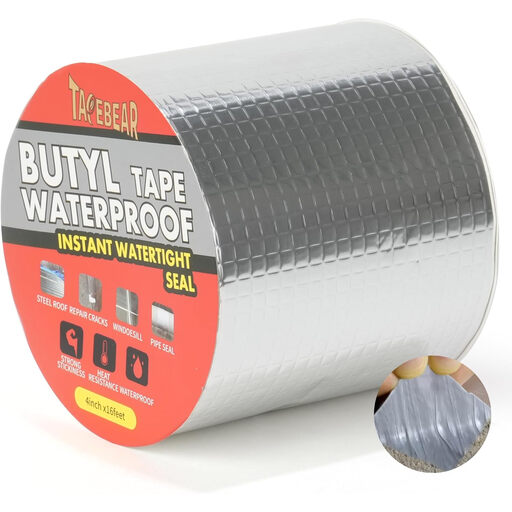
Why we chose it: The 100 mm width is particularly suited for marine and mobile applications. It can cover panel joints on an RV roof, repair a tear in an awning, or seal a porthole on a boat, providing wide coverage in a single pass.
It avoids the "universal" adhesion trap by being specifically designed for effectiveness on difficult surfaces like EPDM, fiberglass, and metal, which are very common on recreational vehicles.
Its wide format reduces the number of seams required, minimizing potential points of failure for a more robust and durable seal.
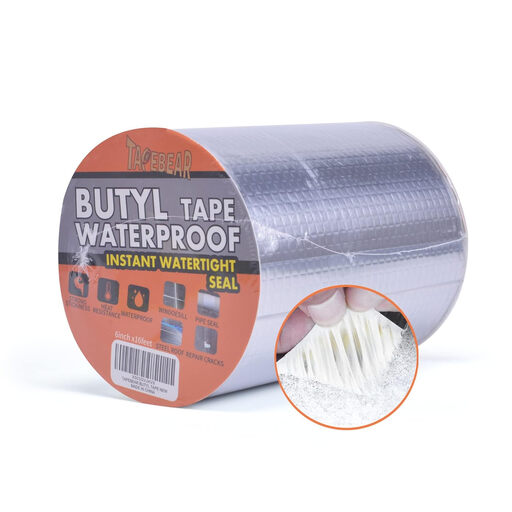
Why we chose it: With its 150 mm width, this tape is designed for large-scale jobs. It's perfect for sealing wide cracks on a metal roof, joining a wall to a sunroom extension, or even for sealing foundations.
It directly tackles the problem of insufficient thickness. Its substantial butyl mass, combined with its wide format, allows it to fill significant irregularities and create an ultra-robust waterproof barrier.
Maximum coverage for efficiency and speed on large surfaces, making it a top choice for professionals and ambitious renovation projects.
We have compiled a comprehensive and up-to-date selection of products that meet these strict selection criteria and current standards.
The longevity depends heavily on the product's quality and its exposure conditions. A high-quality butyl tape with a protective aluminum film, applied to an impeccably prepared surface (clean, dry, and dust-free), can provide a reliable seal for many years, often over 5 to 10 years. Never forget that surface preparation is just as crucial as the product itself.
Generally, this is not recommended. The aluminum surface is smooth, non-porous, and designed to resist the elements, which prevents most paints from adhering permanently. The paint would likely peel off very quickly. This type of tape is a functional repair solution, not an aesthetic one.
Yes, this is one of its key applications, especially for EPDM leak repair on RV roofs. Butyl has an excellent chemical affinity with EPDM, allowing it to create a bond that is both very strong and perfectly watertight. for optimal results, the EPDM surface must be cleaned with a suitable product and be completely dry before application.