
Livraison le jour même ou le lendemain

Qualité garantie

Débloquez vos offres de bienvenue: Livraison GRATUITE | Jusqu'à -80 % | 30 jours d'essai gratuits à JoyPlus
Téléchargez l'application
Maintaining a pristine lawn is a full-time job... or it used to be. The wireless robotic lawnmower is a game-changer, promising a fully automated mow without the hassle of installing a perimeter wire. But be warned?: the market is flooded with tech promises that don't always hold up on the turf. As the Head of Product Recommendations at Joybuy, my role is to help you decode the spec sheets to make an informed choice that's perfectly suited to your garden's layout.
Before you pull out your credit card, let's review the common pitfalls to avoid, so this promising purchase doesn't turn into a costly disappointment.
To sidestep these traps, focus on three technical criteria that make all the difference in a wireless robotic mower's real-world performance.
This is the robot's brain. The absence of a perimeter wire relies on advanced sensors that allow the robot to know where it is and define its work area.
Your garden probably isn't a perfectly flat football pitch. A robot's ability to handle slopes is therefore a critical selection criterion.
Choosing an undersized model is a common mistake. A robot designed for 500 m? will exhaust itself trying to maintain a 1000 m? lawn. It will run constantly, leading to premature wear on its battery and components.
Rather than an exhaustive list, here is a curated selection of models that meet specific needs, based on the performance criteria we've just discussed.
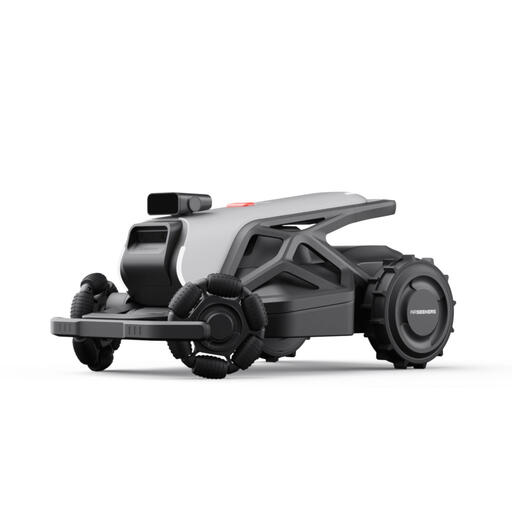
Why it stands out : Built for challenges, it covers up to 1800 m? and tackles impressive slopes of up to 65% (33°). It's the ideal solution for large, uneven gardens where standard models give up.
It directly counters the risk of underestimating terrain complexity. Its ability to master extreme slopes and its precise RTK navigation make it a reliable ally for the most demanding layouts.
Slope Performance : Capable of mowing on inclines up to 60% and traversing slopes of 65%.
RTK Navigation : Ensures precise mapping and complete coverage, leaving nothing to chance.
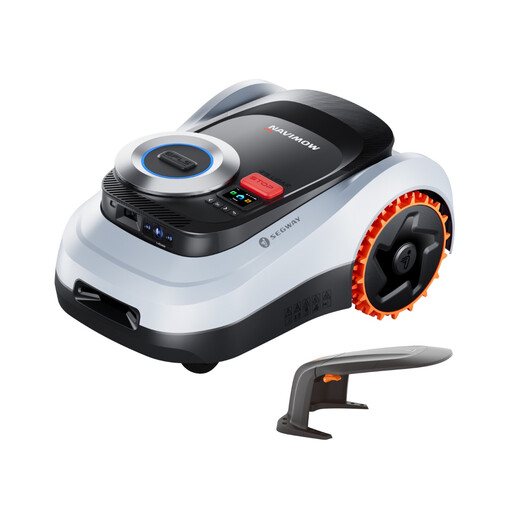
Why it stands out : For technophiles seeking absolute precision. The fusion of LiDAR and camera vision provides flawless navigation, even in complex areas, without needing an external antenna.
It sidesteps the problem of GPS signal dependency. By combining LiDAR and vision, it guarantees stable and precise navigation everywhere, every time. A truly autonomous mower that doesn't put all its tech eggs in one basket.
LiDAR + Vision Fusion : Ultra-precise navigation and obstacle avoidance, without relying on satellites.
Intuitive Mapping : The app lets you define and adjust mowing zones with your fingertips.
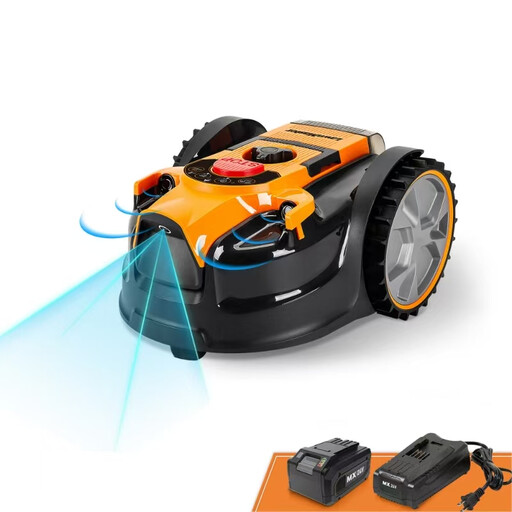
Why it stands out : Perfect for city gardens or more modest areas (up to 150 m?). It offers the benefits of a wireless solution—simplicity and automation—at a much more accessible price point.
It removes the main barrier to entry : wire installation. While its navigation is simpler, its strength lies in its ease of use for the right-sized area. No need to overpay for superfluous features.
Simple Setup : Ready to mow in minutes, without complex mapping.
Quiet Operation : Perfect for residential areas and keeping the neighbours happy.
Garden maintenance isn't just about mowing. For smart, water-efficient irrigation, take a look at our selection of equipment.
The lifespan of a robotic mower is typically between 5 and 10 years, depending on use and quality of maintenance. The component that wears out fastest is the lithium-ion battery, whose capacity naturally decreases after a certain number of charge cycles (usually between 800 and 1500). You should plan to replace it every 3 to 5 years. Good to know?: brushless motors, found in higher-end models, have a much longer lifespan than conventional brushed motors.
Excellent question, and it highlights a key limitation of this technology. An RTK-type GPS robotic mower needs a clear view of the sky to communicate with its base station and satellites. Near high walls, under dense foliage, or in narrow passages, the signal can indeed weaken or be lost entirely. This is why the top-performing models combine multiple technologies (GPS + vision, or a LiDAR robotic mower). That way, if the GPS signal is lost, the robot can fall back on its other sensors to continue navigating accurately.
Yes, and it's one of their biggest advantages?: goodbye to the chore of burying a perimeter wire! Generally, installation comes down to three steps:
If you're replacing an older model, services like Joybuy's Robotic Lawnmower Removal and Recycling Service can make your life easier by taking care of your old equipment.