
Livraison le jour même ou le lendemain

Qualité garantie

Débloquez vos offres de bienvenue: Livraison GRATUITE | Jusqu'à -80 % | 30 jours d'essai gratuits à JoyPlus
Téléchargez l'application
A robot lawn mower without perimeter wire can significantly reduce the work involved in maintaining your lawn, provided you choose technology suited to the layout of your garden. The latest models use virtual navigation, cameras, RTK, LiDAR and mobile apps. However, an impressive specification sheet does not guarantee that the robot will perform correctly in every garden.
Here are the key criteria to consider before buying, along with a selection of models suited to different uses in France.
A robot lawn mower advertised for 600 or 800 m² will not necessarily cover the entire area if the garden has several separate zones, narrow passages or a significant slope. Of course, you need to consider the lawn area, but also charging time, no-go zones and any movement required between the charging station and the different parts of the garden.
For a large property, it is best to leave some margin. A model designed for 600 m² may be perfectly suitable for a simple 500 m² lawn, but less comfortable on a fragmented garden of the same size.
A robot lawn mower without a perimeter wire still needs to know the boundaries of the lawn. Depending on the model, these are defined using automatic mapping, virtual boundaries in the app, or a combination of RTK signals and cameras.
Dense trees, walls, canopies and enclosed areas can disrupt satellite reception. Even without digging a trench to install a perimeter wire, it is therefore essential to position the charging station or antenna correctly.
AI-assisted vision and cameras can identify certain objects, but they do not remove the need to prepare the garden. Small toys, cables, clothing, branches and low-contrast objects may go undetected. Before each mowing session, it is best to remove loose objects and keep children and pets away from the machine while it is operating.
A robot lawn mower with RTK navigation uses positioning signals to follow virtual boundaries accurately. This technology is particularly well suited to open gardens, provided there is sufficiently clear reception.
A robot lawn mower with AI vision uses cameras to recognise the lawn and certain obstacles. It can be a good choice in areas where satellite reception is unstable, although it does not eliminate all the challenges associated with mapping.
Models combining LiDAR and vision add depth and obstacle perception. Nevertheless, check their range, operating conditions and compatibility with your garden. The name of the technology alone is not enough to guarantee the results.
Three specifications deserve careful comparison:
The Joybee K2, for example, claims 90 minutes of runtime with around 60 minutes of charging time, and has a cutting width of 22 cm. The ISWARD GX claims around 160 minutes of operation and a cutting width of 23.5 cm, with a recommended area of 2,500 m² according to its product listing. These figures are indicative: grass density, slopes and movement between zones can significantly affect day-to-day use.
The ability to work on slopes is generally expressed as a percentage or in degrees. These two units are not interchangeable: 45% is approximately 24 degrees, while 45 degrees describes a considerably steeper incline. Also check whether the stated figure applies to the entire area or only under certain conditions.
An rating such as IPX6 means that the machine is resistant to powerful jets of water, but not that it can be submerged. Before carrying out any work, stop the blades and disconnect the mower in accordance with the manufacturer’s recommendations. The sensors and underside of the chassis should also be cleaned regularly.
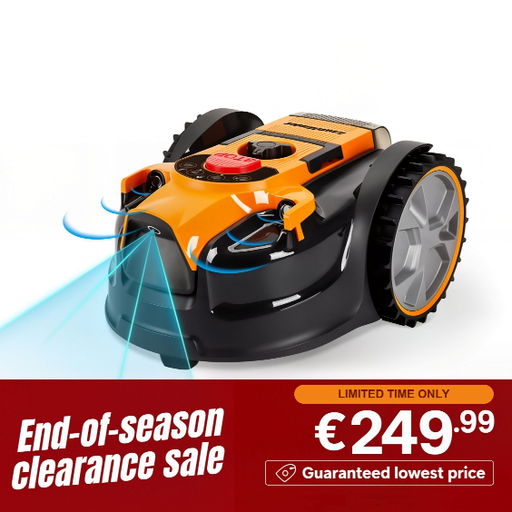
Why this choice suits this profile : This wire-free model is designed for small lawns of up to 150 m². Its advertised simple setup could suit anyone looking to move from a manual mower to an automated solution.
Its limited capacity reduces the risk of paying for an oversized machine. However, you must follow the rain and bad-weather protection instructions provided in the product listing.
Advertised coverage of 150 m², autonomous operation and obstacle detection according to the published specifications.
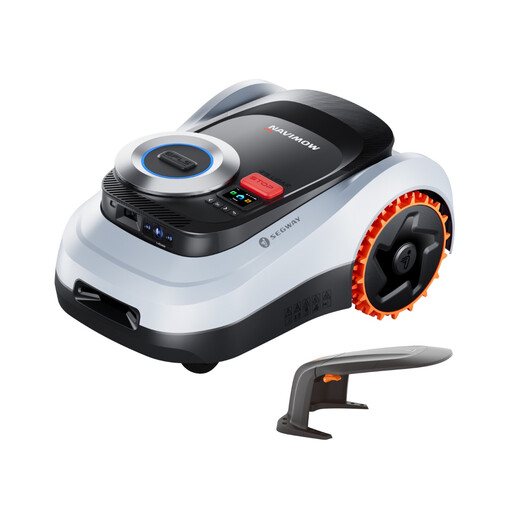
Why this choice suits this profile : Combining LiDAR and vision, this model is designed for gardens of up to 1,500 m², including those with several zones or advertised slopes of up to 45%.
Its navigation does not rely solely on an RTK antenna, which can be useful in gardens where satellite reception is inconsistent. However, the exact layout of the zones should be checked on site.
Advertised automatic mapping, management of 20 zones from the app and edge mowing to within 5 cm, according to the product description.
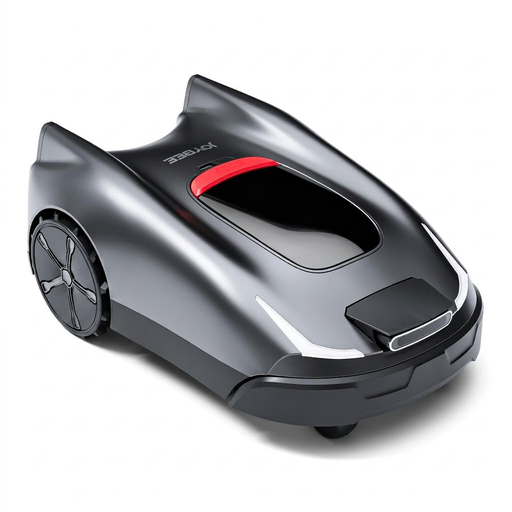
Why this choice suits this profile : With advertised coverage of up to 3,000 m², RTK and vision-based navigation, and multi-zone management, it is designed for large lawns with obstacles or slopes.
Its advertised coverage and slope capability help prevent you from choosing a small model for demanding terrain. However, the positioning system must be installed in an unobstructed area.
Adjustable cutting height from 25 to 60 mm, obstacle clearance of up to 30 mm, IPX6 protection and control via a mobile app.
A connected robot lawn mower generally requires a stable charging station and, depending on the model, a Wi-Fi or Bluetooth connection. You then need to create a map of the garden. Before using it for the first time, check the accessories, charge the battery and clear the lawn of stones, toys and branches.
The app is usually used to schedule mowing times, manage a multi-zone robot lawn mower, set no-go areas and check the machine’s status. You should also check the availability of updates, the quality of the after-sales service and the warranty terms applicable in France.
Lift and tilt sensors improve safety, but they are never a reason to allow a child or pet to approach while the mower is operating. Always stop the blades before cleaning the machine or replacing a part.
We have brought together a complete, real-time selection of products that meet these demanding selection criteria, as well as European safety standards.
Not necessarily. RTK models generally use an antenna or reference station, while some devices combine vision and LiDAR. So, the absence of a perimeter wire does not necessarily mean that no additional equipment will be needed.
It depends on its exposure to the weather, blade maintenance, battery condition and compliance with the manufacturer’s recommendations. Cleaning the sensors, storing the machine under cover during frosty periods and replacing worn parts when necessary will help extend its working life.
Electricity consumption depends mainly on charging cycles, the area to be mowed, the slope and how frequently the mower is used. You should also budget for replacement blades, a possible replacement battery and positioning accessories. Check the model’s product listing for details of what is included and the applicable service terms.