
Livraison le jour même ou le lendemain

Qualité garantie

Débloquez vos offres de bienvenue: Livraison GRATUITE | Jusqu'à -80 % | 30 jours d'essai gratuits à JoyPlus
Téléchargez l'application
A winter duvet isn’t just about thickness or the promise of intense warmth. Between a chilly bedroom, bedding that traps too much heat, and a cover that’s difficult to care for, a poorly considered purchase can quickly become uncomfortable.
Before comparing models, three common pitfalls keep cropping up:
Expressed in g/m², the fill weight indicates how much filling has been used. However, it alone doesn’t determine thermal comfort. The type of fibres, their loft and the duvet’s construction all play a part.
A 15 tog duvet is generally designed for cold nights, but how it feels depends on your room temperature, nightwear and personal sensitivity. In a heated room or for year-round use, an all-seasons duvet or a more temperate model will often prove more practical.
People who tend to feel hot may prefer a lightweight yet warm duvet that’s sufficiently breathable, or keep a cooling blanket for milder periods. A quilted bedspread can also add a layer of warmth without replacing a proper winter duvet.
A cotton and polyester duvet typically combines a soft cover with an easy-care filling. Some models use, for example, 100% cotton percale and siliconised hollow polyester fibres. These fibres can provide loft while keeping the weight down.
A duck feather duvet offers a different feel: the blend of feathers and down gives both support and a cosy, enveloping touch. However, do check the stated proportions carefully, along with the washing instructions and drying conditions. Those sensitive to animal materials may prefer a synthetic fibre, which is simpler to wash regularly.
For an anti-dust mite or hypoallergenic duvet, take the time to read the compliance information and any certifications listed. OEKO-TEX Standard 100 relates to the control of certain substances in textiles. CertiPUR, on the other hand, applies to foam components and should not be taken as a medical guarantee. These mentions do not replace the advice of a healthcare professional if you have an allergy.
The duvet should overhang sufficiently on each side of the mattress to minimise draughts and nighttime tug-of-wars. Here are some common size guides:
Also remember to measure your mattress depth and base height. A 220 × 240 cm duvet won’t cover the sides of every bed in the same way.
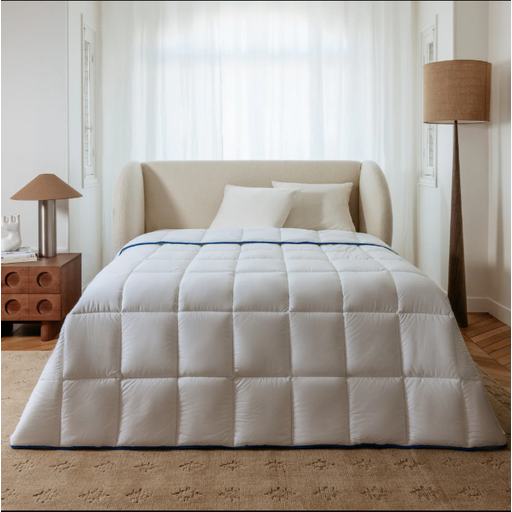
Why this choice suits this profile: its 140 × 200 cm size works for a single bed and its composition is straightforward enough for a first purchase.
The product page states a fill weight of 400 g/m² and a cotton percale cover, rather than relying on a simple promise of thickness.
Filling made from siliconised hollow polyester fibres, washable at 40 °C as stated, and certifications listed on the product page, including OEKO-TEX Standard 100.
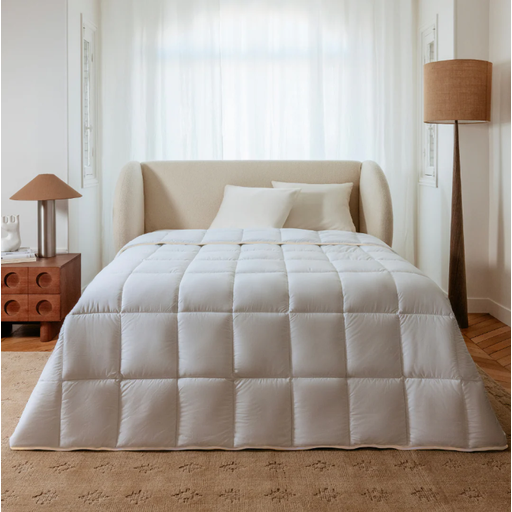
Why this choice suits this profile: its large size suits a couple in a spacious bed looking for a natural filling.
The composition is detailed: 90% duck feathers and 10% down, with box stitching to distribute the filling evenly.
Cover stated as organic cotton sateen, 220 × 240 cm size and care at 40 °C with gentle tumble drying or professional cleaning.
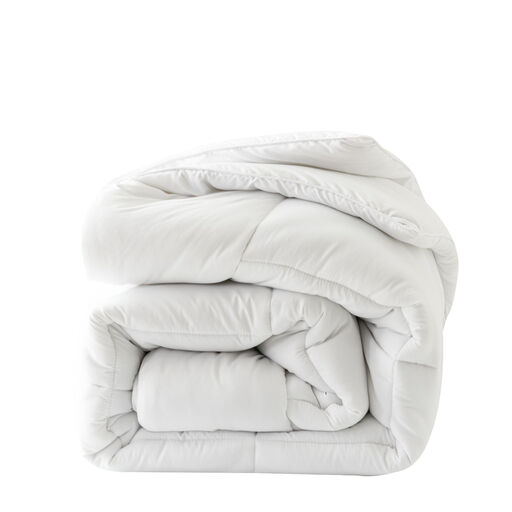
Why this choice suits this profile: its size suits couples and cold bedrooms looking for a warm microfibre duvet.
The 15 tog rating gives a more concrete warmth benchmark than a simple “very warm” claim. However, do check your actual room temperature.
Microfibre described as soft and hypoallergenic, box-stitch construction and large 220 × 240 cm size.
We’ve put together a comprehensive, real-time updated list of products that fully meet these strict selection criteria and European safety regulations.
Before washing, check the label and your washing machine’s capacity. A thick duvet may require a machine of at least 12 kg. Avoid overloading the drum, as well as bleach and ironing if the manufacturer advises against them. For natural fillings, a gentle, thorough drying cycle helps to minimise residual moisture. If stored while still damp, a duvet can develop an unpleasant smell or become damaged.
Air it regularly, use a suitable duvet cover and give it a gentle shake to redistribute the filling. When to replace it depends mainly on its condition: loss of loft, weakened seams, persistent stains or filling that shifts are more telling signs than a theoretical lifespan.
Compare the stated warmth level, fill weight, filling and dimensions. A 15 tog duvet can suit a room with little heating, while a natural feather and down model will offer a different feel. Needs vary depending on your sensitivity to cold and the type of bedding you use.
It can work for a compact double bed, but the overhang on the sides will be limited. For more room, check your mattress width and consider a 220 × 240 cm duvet or an equivalent large size.
Start by checking the label. If your washing machine doesn’t have enough capacity, a launderette with a large drum will be more suitable. Stick to the stated temperature, dry the filling completely and never store the duvet while it’s still damp.