
Livraison le jour même ou le lendemain

Qualité garantie

Débloquez vos offres de bienvenue: Livraison GRATUITE | Jusqu'à -80 % | 30 jours d'essai gratuits à JoyPlus
Téléchargez l'application
A winter duvet should not be chosen based on thickness alone. A poorly heated bedroom, a cold sleeper or a couple with different temperature preferences will all have different needs. Conversely, a duvet that is too warm can quickly feel stifling and become difficult to care for.
Before placing your order, it is therefore worth checking the practical details: filling composition, fill weight or warmth rating, dimensions and washing instructions. Here are the main pitfalls to avoid, along with a selection suited to different needs.
A thick duvet is not necessarily the most insulating. Its volume may come from hollow fibres, a layered construction or a natural filling. Take the time to check:
A duck down and feather duvet can offer generous loft, while a cotton and polyester model focuses more on a consistent structure and easy care.
The term ‘all seasons’ may simply refer to a duvet that can be used for much of the year. A 4-season duvet generally consists of two elements that can be joined together, but this feature must be clearly stated on the product page.
In a bedroom where the temperature varies, pairing a winter duvet with a summer duvet or a lightweight duvet will often be more versatile than using a very warm model all year round.
A bulky duvet can quickly fill the entire drum. Some models require a machine with a capacity of at least 12 kg, low-temperature drying or professional cleaning. A duvet that is machine washable at 40 °C will only be genuinely convenient if your washing machine can accommodate its volume.
The ‘tog’ rating, shown on some products, indicates thermal resistance. However, it should be considered alongside the bedroom temperature and your own sensitivity to the cold. A duvet rated at 15 tog is generally intended for cold nights, but this rating does not replace the manufacturer’s recommendations.
Here are some useful guidelines:
Duck down and feathers provide a lofty, enveloping feel. Microfibre models are often popular for their even texture and easy-care properties. A hypoallergenic microfibre duvet may suit people looking for this type of filling, provided you check the information and certifications actually shown on the product page.
The outer cover also plays a part. Percale cotton offers a natural, breathable feel, while a cotton-polyester blend can combine softness, durability and easy washing. Claims such as OEKO-TEX Standard 100, CertiPUR or Sanitized should be checked on the product page: these labels and standards cover different criteria and are not interchangeable.
The duvet should cover the mattress with enough overhang at the sides. The most common sizes are:
Also measure the mattress depth and check the dimensions of your duvet cover. A 220 × 240 cm model that is too large for your bed linen will be more difficult to keep properly in place.
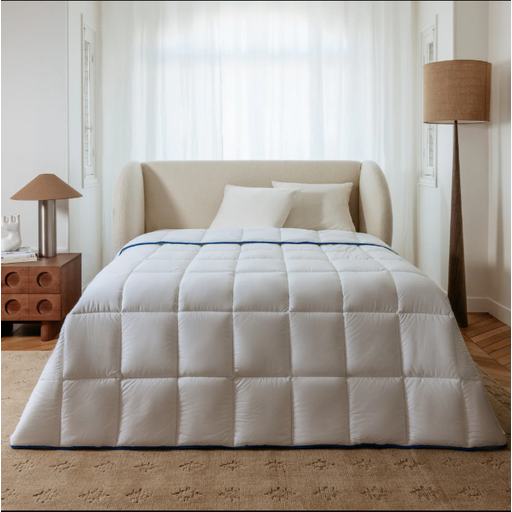
Why this choice suits this profile : The 140 × 200 cm size is suitable for a single bed, while the 400 g/m² polyester filling provides a clear reference point for assessing warmth.
The composition, fill weight and maximum washing temperature of 40 °C are stated, so the product does not rely solely on a claim about thickness.
Percale cotton cover, siliconised polyester hollow fibres and machine washing, provided you have a drum large enough to accommodate it.

Why this choice suits this profile : This generous size is designed for couples who want plenty of coverage and appreciate the loft of a natural duck feather and down filling.
The stated proportion of 90% feathers and 10% down, together with the square-stitched construction, makes the product’s composition and design easier to assess.
Organic cotton satin cover, stated at 129 threads/cm², and washing at 40 °C, with gentle drying recommended.
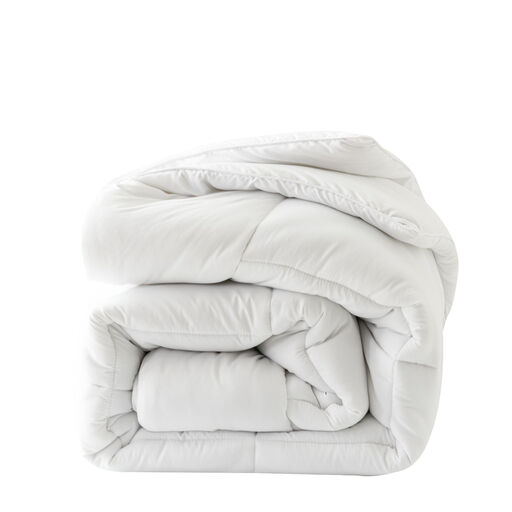
Why this choice suits this profile : Its generous size and microfibre filling meet the needs of couples or households looking for a bulky winter duvet that is still easy to handle.
The stated 15 tog rating provides a reference point for warmth, which should be considered alongside the actual bedroom temperature.
Microfibre filling, box stitching and a 220 × 240 cm size. Check the washing instructions and the required machine capacity before ordering.
We have put together a complete, real-time updated selection of products that meet these criteria, as well as European regulatory requirements for safety.
To preserve your duvet’s loft and minimise wear:
A machine-washable duvet can remain in good condition for several years if it is not overloaded, dried incorrectly or kept compressed permanently. Its lifespan also depends on how often it is used, the quality of the stitching and the care taken during maintenance.
Choose a warm duvet whose fill weight or thermal rating is clearly stated. A natural filling or dense microfibre may be suitable, depending on your preferences for feel and care. Remember to adapt your bed linen and room temperature too.
Yes, but it may be too warm in spring and summer. For greater flexibility, choose a 4-season duvet or pair a winter duvet with a thinner summer duvet. A lightweight duvet will be better suited to a bedroom that is already well heated.
For a double bed, 200 × 200 cm and 220 × 240 cm are the most common sizes. The latter offers more generous overhang, which couples particularly appreciate. Always check the dimensions of the mattress and duvet cover, while also considering each person’s preferences, before making your choice.