
Livraison le jour même ou le lendemain

Qualité garantie

Débloquez vos offres de bienvenue: Livraison GRATUITE | Jusqu'à -80 % | 30 jours d'essai gratuits à JoyPlus
Téléchargez l'application
When the temperature climbs, summer nights can quickly become a nightmare. Between restless sleep and waking up in a sweat, finding a bit of coolness becomes a mission. Choosing a summer duvet seems simple, but with such a vast selection, it's easy to make the wrong purchase. As a product expert at Joybuy, my mission is to help you decode the labels and avoid the most common pitfalls.
Before you buy, here are the three mistakes to avoid:
To make the right choice, focus on objective data. Here are the three key points to check on the label.
Fill weight, expressed in grams per square metre (g/m? or GSM), measures the weight of the filling. It is the most reliable indicator for assessing a duvet's warmth level. For summer use, opt for a low fill weight.
A light and breathable summer duvet will therefore always have a low fill weight, regardless of its composition.
The choice of filling depends on your priorities regarding comfort, maintenance, and allergen sensitivity.
The shell is in direct contact with your duvet cover, so its composition is paramount. A 100% cotton shell, in percale or cotton sateen, ensures excellent air circulation and good moisture-wicking.
Finally, labels are your best allies for judging the quality and safety of the product. The STANDARD 100 by OEKO-TEX label is a must-have. It certifies that the textile has been tested and is free of any substances harmful to health and skin.
To help you see more clearly, here are a few models that perfectly illustrate these criteria.
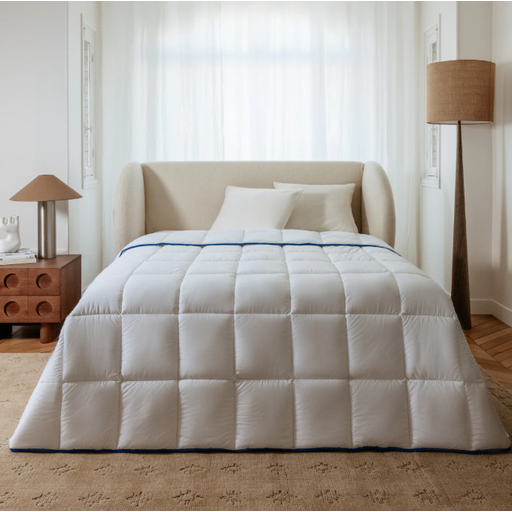
Why we chose it: This duvet combines a synthetic siliconised hollowfibre filling, known for its hypoallergenic properties, with a percale cotton shell. It's the smart choice for those who want to limit allergy risks without compromising on breathability.
With its 250 g/m? fill weight and 100% cotton shell, it is designed for lightness and air circulation, avoiding the "greenhouse" effect of poorly designed duvets.
It is certified STANDARD 100 by OEKO-TEX, Certipur, and Sanitized, which guarantees the absence of harmful substances and an effective anti-dust mite treatment. It is also machine washable at 40°C, a major hygiene benefit.
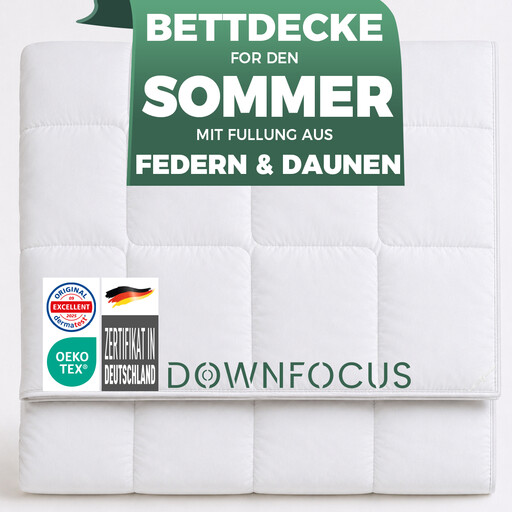
Why we chose it: For those who swear by the comfort and thermoregulation of down, this model is perfectly calibrated for summer. It offers the luxurious feel of a natural duvet without the excessive warmth.
Its fill weight is very light (200 g/m?), making it a true natural down duvet for summer, not a mid-season product in disguise.
It is dual-certified RDS and Downpass for animal welfare, and OEKO-TEX for material safety. Its tightly woven cotton shell forms a natural barrier against dust mites.
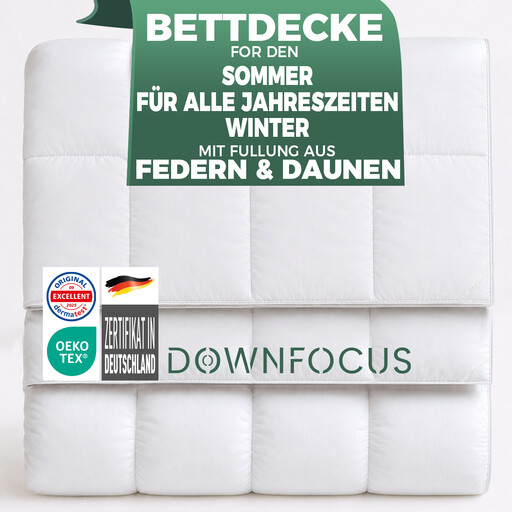
Why we chose it: This is the perfect solution for those who want to optimise their budget in the long run. This model is a true 4-season duvet, composed of two distinct parts: a 200 g/m? summer duvet and a 450 g/m? mid-season duvet.
It sidesteps the trap of the fake "all-season" duvet by offering two distinct, attachable elements. Use the 200 g/m? duvet alone in summer, and combine the two to face the winter.
Total modularity for customised thermal comfort all year round, all in a single purchase. It also benefits from RDS and OEKO-TEX certifications.
We have curated a full range of products that meet our quality criteria and current safety standards.
The general rule is to choose a duvet that hangs over the side of the bed by 20 to 40 cm on each side for optimal comfort and a beautiful drape.
Always check the manufacturer's label. Most synthetic duvets are machine washable at 30 or 40°C. For a large washable duvet, ensure your machine has sufficient capacity (at least 12 kg) to avoid compressing it. For down duvets, professional cleaning is sometimes recommended to preserve the filling's loft. Let it dry completely, either air-drying or in a tumble dryer on low heat with dryer balls.
For most people, a well-maintained and regularly aired duvet is sufficient. However, for sensitive individuals or those with respiratory allergies, an anti-dust mite duvet is an excellent choice. These models are either treated with an acaricide product or feature a shell with such a tight weave that it forms a physical barrier against dust mites. The OEKO-TEX certification guarantees that the treatments used are not harmful.