
Livraison le jour même ou le lendemain

Qualité garantie

Débloquez vos offres de bienvenue: Livraison GRATUITE | Jusqu'à -80 % | 30 jours d'essai gratuits à JoyPlus
Téléchargez l'application
Choosing a winter duvet isn’t just about thickness. You need to consider your bedroom temperature, how sensitive you are to the cold, your sleeping habits and your bed size. Yet product descriptions often mix up tog rating, warmth index, loft and composition. The result? A duvet that’s too hot, difficult to wash or poorly suited to your mattress.
Here are the criteria to check before you buy, along with a selection of models designed for different needs.
A very lofty duvet isn’t necessarily the warmest. Insulation depends mainly on the filling, its weight, its ability to trap air and the construction of the baffle boxes. A hollow-fibre duvet can stay lightweight while still retaining heat effectively. Conversely, a very thick model can feel stifling in a well-heated bedroom.
The 15 tog rating, used on some models, corresponds to high insulation. It’s a useful benchmark, but it’s not enough on its own: also look at the material, the weight and your usual bedroom temperature.
A natural duck feather duvet often offers a cosy feel and good air circulation. However, it requires particularly careful drying to prevent the filling from clumping. A hypoallergenic synthetic duvet is generally easier to care for, but check that your washing machine can handle its volume.
Claims like “anti-dust mite” or “hypoallergenic” should be backed up by verifiable information: composition, certifications stated by the manufacturer and washing instructions. They are not a medical guarantee.
A 140x200 cm duvet is generally suitable for a single bed of the same length, with relatively limited overhang. For a double bed, a 200x200 cm duvet can work for two people, but a wider model will cover the sides better. The 220x240 cm duvet fits many spacious double beds and reduces the risk of tugging during the night.
Before ordering, compare the duvet dimensions with your mattress size, the height of your bed base and each sleeper’s preferences.
Hollow silicone polyester fibres are popular for their easy care and even distribution. Baffle-box or compartment stitching limits the filling from shifting over time. As for cotton, particularly percale, it offers a pleasant feel and is more breathable.
For a natural duvet, look closely at the proportion of feathers and down. A composition of 90% duck feathers and 10% down provides firmer support, while still feeling softer thanks to the down. The comfort will therefore be different from that of a model filled mainly with down.
In a poorly heated bedroom or for someone who feels the cold easily, a winter duvet with a high warmth index can be a good choice. In a room kept at around 20°C or higher, a less warm model will reduce the risk of sweating.
People prone to night sweats would do well to choose a breathable duvet, a less dense filling or a lightweight summer duvet. A two-season solution can also be practical: use the lightweight duvet alone in spring and summer, then add a layer when temperatures drop.
A machine-washable duvet must be compatible with your drum capacity. Some models require a washing machine of at least 12 kg. Follow the recommended temperature, avoid bleach and make sure the duvet is completely dry before storing it.
Air it regularly, shake it gently and use a suitable cover. Its lifespan depends on how often it’s washed, the quality of drying, the strength of the stitching and daily use. A duvet that loses its loft, develops compacted areas or shows its filling through the cover should be replaced.
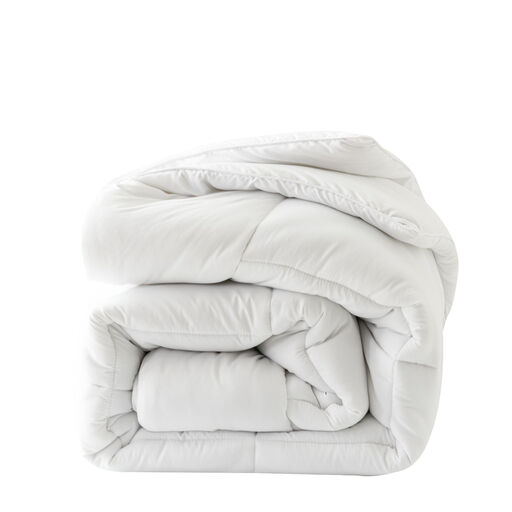
Why this choice suits this profile: its double size and stated 15 tog rating offer a simple benchmark for furnishing a cool bedroom without moving to natural filling.
The size is clearly stated and the microfibre filling avoids the care constraints associated with feathers.
Microfibre, baffle-box stitching and 15 tog rating stated on the product page.
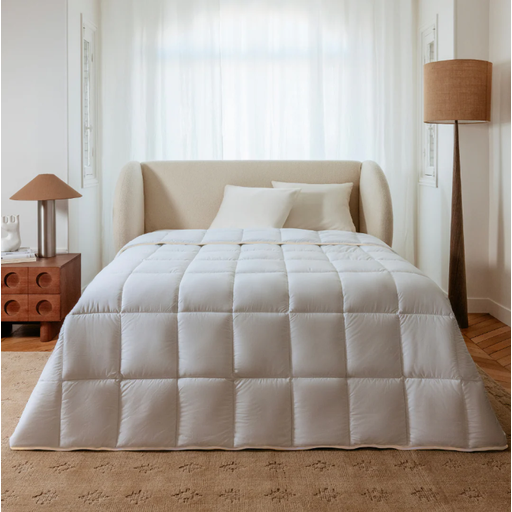
Why this choice suits this profile: its large size suits a spacious double bed and its natural filling appeals to those looking for a more enveloping feel.
The precise composition, square stitching and washing instructions are on the product page, making comparison easier.
90% duck feathers, 10% down, cotton satin cover and stated washable at up to 40°C.
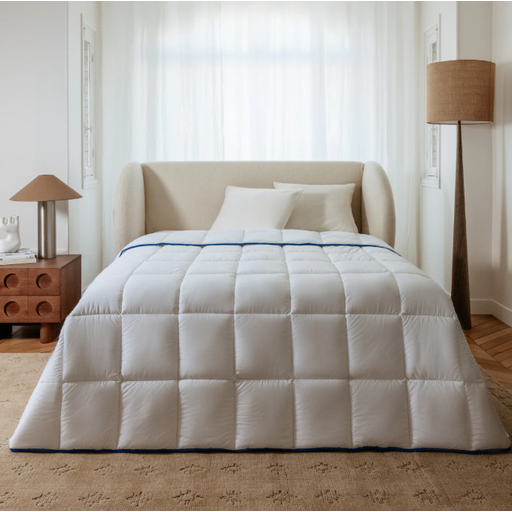
Why this choice suits this profile: this lightweight model is ideal for people who alternate between a winter duvet and a summer duvet, or who wash their bedding regularly.
The product page states it’s intended for rooms at 20°C or above, which prevents confusion with an extreme-cold duvet.
Polyester filling, cotton percale cover, stated weight of 250 g/m² and washable at 40°C.
We’ve put together a comprehensive, real-time updated selection of products that meet these selection criteria as well as European safety requirements.
In winter, start by considering your bedroom temperature and how sensitive you are to the cold. A warm fibre or feather duvet will suit a poorly heated room. In summer, go for a lower weight, a breathable cover and easy care. Some reversible models offer a cooler side and a softer side, so you can adjust your comfort throughout the night.
If you have sensitive skin, choose a washable cover, a clearly detailed composition and certifications that are actually mentioned on the product page. When a duvet is described as anti-dust mite, check the treatments or standards referred to: this claim should not be taken as a health promise.
No. A 15 tog rating corresponds to high insulation. It may be suitable for a cold bedroom or someone who feels the cold very easily, but it can be excessive in a well-heated room. The duvet’s breathability and your sleeping habits also matter.
For a double bed, 200x200 cm and 220x240 cm sizes are common. The right choice depends on the bed width, mattress thickness and the overhang you prefer. For two sleepers who move around a lot, a wider duvet reduces the risk of being left uncovered during the night.
There’s no universal lifespan. Regularly check its loft, the condition of the stitching, any persistent odours and the distribution of the filling. Washing it according to the instructions, drying it thoroughly and using a clean cover will help preserve its qualities for longer.