
Livraison le jour même ou le lendemain

Qualité garantie

Débloquez vos offres de bienvenue: Livraison GRATUITE | Jusqu'à -80 % | 30 jours d'essai gratuits à JoyPlus
Téléchargez l'application
A leak on a roof, a window or the roof of a campervan usually leaves you very little time to act. Waterproof butyl sealant tape lets you carry out a quick repair without any specialist tools, provided you choose the right width and prepare the surface properly.
However, online offers can sometimes be confusing. A tape described as "reinforced" won't necessarily have the same structure as a model with an aluminium film and polyester reinforcement. Likewise, the length stated in the title may differ from the dimensions detailed in the product listing. Here are the points to check before you buy.
A 50 mm strip is suitable for narrow joints, pipe connections or small cracks. For a roof joint or a large tear in a tarpaulin, this width may require several parallel strips, increasing the risk of uneven overlap.
Formats of 100 to 150 mm cover more surface area in a single application. They are often more practical for a roof leak repair tape, a gutter or a campervan repair. Also check the actual length included on the roll.
Water resistance depends on the material, but also on the adhesion to the surface. A tape can be water-resistant yet still adhere poorly to a dusty, greasy, damp surface or one covered in old adhesive.
For outdoor use, look for a composition that combines butyl rubber, aluminium foil and, where stated, a layer of polyester, PET or non-woven fabric. These elements can improve mechanical strength and protection against ultraviolet rays, without guaranteeing an identical lifespan in all conditions.
This is one of the most common causes of peeling. Even a reinforced waterproof adhesive must be applied to a clean, perfectly dry surface. Rain falling shortly after installation can also compromise the initial bond.
For a temporary repair in the rain, dry the area as much as possible first and plan to reapply when conditions are more favourable.
Butyl remains flexible and conforms to irregularities, corners and some slightly textured surfaces. An aluminium foil layer can protect the tape from the weather and act as a surface barrier. For a repair on a boat or a van, check that the product is stated as compatible with the surfaces in question: aluminium, painted metal, fibreglass, PVC, wood, glass or EPDM.
Compatibility with bitumen, tiles or roofing membranes should be confirmed in the product listing. Always test on a small area if the surface is old, porous or painted.
A wider tape does not replace careful preparation. It must extend evenly beyond the damaged area, onto a sufficiently stable surface.
The usual procedure is straightforward:
Some TAPEBEAR models indicate a usage range of –40 °C to 80 °C. This data should be considered a manufacturer specification and not a guarantee of results in all environments.
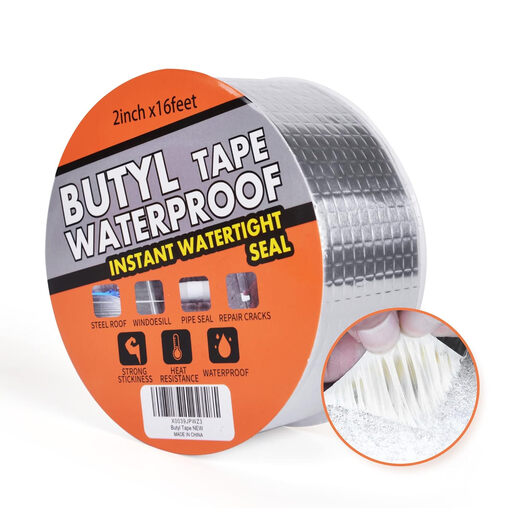
Why this model suits them: With a width of 50 mm and a roll of approximately 5 metres, this format is suitable for small household repairs, windows and pipe connections.
The listing clearly states the width, approximate length and application procedure on a dry surface, making it easy to calculate the quantity needed.
Adheres to PVC, EPDM, glass, wood and metal, among others. No additional tools required for application.
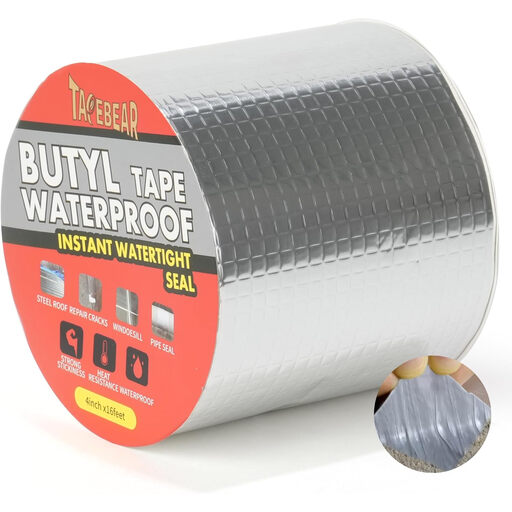
Why this model suits them: This aluminium butyl adhesive tape is aimed at homeowners who want to treat exterior joints on a campervan, window, roof or boat.
The listing mentions an aluminium-PET backing, an anti-ageing film and an application requiring repeated pressure to expel air bubbles.
Width of 100 mm, stated thickness of 1 mm (39.37 mil) and compatibility indicated with metal, tiles, wood, fibreglass and concrete.
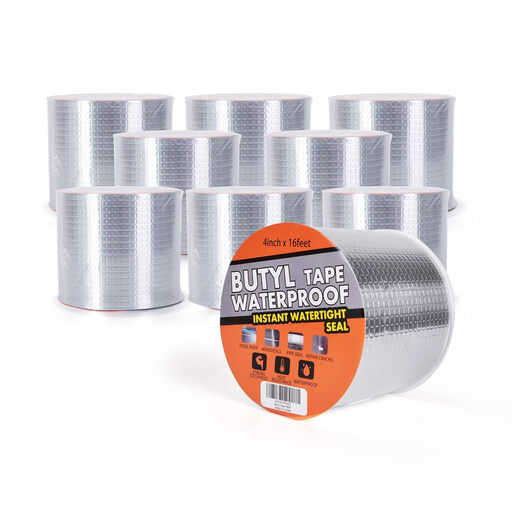
Why this model suits them: The multi-pack is suitable for regular maintenance of a house, a fleet of caravans or several pieces of outdoor equipment.
The available volume reduces the need for repeat purchases. However, check the length of each roll, as the displayed information shows different measurements in different sections of the listing.
Pack of 9 rolls, stated width of 100 mm and compatibility indicated with PVC, EPDM, wood, metal and glass.
A tape for guttering and pipes can treat a connection, a micro-crack or a joint before a more thorough repair. On a window, apply it to a compatible surface and not to a friable one. For the roof of a caravan or campervan, carefully clean off old residue and check the surrounding areas.
On a boat, the tape can be used to temporarily limit water ingress or protect a joint, but it does not replace a structural repair. For a major leak, a pressurised pipe or an extensive roof defect, call in a maintenance professional.
Find an updated selection of products for your sealing work, checking the dimensions, surface compatibility and application conditions stated on each listing.
Yes, the models are designed to form a barrier against water when correctly applied. The surface must be clean and dry, and the freshly treated area must be kept protected from rain for the period stated by the manufacturer, often 24 hours.
The duration depends on the surface, UV exposure, temperature variations, the quality of the application and any movement of the structure. Regularly inspect the edges of the tape, especially after winter or a period of heavy rain. Replace it if it peels, cracks or if moisture reappears.
This is not recommended. Water, grease and dust reduce adhesion. Dry the area, clean it with a product suitable for the surface, then wait for it to evaporate completely before application.