
Livraison le jour même ou le lendemain

Qualité garantie

Débloquez vos offres de bienvenue: Livraison GRATUITE | Jusqu'à -80 % | 30 jours d'essai gratuits à JoyPlus
Téléchargez l'application
Overflowing closets, packed wardrobes… Lack of space is a nightmare for many of us, especially in the city. On paper, the vacuum storage bag is the miracle solution for optimising every square inch. But in reality, an impulse buy often ends in disappointment: bags that reinflate in a few weeks, zips that break, or plastic that punctures at the slightest touch. To avoid turning a great idea into a useless gadget, here are the pitfalls to avoid to make the right choice.
Our mission as editors: to guide you through the jungle of options based on clear, objective criteria. Here are the three most common problems and, more importantly, how to overcome them:
Fortunately, avoiding these disappointments is as simple as checking a few technical details. These are the details that separate a smart investment from a quickly-regretted gadget.
The durability of a garment compression bag depends primarily on its composition. Entry-level models often use only polyethylene (PE). While flexible, this material alone is too fragile and punctures easily.
The secret to a good bag? The combination of Polyamide (PA) and Polyethylene (PE). PA provides toughness and resistance to friction, while PE ensures flexibility and a perfect seal. A PA+PE composition is therefore a true mark of quality and durability. The plastic's thickness, sometimes indicated in microns (?m), is also a good indicator: aim for over 70 ?m for decent resistance.
The seal is the heart of the matter. For seasonal clothing storage that lives up to its promise, two points must be inspected closely:
The compression method will depend on your needs and your equipment.
To put theory into practice, here is our selection of products that meet specific needs.
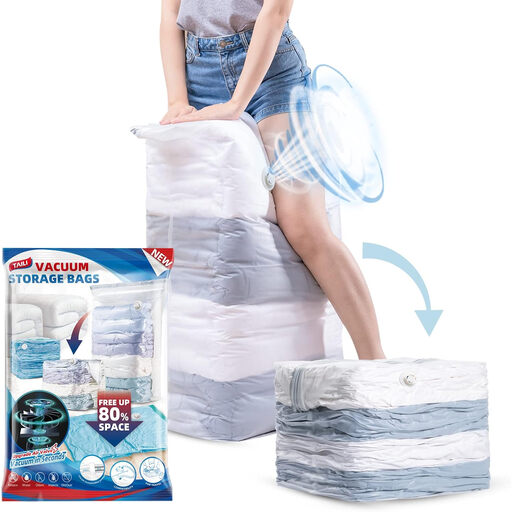
The Editor's Verdict: Perfect for storing duvets, pillows, and winter coats. Its cube shape stands up on its own, which is a game-changer for filling it, and allows for easy stacking under a bed or on top of a wardrobe.
Its PA+PE composition ensures excellent tear resistance, even with bulky items. Its universal valve is compatible with most vacuum cleaners, preventing any nasty surprises.
The "Jumbo" cube format for XXL storage volume; its self-supporting structure truly makes filling easier.
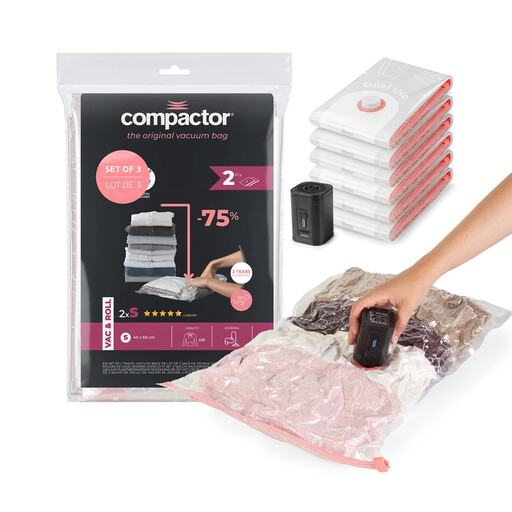
The Editor's Verdict: The perfect kit for nomads. The mini electric pump fits right into your suitcase, and the S-sized bags (40 x 60 cm) are calibrated for clothes, perfect for optimising space in a carry-on.
It bypasses the compatibility problem by including its own pump. Even better, the bags can also be compressed by simply rolling them, a very handy backup solution.
An all-in-one kit with its portable electric pump; the dual-use (rolling or pump) offers maximum flexibility on the go.
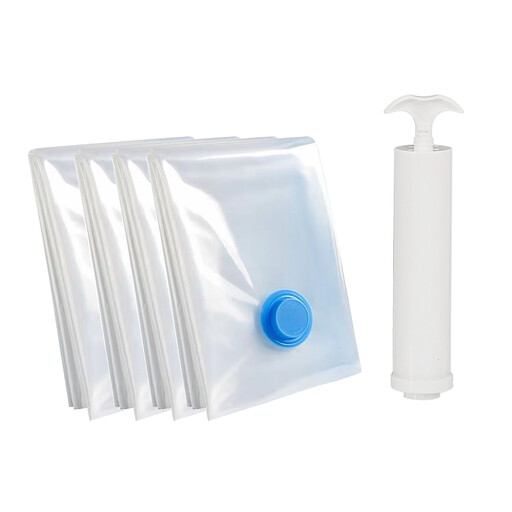
The Editor's Verdict: A complete and affordable starter kit. The manual pump makes it 100% self-sufficient, ideal for a student dorm or a first apartment without a vacuum cleaner. The medium size is very versatile.
The included hand pump immediately eliminates any risk of incompatibility. It's a turnkey solution that works right out of the box.
A complete kit with a hand pump included; the perfect economical and self-sufficient solution for small spaces.
Discover our full selection of products that meet our quality criteria and European safety standards.
A high-quality, properly sealed bag can hold its compression for several months, or even over a year. It all depends on the seal of the zip and valve, as well as the overall condition of the bag. If a bag reinflates, the first thing to do is check that the double zip is sealed along its entire length and that the valve cap is screwed on tightly.
Yes, absolutely. Most models are designed to be reused many times. To maximise their lifespan, handle them with care, don't overfill them, and keep them away from sharp or pointed objects. A quick wipe with a damp cloth before storing them flat in a dry place, and you're all set.
For the majority of textiles (cotton, synthetics, etc.), there is no risk. Just avoid extreme compression for delicate materials like silk. For natural fibres that need to "breathe" (feathers, down), it is not recommended to leave them compressed for more than 6 months at a time. For simple seasonal storage, it's perfectly safe.