
Livraison le jour même ou le lendemain

Qualité garantie

Débloquez vos offres de bienvenue: Livraison GRATUITE | Jusqu'à -80 % | 30 jours d'essai gratuits à JoyPlus
Téléchargez l'application
Overflowing wardrobes, a winter duvet monopolising an entire closet in summer, a suitcase that stubbornly refuses to close... Lack of space is a daily headache. The vacuum storage bag appears to be the miracle solution: a promise of up to 75% more space and unbeatable protection against dust and moisture.
However, the experience sometimes ends in disappointment: a bag that tears on the first use, a bag that mysteriously re-inflates after a few weeks, or a valve that's incompatible with your vacuum cleaner. As a Product Expert at Joybuy, I test and analyse these products daily. My role? To help you avoid the pitfalls and make the right choice. Here are the essential points to watch out for.
The market is flooded with models, but not all are created equal. Certain design flaws can turn a promising purchase into a real frustration.
Fortunately, you only need to check a few technical points to sort the good from the bad. These are what make all the difference between a disposable gadget and a true ally for your organisation.
The durability of a garment compression bag depends primarily on its materials. The highest-performing models combine two complementary plastics: PA+PE (Polyamide + Polyethylene).
In terms of thickness, aim for at least 70 microns (0.07 mm): it's an excellent indicator of durability. For example, products in the Compactor Aspispace range go up to 0.085 mm, offering superior robustness, ideal for repeated use.
A perfect seal relies on two critical points:
The right format is one that fits both your belongings and the space where you'll store them.
The smart move: buy a set of storage bags in different sizes. It's often more economical and allows you to be prepared for any situation.
Every need is unique. Here are a few options that cater to different user profiles, taking into account the quality criteria we've just discussed.
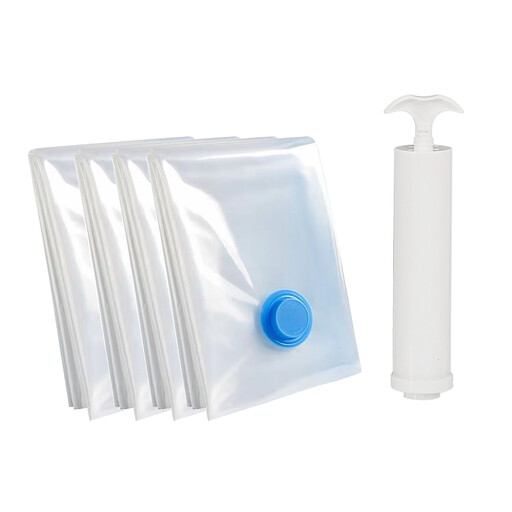
Why we chose it: This is the ultimate all-in-one, portable solution. The included hand pump makes it perfect for a student dorm, a studio flat, or for optimising suitcase space without needing a vacuum cleaner. Its medium size is very versatile, suitable for both clothes and household linens.
By including its own pump, it completely eliminates the risk of an incompatible valve with your vacuum cleaner.
A 100% self-sufficient solution, ideal for travel and small spaces. The 5-pack offers excellent value for money.
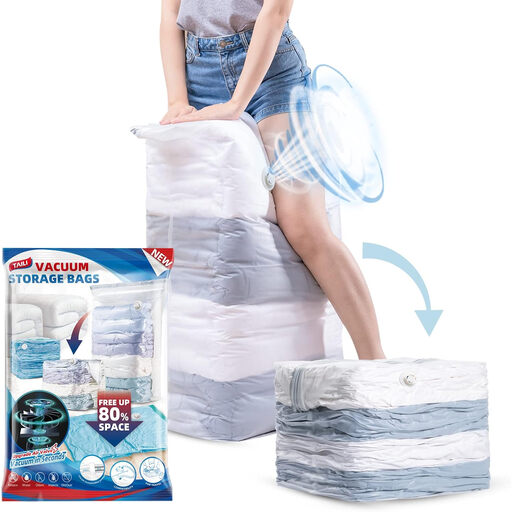
Why we chose it: The "Jumbo Cube" format is tailor-made for the bulkiest items: duvets, blankets, winter coats... Its self-supporting 3D structure makes filling incredibly easy and allows you to create stable stacks in a closet, attic, or cellar.
Its PA+PE composition gives it excellent puncture resistance, even with heavy textiles. Its cap-free valve is designed for quick compression and maximum compatibility with standard vacuums.
Very large capacity and a stackable cube format—the winning combination for seasonal storage of bulky textiles.
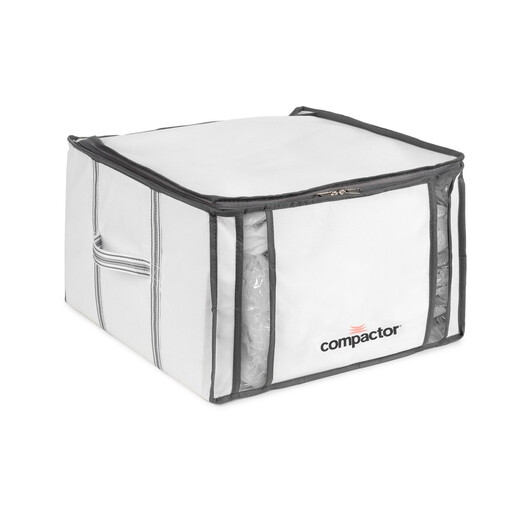
Why we chose it: More than just a bag, this semi-rigid model is a true storage box. The outer non-woven polypropylene cover structures the inner compression bag, creating a neat storage "block" that is easy to handle and stack on a shelf.
The external structure acts as a shield, protecting the inner compression bag from snags and punctures. This extends its lifespan tenfold. Bonus: the internal securing straps hold linens in place even before compression.
Semi-rigid design for neat, perfectly stackable storage. Double protection (outer cover + inner bag).
We have selected a complete range of products that meet our quality criteria and safety standards.
Rest assured, for cotton and most synthetic textiles, there is no risk. Caution is advised for delicate natural fibres (down, feathers, wool): excessive and prolonged compression can break the fibres and alter their loft. Our advice: do not reduce their volume by more than 50% and do not leave them compressed for more than six months at a time.
A good product, with thick plastic and a double zip, should remain compressed for several months, or even a full year. If your bag re-inflates in a few days or weeks, it's a sign of a micro-leak at the closure or the valve. For long-term storage, a quick check every six months is a good habit to adopt.
The vast majority of bags on the market are equipped with a "universal" valve, compatible with the round nozzle of most canister vacuums. However, be careful with cordless stick vacuums, whose specific nozzles are rarely compatible. If in doubt, models with a manual pump or those that compress by rolling are always safe bets.