
Livraison le jour même ou le lendemain

Qualité garantie

Débloquez vos offres de bienvenue: Livraison GRATUITE | Jusqu'à -80 % | 30 jours d'essai gratuits à JoyPlus
Téléchargez l'application
Lack of space is a constant struggle, whether you live in a small apartment or a large house. Winter duvets, bulky coats, seasonal linens… these items inevitably overwhelm our closet space. The vacuum storage bag then emerges as the perfect solution to optimize every square inch.
But be warned, not all bags are created equal. A poor choice guarantees disappointment: bags that re-inflate after a few days, zippers that break, or plastic so flimsy it punctures on first contact. To avoid throwing your money down the drain, here are the 3 pitfalls to avoid at all costs.
Keeping these weaknesses in mind is the key to making a smart choice and investing in a wardrobe space-saver that truly delivers on its promises.
To ensure you make the right decision, scrutinize these few technical specifications. This is what separates a reliable product from a mere gadget.
The plastic composition is the best indicator of a vacuum storage bag's robustness. The most durable models systematically combine Polyamide (PA) and Polyethylene (PE).
A 100% PE bag will certainly be cheaper, but it will be far more fragile and porous. For long-term storage, especially for a vacuum bag for duvets, a PA+PE blend is a non-negotiable prerequisite.
The effectiveness of the compression relies entirely on the bag's hermetic seal. Two points must be examined closely:
Not all bags work with a vacuum cleaner. The choice depends on how you plan to use them.
To put theory into practice, here is our selection of bags that check all the right boxes, each tailored to a specific need.
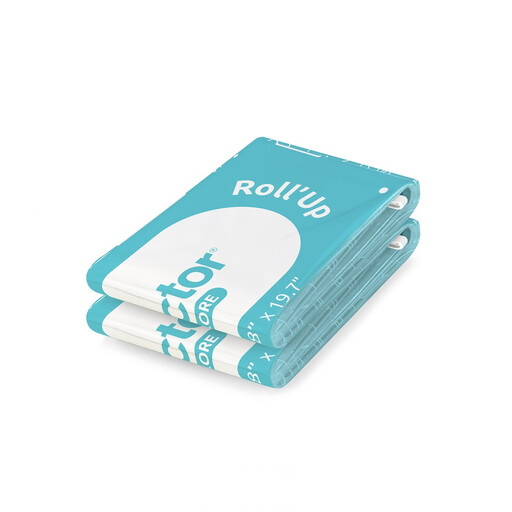
Why we chose it: Perfect for saving space in a carry-on suitcase or backpack without needing a vacuum. It also helps to compartmentalise your belongings and protect them from moisture or odours during your trip.
This model eliminates the risk of vacuum incompatibility, as it doesn't need one! Compression is achieved simply by rolling the bag.
No pump or vacuum required. Lightweight, flat, and reusable, it's the ultimate travel companion.
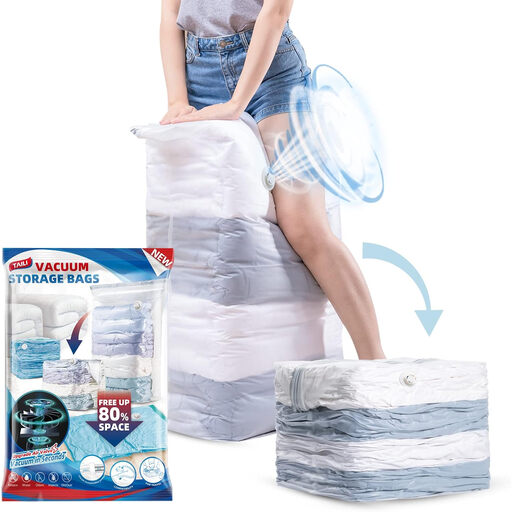
Why we chose it: Unbeatable for storing multiple duvets, blankets, and puffer jackets. Its cube shape, once compressed, is much more convenient for stacking on a shelf or sliding under a bed than a classic flat bag.
Its PA+PE composition gives it excellent tear resistance, countering the flimsy material trap. Its universal valve is designed to fit the majority of vacuum cleaners.
Its extra-large capacity ("Jumbo Cube" size) and its self-supporting base, which makes filling much easier. A single bag can accommodate 3 to 5 duvets.
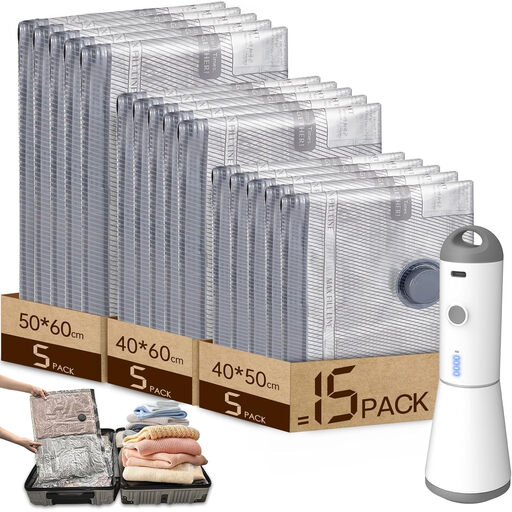
Why we chose it: The perfect starter kit for organising everything at home. The set includes multiple bag sizes to suit all needs (clothes, linens, etc.), with the bonus of an ultra-convenient cordless electric pump.
By providing its own pump, this kit eliminates any risk of incompatibility. The PA+PE composition and double zip ensure an excellent airtight seal.
The included cordless electric pump. Portable and rechargeable, it's perfect for use anywhere, even far from an outlet (basement, attic, or even while travelling).
Explore our full selection of products that meet our quality criteria and current safety standards.
A good quality model (PA+PE material, double zip, high-performance valve) should remain compressed for several months, or even a full year. If your bag re-inflates in a few days or weeks, it's a sign of a micro-leak at the zip or valve.
Yes, absolutely. Most models are designed to be reused many times. Their longevity will depend on the quality of the plastic and the durability of the zip. To make them last, avoid overfilling them, folding them at the closure, and storing them near sharp objects.
For the majority of textiles (cotton, synthetics, wool), it is completely safe. However, the method is not recommended for delicate materials like silk, leather, or items made with natural down and feathers (pillows, some luxury puffer jackets), as prolonged compression could irreversibly damage the fibres. When in doubt, always check your item's care label.