
Livraison le jour même ou le lendemain

Qualité garantie

Débloquez vos offres de bienvenue: Livraison GRATUITE | Jusqu'à -80 % | 30 jours d'essai gratuits à JoyPlus
Téléchargez l'application
Lack of space is a common headache for many households. Between winter duvets, seasonal clothing, and household linens, closets can quickly become overwhelmed. The vacuum storage bag emerges as a miracle solution, promising to dramatically reduce the volume of your textiles. However, the experience is often disappointing: bags that reinflate after a few days, or worse, tear during the first use.
To ensure your investment doesn't fall flat (literally), it's crucial to know how to avoid the most common pitfalls. Here are the key points to watch for to choose a reliable and truly effective model.
The promise of instant space-saving often leads to an impulse buy. Watch out for these three design flaws that can turn a great idea into a costly disappointment:
To make the right choice, focus on the technical specifications that truly make a difference in terms of durability and efficiency.
The sturdiness of a clothing compression bag primarily depends on its material. The highest-performing models often combine Polyethylene (PE) and Polyamide (PA) or PET. This blend offers the best of both worlds: flexibility and puncture resistance. The thickness, measured in microns (?m), is the key criterion to monitor.
The valve and closure duo is the true guardian of the seal.
Choosing the right size is obviously essential for optimising your storage.
Buying a set of compression bags is often more economical and allows you to standardise your storage with various sizes at your disposal.
Rather than an endless list, we've chosen to match user profiles with specific products. The goal: to help you find the solution that precisely fits your needs.
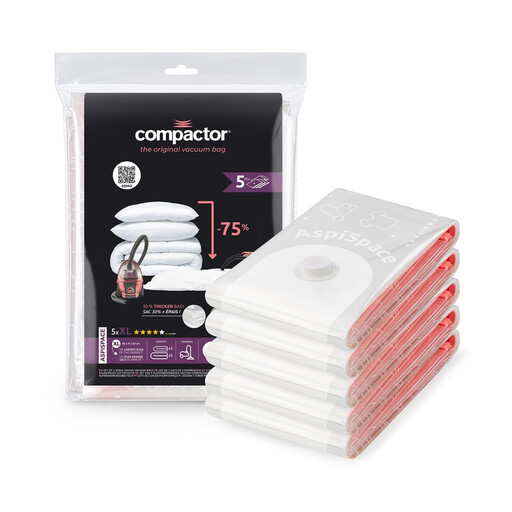
Why this choice? Perfect for large seasonal storage needs. This set allows you to store multiple duvets, winter coats, and pillows, freeing up considerable space in wardrobes or under the bed.
Its 85 ?m (0.085 mm) recyclable PE/PET material offers superior robustness, limiting the risk of punctures (pitfall #2). The valve and closure design ensures a durable, airtight compression (pitfalls #1 and #3).
The XL size (80 × 130 cm) and the 5-pack format make it an economical and incredibly practical solution for the bulkiest items.
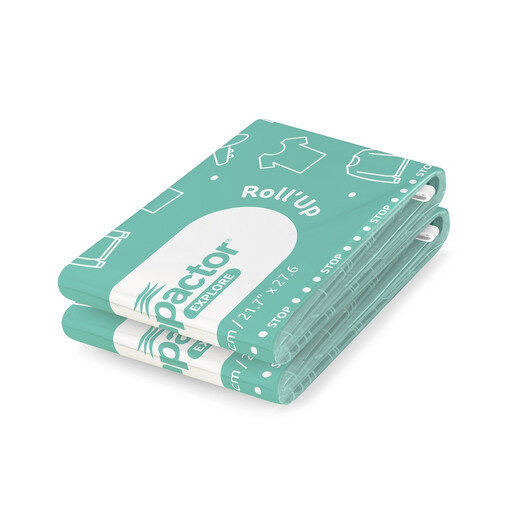
Why this choice? Designed for those who want to optimise every square inch of their carry-on suitcase or backpack. Compression is done manually by simply rolling the bag, with no vacuum cleaner needed.
This clever system inherently eliminates the risk of a faulty valve (pitfall #1). Air is expelled through a one-way valve simply by rolling the bag. Its 55-micron material is an excellent compromise between lightness and durability for travel.
No vacuum required. Roll-up compression is simple, fast, and can be done anywhere. It's the ideal travel companion for saving space.
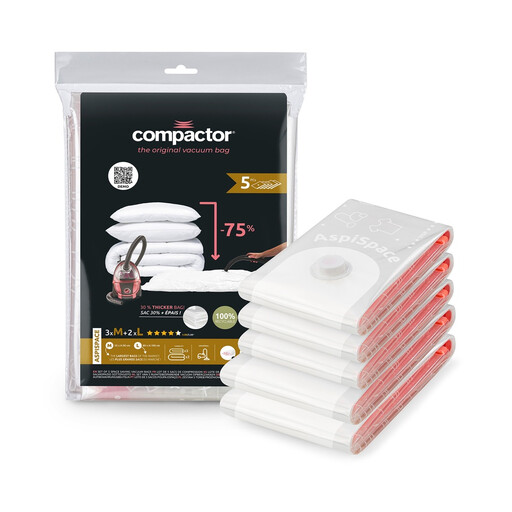
Why this choice? For those just starting out or who have varied needs. This mixed set is perfect for testing compression on different types of textiles, from sweaters to duvets, without committing to a large number of bags in a single size.
Like other products in the Aspispace range, it features a 85 ?m material and a secure valve and closure system, offering excellent protection against leaks and tears (pitfalls #1, #2, and #3).
Versatility. The mix of M (55 × 90 cm) and L (80 × 100 cm) sizes allows it to meet most household storage needs.
1. Can vacuum storage bags damage clothes? For most textiles, the risk is zero. However, you should be cautious with delicate natural fibres like down or feathers: excessive compression could break the fibres and reduce their loft over the long term. For these items, compressing to 50% of their volume is a good compromise.
2. How long does a bag stay compressed? A high-quality model, properly sealed and stored away from sharp objects or heat, should stay compressed for several months, or even a full year. If a bag reinflates quickly, it's an almost certain sign of a micro-puncture or a poorly sealed closure.
3. Can you reuse a clothing compression bag? Yes, absolutely. Most models are designed to be reused many times. To maximise their lifespan, handle them with care, ensure the zip area is clean before each closure, and store them neatly folded when empty.