
Same-day & Next-day Delivery

Quality Guaranteed

Unlock Your Welcome Offers: FREE Delivery | Up to 80% OFF | Free 30-day JoyPlus trial
Download the APP
Overflowing closets, wardrobes on the verge of collapse? It's the same story every time the seasons change. The vacuum storage bag emerges as the game-changing solution for compressing duvets, coats, and household linens. But be warned, not all models are created equal. Make the wrong choice, and disappointment is guaranteed: a bag that secretly reinflates or tears at the slightest touch.
Our editorial mission? To help you cut through the noise. Let's forget the marketing jargon and focus on what truly matters. Here are the 3 pitfalls to avoid and the essential technical criteria for a smart, long-lasting purchase.
To avoid these setbacks, a few technical details need to be examined closely. These are what guarantee the longevity and effectiveness of your bag.
A bag's durability comes down to its composition. The models that last are made from a blend of Polyamide (PA) and Polyethylene (PE).
A 100% PE bag might be cheaper, but it's far more fragile. Spotting "PA+PE" on the packaging is the first step toward a durable investment.
A good compression bag for clothes or duvets must be hermetically sealed. Two elements are crucial here:
The ideal format depends on what you're storing and your need for a closet organiser.
To illustrate these criteria in practice, here are three solutions that each meet a specific need.
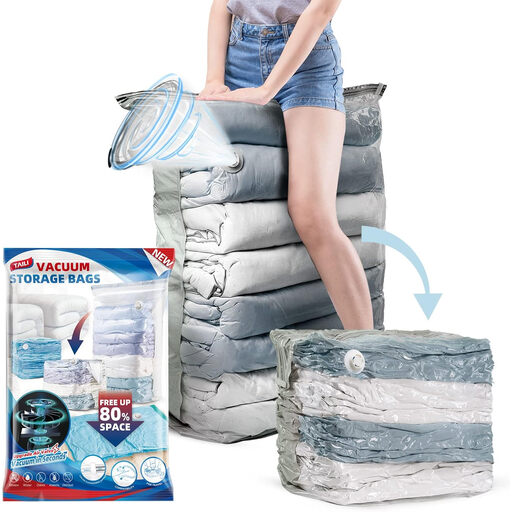
Why it's the right choice: Perfect for large families or major spring cleaning. Its XXL cube format is designed to swallow multiple duvets and pillows, while its self-supporting structure makes it incredibly easy to fill, even on your own.
No more misshapen bundles! The cube format creates a stable, rectangular block when compressed, perfect for neat, optimised stacking on a shelf.
Extra-large capacity (up to 5 duvets). Durable PA+PE material. Universal valve compatible with all vacuums.
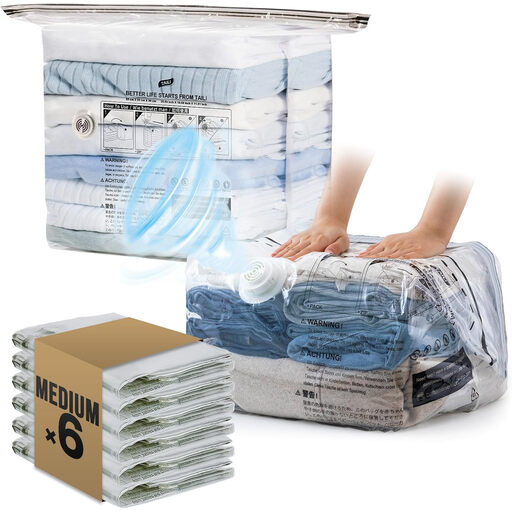
Why it's the right choice: Designed for travellers and anyone without a vacuum cleaner handy. Its medium size is optimised for carry-on suitcases or travel bags.
It eliminates the need for a vacuum thanks to its patented valve: simply press and roll the bag to expel the air. No extra equipment required.
Ultra-simple manual compression. Cube format is ideal for luggage. Robust PA+PE material to withstand the rigours of travel.
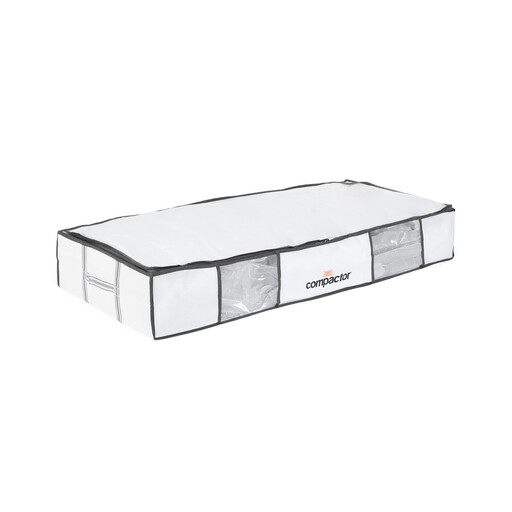
Why it's the right choice: The ultimate solution for organisation perfectionists who demand a flawless setup. The vacuum bag is directly integrated into a semi-rigid box, combining compression with structure.
It definitively solves the problem of unstable stacks of linen. Its structure guarantees a perfect box shape, even when half-full, for impeccable stacking and a very clean visual result.
Patented semi-rigid structure for perfect stacking. Large XL capacity for bulky items. Optimal protection against dust, mites, and moisture.
Discover other models that meet our quality standards and cater to a variety of needs, from clothing organisation to bedding storage.
1. Can a vacuum bag damage my feather or down duvets? That's an excellent question. For delicate natural materials like down and feathers, the golden rule is not to compress more than 50% of the volume. Full compression could break the fibres and reduce your duvet's loft over the long term. Always leave a little air in to preserve its quality.
2. How long does a good bag stay compressed? A quality model, with a PA+PE composition and a double zip, should hold its compression for several months, or even a full year. If your bag reinflates in a few days, it's a sign of a micro-leak at the valve, the zip, or a puncture in the bag itself.
3. Is my vacuum cleaner compatible with all vacuum bags? The vast majority of valves are universal and fit the standard round nozzle of canister vacuums. However, be careful with certain stick vacuums (like Dyson models) which have specific nozzles. If in doubt, check for compatibility or choose a model that includes a pump or a manual compression system.