
Livraison le jour même ou le lendemain

Qualité garantie

Débloquez vos offres de bienvenue: Livraison GRATUITE | Jusqu'à -80 % | 30 jours d'essai gratuits à JoyPlus
Téléchargez l'application
Optimising a carry-on suitcase, freeing up closet space, making a move easier… The promise of the vacuum storage bag is alluring: significant space savings. Yet, the experience often ends in disappointment. A bag that reinflates in a few hours, a valve incompatible with your vacuum cleaner, or plastic that tears on the first use—these scenarios might sound familiar.
Our mission, as product experts at Joybuy, is to guide you in making the right choice. Together, let's break down the three most common pitfalls and the essential criteria for finding a bag that truly delivers on its promises.
To avoid these disappointments, let's focus on a few objective technical specifications.
There are two main types of bags, each suited for a specific use:
A bag's robustness depends on its composition. Prioritise models made from PA+PE (Polyamide + Polyethylene). This blend offers an excellent balance of flexibility and puncture resistance. Another indicator, less frequently shared by brands, is the film thickness, measured in microns.
For airtightness, opt for a double-zip seal. This dual-track system provides a double barrier against air leaks. Some bags even include a colour-change indicator slider that confirms the bag is perfectly sealed.
The bag's size should obviously be tailored to your needs. A 40x60 cm format will suffice for a few t-shirts in a backpack, while a hanging vacuum bag for clothes or a jumbo model (over 100 cm) will be necessary for duvets and coats. Think about the end use: a suitcase organiser needs to be compact, whereas a home storage bag can be larger.
Here is our selection of products that cater to distinct uses, all evaluated against our quality and practicality criteria.
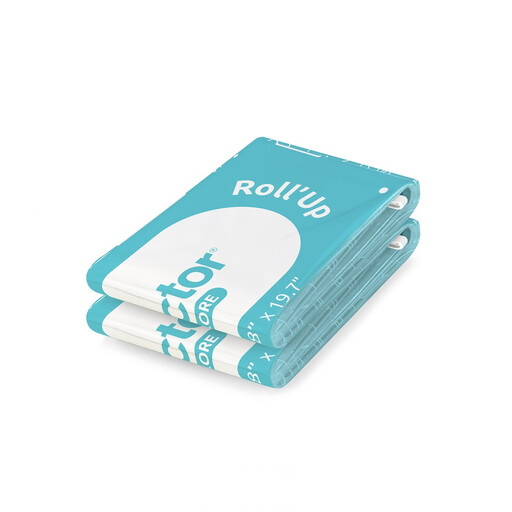
Why we chose it: For those looking for a simple and effective solution to optimise space in a suitcase or backpack, without the hassle of a vacuum cleaner or pump.
The roll-up system completely bypasses the valve compatibility issue. You simply roll the bag to force the air out, making it perfectly self-sufficient and reliable on the go.
No equipment required: Manual compression is ideal for travel. Reusable: Designed to be used for multiple trips.
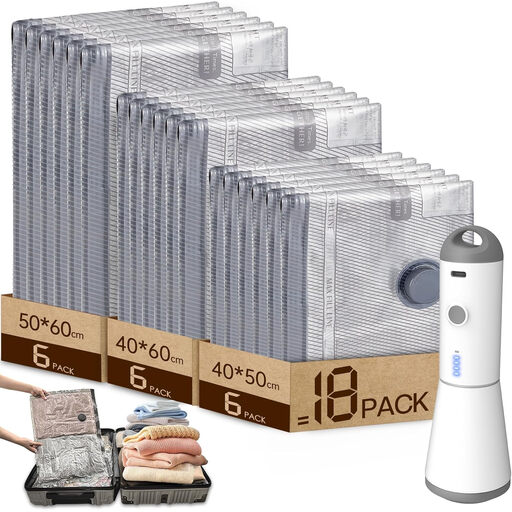
Why we chose it: For those undertaking a major seasonal clear-out, a move, or needing to store many bulky items (duvets, pillows, winter clothes).
This kit includes its own wireless electric pump, solving the compatibility problem from the start. The double-zip closure and PA+PE material ensure superior airtightness and durability.
All-in-one solution: The 18-pack of assorted sizes and the portable pump cover all home storage needs. Rapid compression: The electric pump removes air in a matter of seconds.
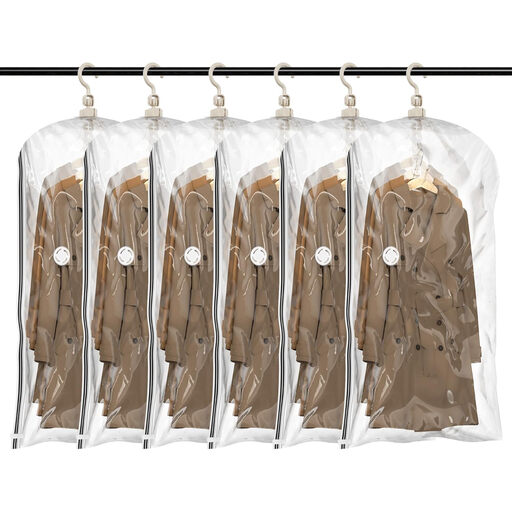
Why we chose it: For those who want to compress suits, dresses, or long coats directly on hangers, protecting them from dust and maximising vertical space in a wardrobe.
The hanging design is an ingenious solution that preserves the shape of garments. The valve is advertised as universal and compatible with any vacuum cleaner, removing one of the main barriers to purchase.
Vertical space-saving: Allows you to store up to 5 garments on a single hanger. Long-term protection: The PA+PE material protects against dust, moisture, and odours.
We have compiled a complete and up-to-date selection of bags that meet our demanding selection criteria.
For most textiles (cotton, synthetics), vacuum storage is safe. However, for delicate natural fibres like wool, cashmere, or down (in a duvet or puffer jacket), it's advisable not to compress the bag completely. Leave about 20% of the air inside to avoid crushing the fibres and to preserve their loft over the long term.
A high-quality bag that is properly sealed and has no punctures should maintain compression for several months, or even a full year. If a bag reinflates in a few days or weeks, it's an almost certain sign of a micro-leak at the zip or a snag in the plastic.
Yes, almost all vacuum bags are designed to be reusable. Their longevity will depend on the quality of the plastic (PA+PE being a mark of durability) and the care you take with them. Avoid overfilling them or placing them in contact with sharp objects (zippers, metal buttons) to maximise their lifespan.