
Livraison le jour même ou le lendemain

Qualité garantie

Débloquez vos offres de bienvenue: Livraison GRATUITE | Jusqu'à -80 % | 30 jours d'essai gratuits à JoyPlus
Téléchargez l'application
When faced with a broken object or a mounting project, the adhesives aisle can be overwhelming. Between promises of extreme strength and "all-in-one" formulas, it's easy to make the wrong choice and end up with a bond that fails at the first sign of stress. As a product expert at Joybuy, my role is to bring you clarity and help you decipher the labels so you can find the most suitable solution with confidence.
The fundamental mistake? Believing that a "universal" glue can truly do it all. Here are the 3 most common pitfalls that lead to buyer's remorse:
water-resistant adhesive isn't an option but a requirement for any use in a bathroom or outdoors.To avoid making mistakes, focus on these three technical parameters before any purchase. They are the guarantee of your bond's performance and durability.
The term extra-strong adhesive actually covers several product families with very distinct properties.
drill-free mounting. It's ideal for attaching heavy objects (shelves, mirrors, skirting boards) to vertical surfaces. Its main asset is its flexibility after curing, which allows it to absorb vibrations and material expansion. It can also serve as a waterproof sealant.all-purpose repair putty is a mouldable variant, perfect for filling gaps or rebuilding a broken part.Systematically check the list of compatible materials on the packaging. The note "not suitable for PE, PP, PTFE" is a warning sign you should never ignore. To bond these stubborn plastics, it is imperative to use a specialty plastic glue, often sold with a primer (an activator pen or liquid). For metals, an epoxy-type metal adhesive will ensure an infinitely more durable bond than a standard super glue.
The environment is a decisive factor. For outdoor use, or in a kitchen or bathroom, a water-resistant and UV-resistant adhesive is non-negotiable. Also, take a look at the service temperature range (e.g., from -40°C to +100°C), especially if the object will be exposed to the sun or near a heat source.
Rather than an endless catalogue, we've matched proven products to specific, real-world applications.
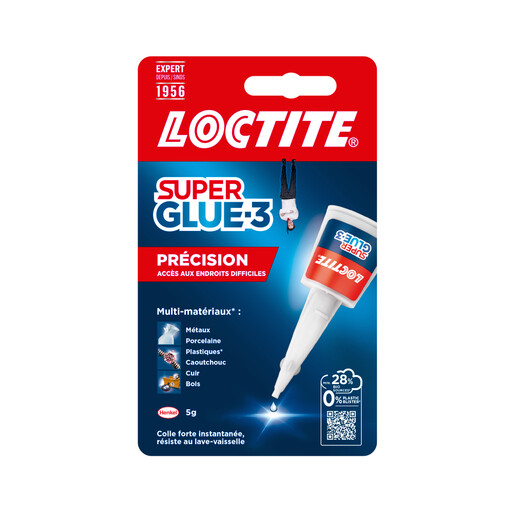
Why we chose it: Perfect for a chipped dish, a hard plastic toy, a peeling shoe sole, or costume jewellery. It's the solution to keep in a drawer for everyday emergencies.
It doesn't claim to be universal. Its strength lies in its specialisation: an instant bond on common, non-porous materials. Its long nozzle allows for drop-by-drop application, preventing unsightly excess.
Transparent finish and water resistance (dishwasher safe after full cure), a real asset for kitchen items.
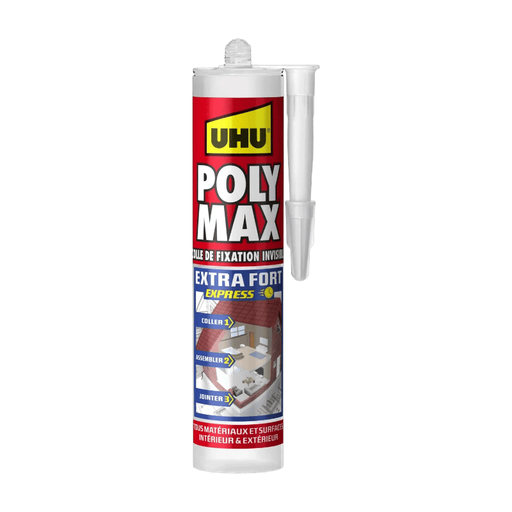
Why we chose it: Perfect for fixing skirting boards, battens, a letterbox, or heavy decorative elements both indoors and outdoors, without getting out the drill and wall plugs.
It avoids the "brute force" trap. Its hybrid polymer (MSP) technology ensures a powerful bond while maintaining permanent elasticity. It withstands weather, UV rays, and impacts where a rigid adhesive would eventually crack.
Versatility and durability. It glues, assembles, and seals on almost all surfaces (wood, tile, metal, PVC, concrete). Its formula is solvent-free and odourless.
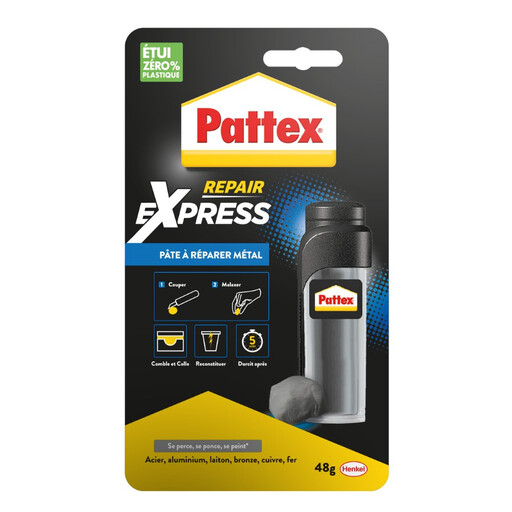
Why we chose it: For sealing a leak in a copper pipe, welding a metal mounting bracket back on, or rebuilding a worn metal part. This is a durable repair solution, not just a simple glue job.
This two-part epoxy putty is a specialised solution. Instead of promising average performance on everything, it delivers outstanding mechanical and thermal resistance (-30°C to +120°C), specifically for metals.
After curing, the material becomes as hard as metal and can be drilled, sanded, and painted for an invisible finish. It is resistant to water, even when submerged.
We have compiled a complete selection of products that meet these performance criteria and current safety standards.
The main difference lies in their state after curing. A fixing mastic remains flexible to absorb vibrations and movement, making it the perfect mounting adhesive. Conversely, a two-part epoxy adhesive hardens like stone to become ultra-rigid and resistant, ideal for structural repairs where no flexibility is allowed.
You must distinguish between the initial set time (the time it takes for the parts to hold on their own, from a few seconds to a few minutes) and the final strength (the maximum strength of the bond). For most extra-strong adhesives, this strength is only reached after 24 hours. Always read the manufacturer's instructions to avoid ruining your repair.
No, and this is the most common pitfall. Most consumer-grade adhesives are ineffective on so-called "oily" or low-surface-energy plastics like polyethylene (PE), polypropylene (PP), and PTFE. If you need to bond this type of plastic, you must use a dedicated specialty plastic glue that includes an adhesion promoter or primer.