
当日/次日达

品质保障

开启新人专享福利: 全场免邮 | 低至 2 折 | 免费试用 30 天 JoyPlus 会员
下载 Joybuy
Outfitting your kitchen can be a daunting task. At first glance, choosing a stainless steel induction stock pot seems simple. However, a single detail can be the difference between a purchase you'll cherish for years and a real disappointment. As a product expert at Joybuy, my mission is to teach you how to read between the lines of spec sheets to make a truly informed choice, far from the marketing jargon.
Before we get to our top picks, let's review the common mistakes that could lead to buyer's remorse.
To avoid these setbacks, here are the technical points on which you should make no compromises. This is where the true quality of your future stainless steel stock pot lies.
Stainless steel is an alloy, and its composition determines its durability.
For a pot to work optimally on an induction hob, its base must be ferromagnetic. But for perfect cooking, it must also be an excellent heat conductor. This is the role of the thermo-diffuser base (or sandwich bottom). It typically consists of three layers: an inner layer of stainless steel, a core of aluminium or copper (excellent conductors), and an outer layer of magnetic stainless steel. This structure ensures rapid heating and even heat distribution across the entire surface.
Beyond materials, ergonomics are paramount.
Because every kitchen is different, here are our recommendations designed for various profiles, all vetted against the quality criteria we've just discussed.
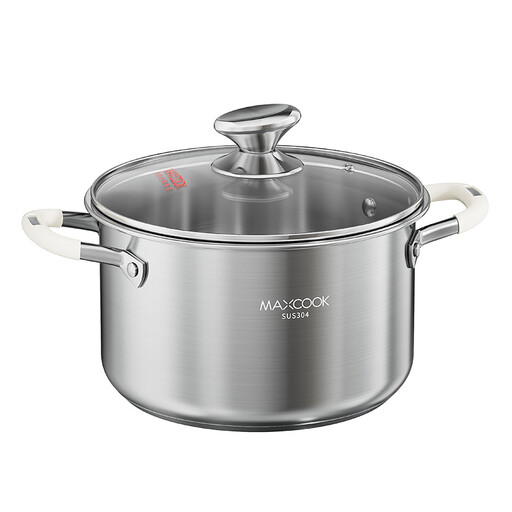
Why we love it: At 4.3L, it's the perfect versatile size for soups, pasta, or a family's slow-cooked meals. It meets all the criteria for reliable, fuss-free daily use.
Made from food-grade 304 stainless steel, its all-hob compatibility (including induction) is ensured by a purpose-built base. Safety bonus: the silicone handles prevent burns.
The perfect balance of capacity, safety features (glass lid, insulated handles), and reliable materials for the week's culinary marathon.
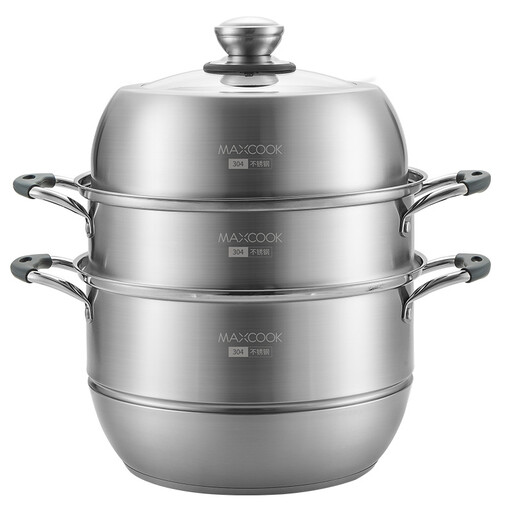
Why we love it: Much more than a pot, this multi-level stainless steel steamer is the perfect partner for preserving the nutrients in vegetables, fish, or dumplings. Its large volume makes it incredibly versatile.
No surprises here: the spec sheet is upfront, specifying 304 stainless steel and a thick composite base that guarantees even heating on induction hobs.
Its 3-in-1 versatility (stock pot, colander, steamer) lets you create a multitude of healthy recipes with a single piece of cookware. Smart and efficient.
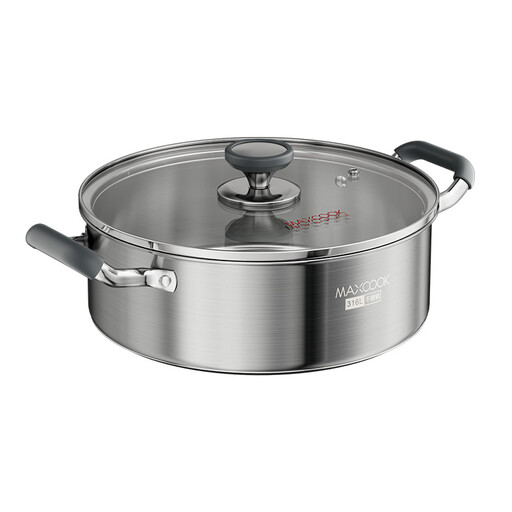
Why we love it: For those who see their cookware as a long-term investment. 316L steel is the best insurance against corrosion, even with intensive use and the most acidic or salty foods.
It stands out by clearly stating its use of 316L steel, a superior quality that is still all too rare. Its composite base ensures optimal performance on all hobs.
Unbeatable robustness and maximum longevity thanks to 316L steel, all in a generous 30 cm size with a smart design that maximises usable volume.
A simple lid can revolutionise how you cook and store your dishes. Discover our selection of accessories that are as practical as they are durable.
Stainless steel is tough, but not invincible. For white spots (limescale) or iridescent sheens (starch), a wipe with a cloth soaked in white vinegar or lemon juice is all it takes. To prevent yellowing, never overheat your pot while empty and prefer cooking over medium heat. Finally, always use soft sponges to preserve its shine.
Absolutely. Food-grade stainless steel (grades 304 and 316L) is renowned for its high stability. It is non-porous, does not react with foods (even acidic ones), and has no chemical coating that could degrade over time. It is one of the safest materials for cooking, rightly favoured in both professional and home kitchens.
A slight humming or a few clicks can indeed occur, especially at high power. This is a normal phenomenon, caused by the vibrations generated by the hob's magnetic field interacting with the different metal layers of the base. As long as the heating is uniform, there's no need to worry.