
Livraison le jour même ou le lendemain

Qualité garantie

Débloquez vos offres de bienvenue: Livraison GRATUITE | Jusqu'à -80 % | 30 jours d'essai gratuits à JoyPlus
Téléchargez l'application
A cookware set can look great on paper, only to show its limitations after a few weeks of use: an unevenly heating base, an uncomfortable handle, a lid that lets steam escape, or a food container whose seal eventually holds onto odours. To avoid unpleasant surprises, it’s best to look beyond the finish and the simple piece count.
Stainless steel kitchen utensils are perfectly suited to everyday use, provided you choose the right material, a sufficiently conductive base, and sizes that match your habits. Here are the key criteria to examine before buying a set of stainless steel pans, a frying pan, or storage containers.
The mention “stainless steel” isn’t always enough to determine the quality of the steel. The grades 304 and 316/316L are common in kitchen utensils:
A reliable product page should specify the main material, any associated materials — glass, silicone, polypropylene or coating — as well as the usage precautions.
Some models are covered with a paint or ceramic coating on the outside. This finish can make cleaning easier, but it doesn’t mean the interior surface is non-stick. With a stainless steel frying pan, you generally need to preheat the utensil properly, use a sufficient amount of fat, and avoid excessively high temperatures.
Utensils with a coating should also be cleaned with a soft sponge. Abrasive products, steel wool and thermal shock can damage their surface.
To work on an induction hob, a pan must have a suitable magnetic base. The mere presence of stainless steel isn’t enough: some stainless steels don’t react to a magnet. If you use several types of hob, check that the product page explicitly mentions compatibility with induction, gas, electric and ceramic hobs.
An encapsulated or multi-layer base helps distribute heat more evenly. This is particularly useful for delicate preparations such as sauces, milk, rice or vegetables. A composite base can also improve the stability of the utensil on the hob.
For a family, a stainless steel cookware set should offer several capacities: a small saucepan for individual portions, a medium saucepan or sauté pan for two to four people, and a larger stockpot for soups, pasta or family meals.
Indications in litres are often more telling than diameter alone:
A stockpot with a glass lid lets you monitor the boil without lifting the lid. For steaming, check that the steamer basket fits the diameter of the pan and can be removed easily.
A silicone handle or one made from an insulating material improves grip, but it can still become hot after prolonged cooking. The manufacturer’s recommendations should always take priority. As for the glass lid, it should be handled with care and never subjected to sudden thermal shock.
Before buying, also look for information about:
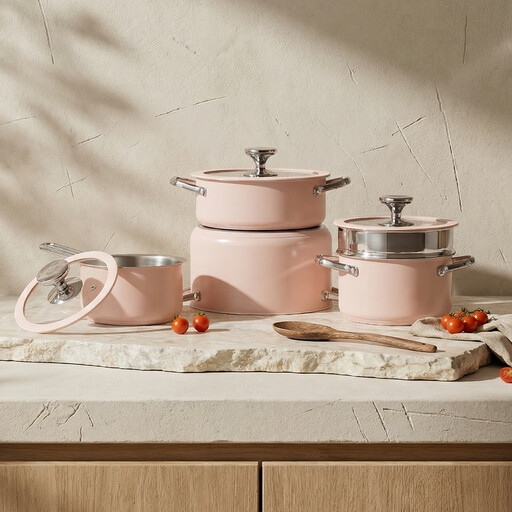
Why this choice suits this profile: This set brings together a 1.5 L milk pan, a 2 L steamer basket, a 2.5 L saucepan and a 5 L stockpot. Enough to cover everyday needs without buying each piece separately.
The capacities are clearly detailed and compatibility with different hob types, including induction, is stated. The exterior ceramic coating does, however, require the use of a soft sponge.
304 stainless steel interior, four sizes and glass lids with silicone. Hand washing is recommended to preserve the exterior finish.
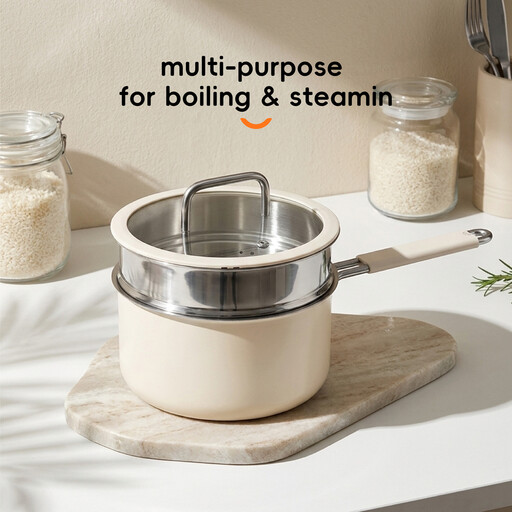
Why this choice suits this profile: Its 316 stainless steel interior, triply base and steamer basket are designed for precise cooking: milk, sauces, porridge and steamed vegetables.
The product page clearly distinguishes the interior material, the exterior coating, the glass lid and the silicone handle. This precision avoids confusing stainless steel with a non-stick coating.
Triply base, steamer basket included, silicone-wrapped handle and glass lid. Hand washing is recommended to protect the coating.
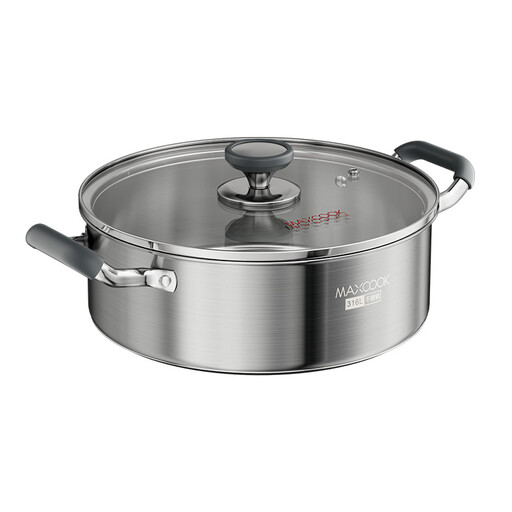
Why this choice suits this profile: With its large format, this stockpot is ideal for families and those who regularly prepare soups, stews or large quantities.
The product page specifies the diameter, 6.5 L capacity, composite base and compatibility with gas, induction, electric, ceramic and halogen hobs.
Glass lid, silicone handle and polished interior wall. Hand washing is recommended.
For storing meals, stainless steel food containers offer a durable alternative to more fragile options. The Maxcook MCFT4793 set offers three capacities — 600 ml, 1,100 ml and 2,200 ml — with lids, freezer compatibility and dishwasher washing, according to the product page. A compartmentalised stainless steel bento box will be more suitable for lunches, picnics and transporting separate portions. For hot meals, the Maxcook stainless steel food flask (1.5 L) uses vacuum insulation and claims to keep food hot for 4 to 6 hours. It is recommended to wash it by hand and to preheat or pre-cool it before filling.
We have compiled a comprehensive, real-time updated list of products that fully meet these strict selection criteria and European safety regulations.
Yes, provided it has a compatible magnetic base. Check the technical data sheet or look for the explicit mention “induction compatible”. A magnet can give you a first clue, but the manufacturer’s information remains essential.
These marks can be caused by mineral deposits, starch or overheating. Allow the utensil to cool, then apply a little white vinegar or lemon juice. Rinse and dry thoroughly. Avoid metal sponges and never pour cold water into a pan that is still very hot.
There is no universal lifespan: it all depends on the thickness of the material, the frequency of use, the heat applied and the care taken. A utensil without an interior coating is generally less prone to scratches, whereas a model with a ceramic finish requires more care. Before continuing to use it, regularly inspect the handles, lids, seals and any signs of warping.