
Livraison le jour même ou le lendemain

Qualité garantie

Débloquez vos offres de bienvenue: Livraison GRATUITE | Jusqu'à -80 % | 30 jours d'essai gratuits à JoyPlus
Téléchargez l'application
A scouring sponge for washing up needs to tackle grease, food residue and baked-on dirt without leaving scratches behind. The problem is that in shops and online, many models look similar yet offer completely different performance: classic sponges, dual-sided versions, non-scratch options, reinforced fibres or specific foams.
Price isn’t everything. A poorly chosen sponge can wear out in days, hold onto odours or damage a non-stick pan. Here are the criteria to check before you order, along with a selection suited to various everyday uses.
A firm abrasive side is handy on a saucepan or a baking dish. However, it isn’t necessarily suitable for glass, polished stainless steel, painted surfaces or non-stick coatings. As for the “non-scratch” claim, it’s worth taking with a pinch of caution: the result also depends on the material being cleaned, the pressure you apply and any debris trapped in the fibres.
On a delicate surface, check the manufacturer’s recommendations and test on an inconspicuous area first.
A durable sponge doesn’t necessarily keep its qualities throughout its entire lifespan. The fibres can flatten, the foam can lose its absorbency, or the different layers can eventually come apart. A claim like “twice as durable” or “four times as durable” is still just a product description promise – it doesn’t guarantee the same results in every household.
Rinsing, drying and frequency of use all play a key role in how long your sponge lasts.
A highly absorbent sponge that stays constantly damp can trap food particles and washing-up liquid residue. Even a washable model needs to be rinsed after every use, wrung out well, and then placed in a well-ventilated spot. Replace it as soon as it frays, loses its shape or develops a persistent smell.
For washing up, a dual-sided sponge is often more versatile than a single-texture model. The absorbent side is for spreading water and washing-up liquid, while the scouring side tackles the toughest grime.
If you regularly clean heavily encrusted dishes, a reinforced scouring sponge could be a good choice. For sensitive surfaces, choose a side labelled as non-scratch and follow any restrictions mentioned on the packaging.
Vegetable cellulose – made, depending on the product, from cotton, wood or linen fibres – absorbs water effectively and makes the final stages of cleaning easier. Synthetic foam can also hold liquids, but its texture, rinsing properties and drying time vary from product to product.
A sponge that rinses easily helps prevent grease building up in the fibres. That’s a detail worth noting if you do the washing up several times a day.
Some products can go in the machine at 40°C, while others can withstand temperatures up to 70°C. Always follow the manufacturer’s instructions: a sponge that’s machine-washable may not necessarily be dishwasher-safe or suitable for cleaning with diluted bleach.
Washing doesn’t mean you can skip regular replacement. For the Spontex models shown below, the product details generally recommend replacing them roughly every two months, depending on their condition.
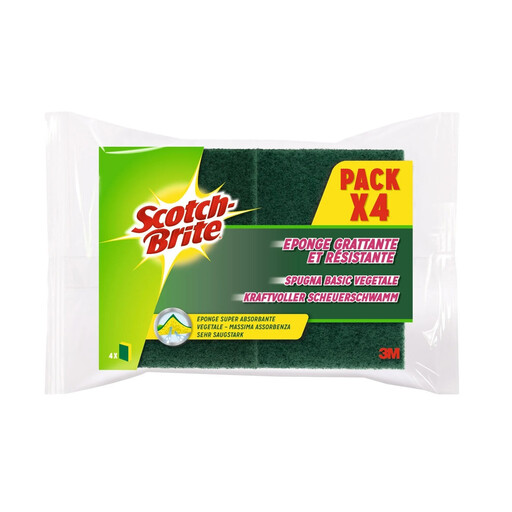
Why this choice suits this profile: its pack of four sponges is ideal for a first purchase or for stocking the kitchen with a model designed for washing up and non-delicate surfaces.
The separation between the green scouring side and the yellow sponge side makes each use clearer. The product details do state, however, not to use it on fragile or particularly scratch-sensitive surfaces.
A cellulose side described as absorbent, a clearly distinct scouring side, and a pack of four sponges.
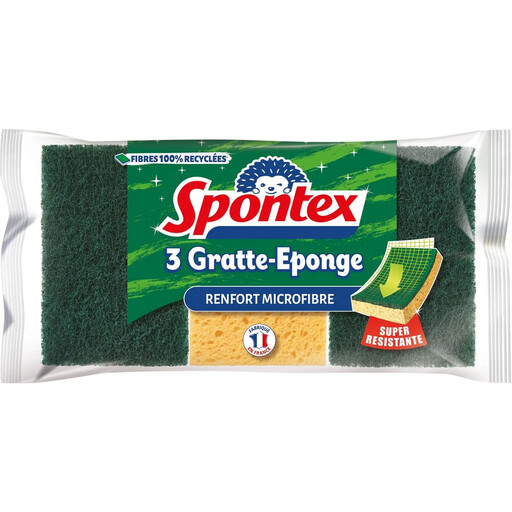
Why this choice suits this profile: the combination of a microfibre surface and a scouring side is ideal for those who want to separate wiping from tackling the toughest residue.
The product details recommend the microfibre for more sensitive surfaces and the scouring side for stubborn residue. A prior test is still advised.
A pack of three, an absorbent plant-based side, a reinforced scouring texture, and machine washing at 40°C.
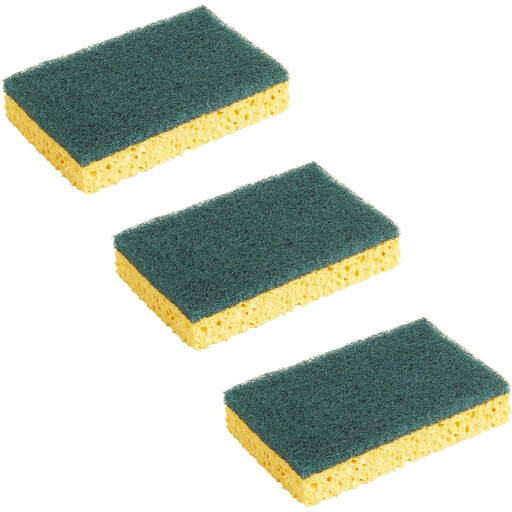
Why this choice suits this profile: this pack can suit a family or someone who frequently cleans washing up, worktops and various surfaces around the home.
The product details claim superior resistance compared to a standard all-purpose sponge and machine washing at 70°C. The scouring side is still not recommended for delicate surfaces.
A cellulose side described as absorbent, a pack of three sponges, high-temperature care, and a design intended for stubborn dirt.
We’ve compiled a complete, real-time updated selection of products that meet these strict criteria, while also complying with European safety regulations.
Choose a model whose product details explicitly allow this use, then test it on an inconspicuous area. Even a sponge described as non-scratch can become abrasive if hard particles get trapped in its fibres or if you press too hard.
It all depends on how often you use it, how well you rinse it and how you dry it. Many product details recommend replacing it roughly every two months, but it’s best to keep an eye on its condition and follow the instructions on the packaging.
Some models can be washed at 40°C, others at 70°C. Always check the instructions for your specific product. After washing, rinse it if needed and let it dry completely before using it again.