
Livraison le jour même ou le lendemain

Qualité garantie

Débloquez vos offres de bienvenue: Livraison GRATUITE | Jusqu'à -80 % | 30 jours d'essai gratuits à JoyPlus
Téléchargez l'application
Whether you're in the middle of a renovation, on a job site, or just a passionate DIYer, the reciprocating saw is an incredibly versatile tool. But all its power depends on one crucial element: the blade. Faced with an overwhelming selection, it's easy to fall into the trap of buying models that will fail after just a few cuts. This guide will help you understand the key criteria for choosing a high-performance, durable reciprocating saw blade set.
Marketing often highlights features that aren't always a guarantee of quality. Here are the most common mistakes that prove costly for DIYers and professionals alike.
To make an informed choice, focus on a few technical specifications that are true indicators of performance and longevity.
This is the number one criterion. It determines both the blade's strength and the materials it can effectively cut.
For most applications, a reciprocating saw blade kit composed mainly of Bi-Metal blades is the wisest investment.
The TPI (Teeth Per Inch), or number of teeth per inch, directly influences the speed and finish of the cut.
Nearly all modern reciprocating saws use a standard 1/2-inch shank, which has given rise to the term universal reciprocating saw blade. Ensure the manufacturer explicitly mentions compatibility with popular brands like Bosch, Dewalt, Makita, Ryobi, or Milwaukee. This guarantees a perfect fit, without play or vibration, for optimal power transmission from the tool.
Here are a few options that meet specific needs, taking into account quality and versatility criteria.
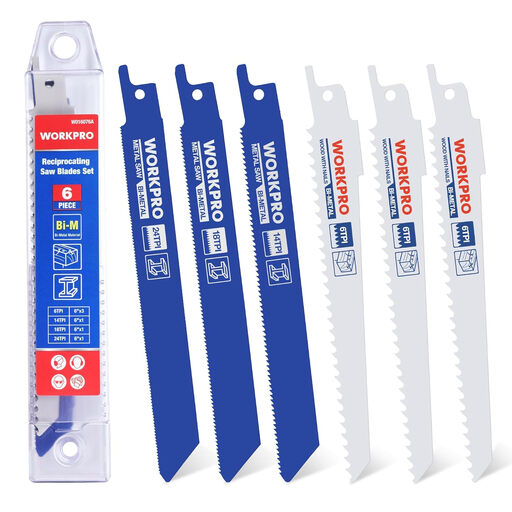
Why we chose it: Ideal for those with occasional needs who don't want to compromise on essential quality. This compact kit covers the most common applications (wood, metal, plastic) for small renovation or gardening jobs.
This kit focuses on Bi-Metal blades, thus avoiding the trap of overly fragile HCS blades that wear out at high speed on mixed materials like nail-embedded wood.
Its Bi-Metal construction ensures good durability and true wood/metal versatility. The included storage case is a nice bonus for protecting the blades.
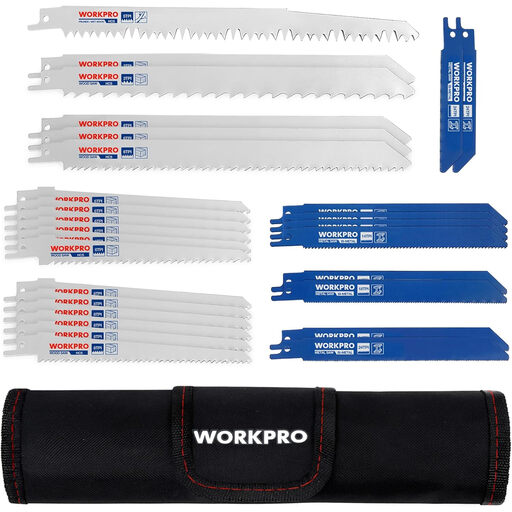
Why we chose it: For professionals or seasoned DIYers who juggle various job sites. This comprehensive assortment offers a solution for every situation: demolition, metal cutting, drywall, and even pruning.
It avoids the ‘do-it-all’ blade trap by providing an arsenal of specialised blades (varied materials and TPIs) for optimal performance in every application.
The assortment is extremely comprehensive, even including a dedicated pruning blade. Universal compatibility is clearly stated for major brands (Bosch, Dewalt, Makita), and the storage pouch makes it easy to transport on job sites.
We have compiled a complete and up-to-date selection of products that meet our strict selection criteria and current safety standards.
The lifespan depends on three factors: the blade material (Bi-Metal blades are more durable), the material you are cutting (metal wears out a blade much faster than softwood), and the pressure applied. Proper use, without forcing the tool, significantly extends the life of any blade.
In the vast majority of cases, yes. The 1/2-inch universal shank has become the industry standard, adopted by all major brands like Bosch, Dewalt, Makita, Ryobi, and many others. As a precaution, however, you should still check that the blade manufacturer explicitly mentions compatibility with your saw model to avoid any unpleasant surprises with the fit.
It's simple: