
Livraison le jour même ou le lendemain

Qualité garantie

Débloquez vos offres de bienvenue: Livraison GRATUITE | Jusqu'à -80 % | 30 jours d'essai gratuits à JoyPlus
Téléchargez l'application
Whether you're opening a package, starting a craft project, or equipping a warehouse, a good utility knife is an indispensable tool. Yet, with an overwhelming number of options on the market, finding a reliable model that won't let you down is no small feat. To help you avoid poor choices that turn a simple purchase into a source of frustration (or even danger), our editorial team has analysed the market to bring you some clarity.
Before you rush to buy the first model you see, watch out for these three common pitfalls?:
To avoid falling into these traps, simply keep an eye on a few key technical points. They are your guarantee of a durable, safe, and comfortable tool.
The 18mm width is a versatile standard, ideal for most common tasks, from cutting thick cardboard to hanging wallpaper. But width isn't everything.
A safety cutter worthy of the name must feature a rock-solid locking mechanism. The two most common systems are?:
Regardless of the system, it must prevent any blade wobble or movement during a cut.
The grip directly affects your comfort and the precision of your cuts. Dual-material handles, which combine a rigid ABS body with soft rubber (TPR) grip zones, are ideal: they offer excellent traction and absorb some of the vibrations. An ergonomic shape that fits the palm of your hand reduces fatigue during prolonged use.
Rather than an endless list, here is our selection of products that check all the boxes, tailored to specific user profiles.
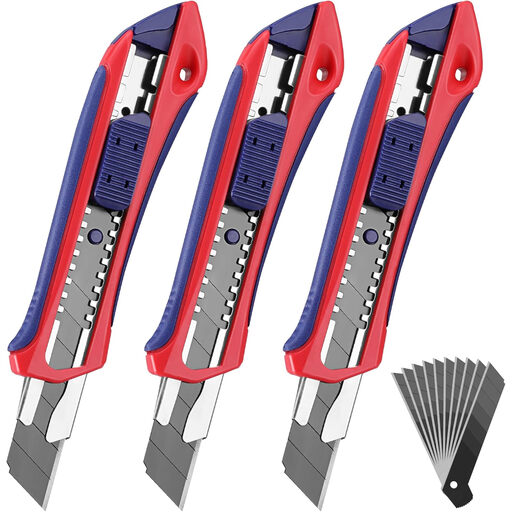
Why we chose it: Perfect for repetitive tasks in the warehouse, office, or for DIYers looking for the best value. This set of cutters ensures you always have a reliable tool on hand without breaking the bank.
The locking mechanism is reliable, and the ergonomic rubber handle reduces fatigue. The included SK5 blades put an end to the headache of low-end blades that dull or break at the first sign of pressure.
Delivered with 3 cutters and 10 18mm replacement blades, it's the complete, budget-friendly pack to get you fully equipped once and for all.
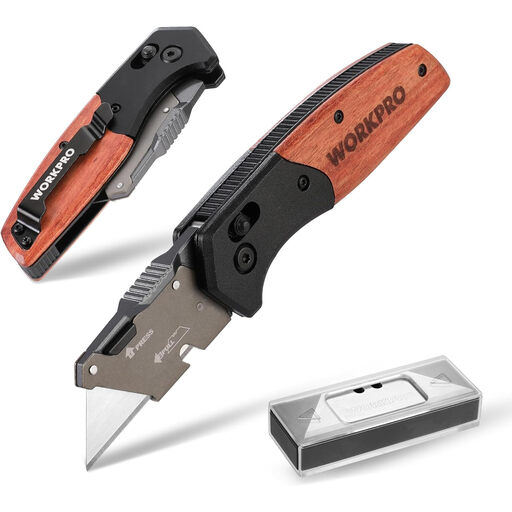
Why we chose it: The ideal tool for those who need a cutting knife that is both robust and portable, easy to slip into a pocket or clip onto a belt for various jobs (cutting lino, plasterboard, etc.).
Its "slide lock" system is designed for safety and one-handed operation. The tool-free blade change prevents risky handling and the loss of small parts.
Its compact, folding design with a belt clip. The blade change is ultra-fast and requires no tools.
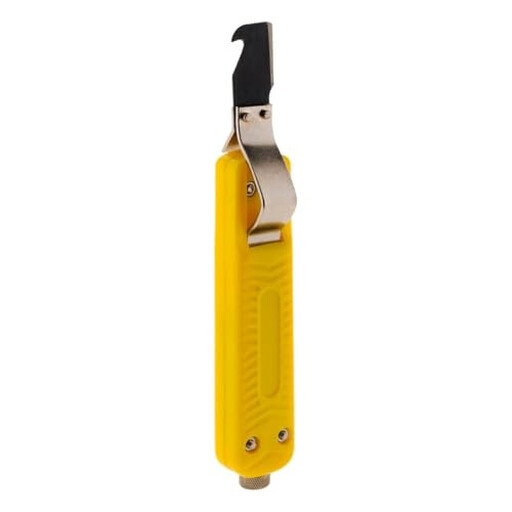
Why we chose it: Designed for electricians and installers, this specialised tool combines several functions for maximum efficiency and safety on the job site.
It single-handedly replaces several often-mediocre tools. Its cutting depth adjustment screw prevents damage to conductors—a very real risk with unsuitable tools.
A 3-in-1 tool (slitting, cutting, stripping) with adjustable cutting depth for high-precision work on electrical cables.
Our editorial team has selected a full range of products that meet our quality criteria and current safety standards.
Fully retract the old blade. Most cutters have a cap at the end that doubles as a blade snapper. Insert the tip of the blade into the designated slot, leaving only the worn segment exposed, then snap it off with a sharp, clean break, holding the tool away from your body. For a complete blade change, simply remove the locking slider, take out the old blade, and slide the new one into its guide. Always remember to dispose of used segments in a suitable container (an old tin can, for example).
It all depends on the material you are cutting. On abrasive materials like thick cardboard or plasterboard, you will likely need to snap off a segment after a few dozen metres of cutting. On the other hand, for paper or plastic film, the same segment can last a very long time. That's the main advantage of a snap-off blade: getting a perfect edge back in an instant.
Yes, an 18mm cutter with a new SK5 blade can certainly cut thin carpet or linoleum. For tougher materials, the trick is to extend the blade by only a few segments for maximum rigidity and to make several passes. However, for heavy-duty use on these types of materials, a trapezoid blade knife, which is even more rigid, would be a better choice.