
Livraison le jour même ou le lendemain

Qualité garantie

Débloquez vos offres de bienvenue: Livraison GRATUITE | Jusqu'à -80 % | 30 jours d'essai gratuits à JoyPlus
Téléchargez l'application
Buying printer consumables isn’t just about grabbing the cheapest box on the shelf. A poorly referenced cartridge, the wrong paper or a badly stored refill can leave you with dull prints, cause paper jams and push your costs up. For families, students, amateur photographers and fans of mini-printers, three common pitfalls keep cropping up.
Two Canon cartridges can have very similar names yet be designed for completely different PIXMA series. Always check the exact reference printed on the cartridge you’re replacing and in your printer’s manual.
The same caution applies to Epson ink cartridges. A 24XL reference, for example, is only compatible with certain Expression Photo models. The ink volume or the “XL” label alone isn’t enough to confirm compatibility.
The stated page yield is usually calculated according to the ISO/IEC 24711 standard, but actual output varies depending on what you print. A page full of colour will naturally use far more ink than a black-and-white letter.
To compare two options properly, look at the cost per page, the ink volume in millilitres and what’s actually in the pack. A three-in-one colour cartridge becomes unusable as soon as one colour runs out. With separate cartridges, you simply replace the empty colour.
Photo paper for printers must be suited to an inkjet printer. Its weight, size and finish directly affect how the ink is absorbed and the final result. On plain paper, a photo is likely to show less accurate colours and a wavy surface.
Thermal printers need a very specific medium. Self-adhesive thermal paper and refills for mini-printers are not interchangeable with standard photo paper.
Note the full make and model of your printer, then look up the corresponding consumable reference. With Canon, the PG and CL families aren’t universal. With Epson, the reference can change depending on the range and cartridge capacity.
Original ink cartridges are designed to work with your printer’s settings. They’re usually recognised without any fuss, but their price needs to be weighed against the stated yield. A compatible cartridge can also do the job, as long as you check its reference, the returns policy and the safety information.
Pigment ink is often preferred for black text, while dye-based inks are common for images and photos. However, this distinction alone won’t predict the final quality – the paper and your print settings also play a big part.
As a guide, the Canon PG‑540L + CL‑541XL pack claims around 300 pages in black and 400 pages in colour under the ISO/IEC 24711 standard. The PG‑585 + CL‑586 pack, meanwhile, offers around 180 pages per cartridge. These figures are useful benchmarks, not a guarantee for every type of use.
Before buying photo cartridges, check the sizes your printer accepts and the recommended media type in its software. The 10 × 15 cm format works for most family prints. Self-adhesive paper is more practical for collages, labels and creative projects.
Store cartridges and paper in a dry place at a moderate temperature, away from direct light. With thermal consumables, be especially careful to avoid high heat, which can damage their sensitive surface.
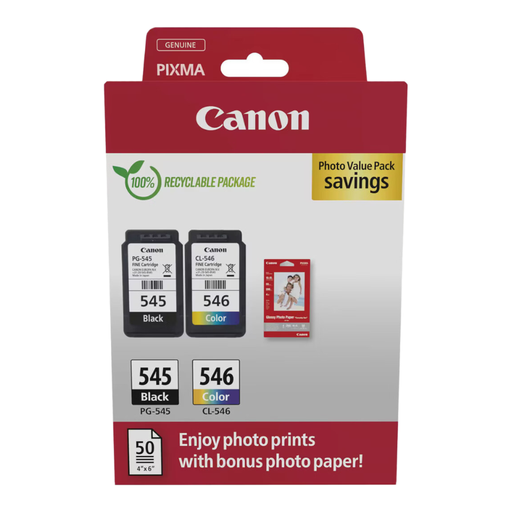
Why this choice suits this profile: This kit brings together a black cartridge, a colour cartridge and 50 sheets of 10 × 15 cm photo paper. A handy solution for restocking your Canon PIXMA consumables in one order – just make sure you check your exact printer model first.
The PG-545L/CL-546 reference and the paper size are clearly stated. You still need to confirm compatibility with your PIXMA before buying.
A pack with 50 sheets in 10 × 15 cm format and Canon PG-545L/CL-546 cartridges.
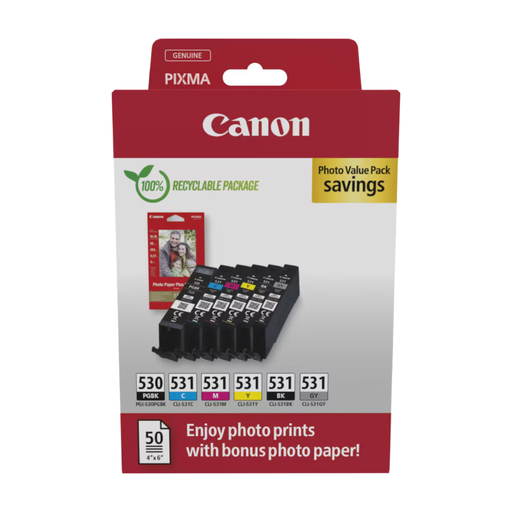
Why this choice suits this profile: With six colours including a pigment black, a photo black and a grey, this system is aimed at users of certain Canon PIXMA PRO models who want detailed photos and more subtle monochrome gradients.
All six references are listed separately. That helps you avoid mistaking a multi-colour photo cartridge set for a standard Canon pack.
Six individual cartridges, including a grey ink and two blacks, with Canon photo paper included depending on the product listing.
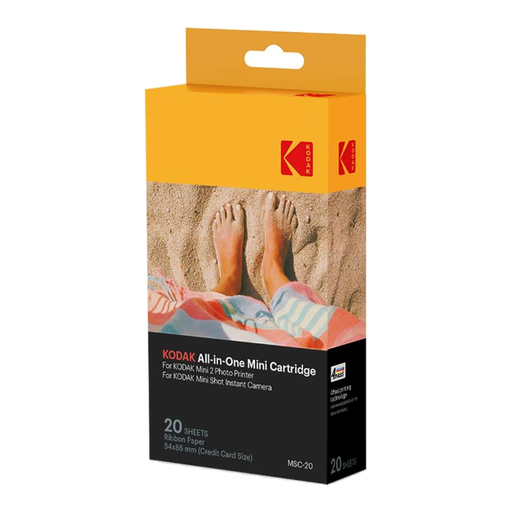
Why this choice suits this profile: This thermal refill is designed for owners of a Kodak Mini 2, Mini 2 Plus, Mini 2 Retro or Mini Shot 2 who print small photos regularly.
The 54 × 86 mm size, 4Pass technology and compatibility with four Kodak devices are clearly stated. This refill must not be used with any other mini-printer.
Each cartridge delivers 20 prints and includes a protective layer claimed to resist water, fingerprints and UV light.
We’ve put together a full, real-time selection of products that meet these demanding criteria and comply with European safety regulations.
Consumables aren’t limited to cartridges. For a 3D printer, the 3D printer filament must be suited to the nozzle temperature, the build plate and the diameter your machine accepts. PLA is generally recommended for beginners, while ABS, PETG and reinforced filaments need specific settings and a suitable environment.
3D printer resin requires even more care: wear nitrile gloves and safety glasses, ensure good ventilation and handle the washing water properly. Anycubic 405 nm water-washable resin must be stirred before use, and any waste must be cured before disposal. Never pour the washing water directly down the drain.
Among other printing accessories, think about build plates, nozzles, cables, removal tools and airtight storage solutions. For a Phomemo mini-printer, check the roll width and exact model before choosing a self-adhesive paper.
It depends on its expiry date, the condition of its packaging and the storage conditions. Keep it in its original packaging, away from heat and sunlight. After opening, follow the manufacturer’s recommendations and avoid leaving your printer unused for long periods.
Compare the stated yield under the ISO/IEC 24711 standard, use draft mode for everyday documents and choose the right paper for each job. For photos, a pack that combines ink and paper can also save you from buying them separately, which can sometimes work out more expensive.
No. Thermal formats, sublimation ribbons and self-adhesive rolls vary by brand and model. Before ordering, always check the reference, the media width and the stated number of prints.