
Livraison le jour même ou le lendemain

Qualité garantie

Débloquez vos offres de bienvenue: Livraison GRATUITE | Jusqu'à -80 % | 30 jours d'essai gratuits à JoyPlus
Téléchargez l'application
The tire pressure warning light on your dashboard? It's a scenario every driver dreads. And if there's no service station in sight, the simplest solution is often to have your own portable air compressor. The problem: the market is saturated with models making tempting promises that often turn out to be costly disappointments. Before you buy, it's crucial to know how to avoid the most common pitfalls.
As the head of product recommendations at Joybuy, my mission is to help you make an informed decision. Here are the three main pitfalls to avoid:
To ensure you invest in a reliable and suitable device, it's best to focus on concrete technical specifications rather than marketing claims.
This is the first question to ask yourself, as it determines everything else.
Almost all portable compressors advertise a maximum pressure of around 150 PSI (about 10.3 bar), which far exceeds the needs of a car tire (typically 2.5 bar). The figure that truly makes a difference in speed is the air flow rate, measured in litres per minute (L/min).
Beyond raw power, certain features can turn a chore into a simple, stress-free task.
To help you see how these criteria apply in practice, here are a few models that cater to specific user profiles.
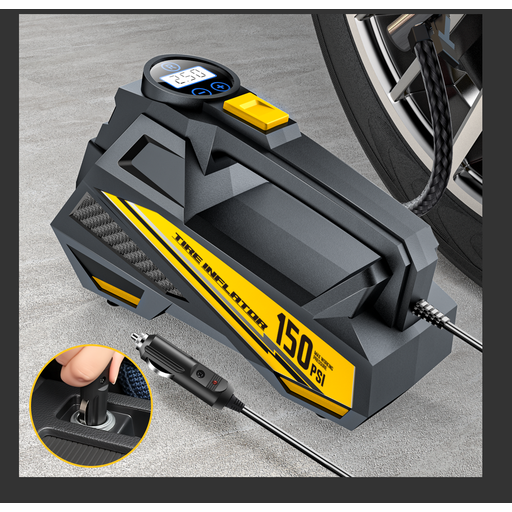
Why it's a great choice: Perfect for those who want a simple, reliable solution to keep in the trunk for emergencies. No battery to charge: just plug it into the 12V socket, and it's ready to go.
This corded model completely eliminates the risk of finding yourself with a dead battery at the worst possible moment. Its reliability depends solely on your car's battery.
A continuous power supply and incredible simplicity. It's the ultimate functional tool that gets the job done with no frills.
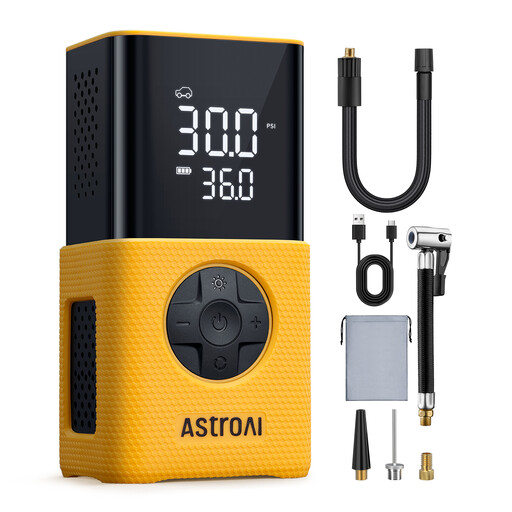
Why it's a great choice: It combines the freedom of a cordless design with solid performance for regular use. Its 4000 mAh battery and compact size make it an ideal travel companion for frequent pressure top-ups.
The manufacturer highlights its reliable pressure sensors and an air flow rate of 17 L/min, which is sufficient for a quick top-up (going from 30 to 36 PSI in 1.5 minutes, according to the brand). This counters the problems of slow performance and unreliable gauges.
The right balance between portability, battery life, and speed. The bonus features (LED light, power bank) make it even more versatile.
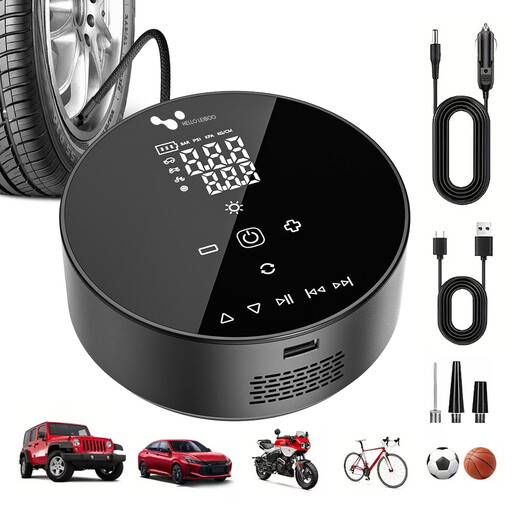
Why it's a great choice: Its dual power supply (4500 mAh battery AND 12V socket) and 4-in-1 functions (inflator, Bluetooth speaker, power bank, light) make it the ultimate Swiss Army knife for travel, camping, or managing multiple vehicles and pieces of equipment.
The dual power supply is the ultimate safety net. Even if you forget to charge the battery, the car's 12V socket takes over. This eliminates the main weakness of 100% cordless models.
Maximum versatility and reliability. Thanks to its dual power supply and multiple functions, it's the true Swiss Army knife for the road.
We have compiled a complete and up-to-date list of products that meet our strict selection criteria and current safety standards.
The lifespan of a battery-powered air compressor primarily depends on the maintenance of its lithium-ion battery. To preserve its performance, it's advisable to recharge it at least once every three months, even when not in use. Also, avoid leaving it in a car in direct sunlight or in freezing weather, as extreme temperatures can permanently damage the battery.
Absolutely. A 12V mini compressor draws its power directly from the vehicle's battery. If used for too long with the engine off, it can drain the battery to the point where you can't restart the car. That's why it is strongly recommended to always keep the engine running during inflation.
Yes, most quality portable compressors can reinflate a flat tire, but the process will take much longer than a simple top-up. For a standard car tire, expect it to take between 7 and 15 minutes, depending on the compressor's air flow rate. However, be aware: a flat tire is often a sign of a puncture. The compressor will allow you to get to the nearest garage, but it will not seal the leak.