
Livraison le jour même ou le lendemain

Qualité garantie

Débloquez vos offres de bienvenue: Livraison GRATUITE | Jusqu'à -80 % | 30 jours d'essai gratuits à JoyPlus
Téléchargez l'application
The tyre pressure light flashing on your dashboard? It's a familiar dread for any driver. Fortunately, having a portable air compressor on hand turns this potential nightmare into a minor inconvenience. The problem is, the market is flooded with models making tempting promises that often fall short. Before you buy, it's crucial to know how to navigate the marketing traps so you don't end up with a device that fails you when you need it most.
As the head of product selection at Joybuy, my mission is to help you see things more clearly. Here are the key things to watch out for and the criteria you should never overlook when choosing a reliable compressor that's truly right for your needs.
Certain features, often highlighted by manufacturers, can actually hide deal-breaking flaws.
To make the right choice, focus on the objective data that defines the real-world performance of a mini air compressor.
Maximum pressure, expressed in PSI (Pounds per Square Inch) or Bar, indicates the compressor's ability to reach high pressure levels. Most models go up to 150 PSI (about 10.3 Bar), which is more than enough for car, motorcycle, and bicycle tyres.
However, inflation speed primarily depends on airflow, measured in litres per minute (L/min). The higher the airflow, the faster your tyre will inflate. For a car tyre inflator, an airflow of at least 20 L/min is recommended to avoid a lengthy wait.
The choice of power source is critical and depends on your intended use.
Beyond raw performance, certain options significantly improve the user experience:
Rather than an endless list, we've selected models that meet specific needs, keeping in mind the reliability criteria we've just discussed.
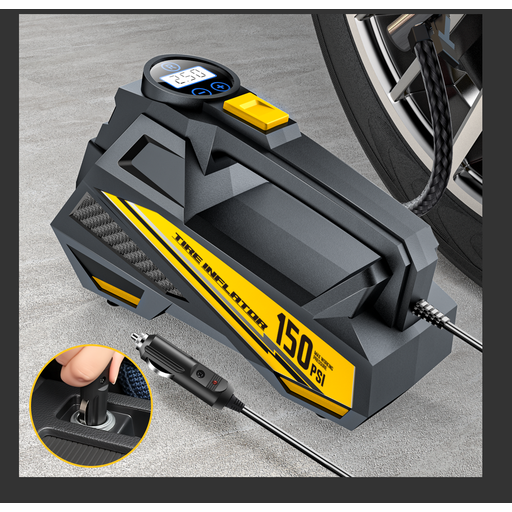
Why we recommend it: The simple, always-ready solution to keep in your glove box or boot. Ideal for emergencies, without ever worrying if the battery is charged.
As a 12V compressor, it completely eliminates the problem of overstated battery life. It delivers consistent power as long as it's plugged into your vehicle.
The reliability of its corded power supply. Its simple, robust design is built to last and be there when you need it.
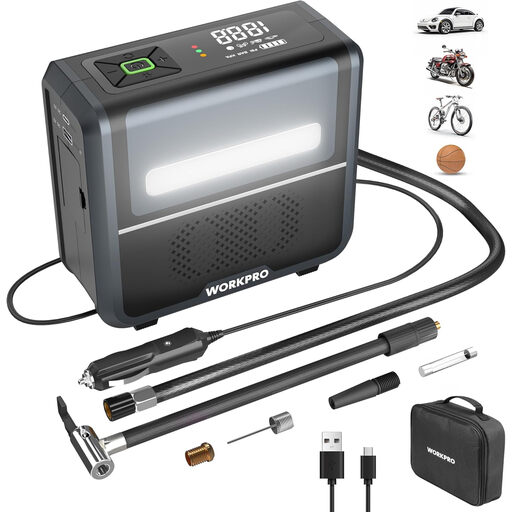
Why we recommend it: Perfect for daily use, whether for your commute or weekend getaways. Its dual power source offers total flexibility, while its extra features make it a true multi-tool.
Its dual power supply (3x2500mAh battery + 12V cable) protects you from running out of juice: you'll never be stuck with a dead battery-powered tyre pump.
Its versatility. A dual power supply, preset smart modes, and 3-in-1 functionality (inflator, light, power bank) make it an excellent ally.

Why we recommend it: For those who prioritise performance above all. Its high inflation speed and extra-large capacity battery (7500mAh) make it a powerful tool for quick top-ups and full inflations, even on large tyres.
It tackles the problems of slow speed and poor battery life head-on. Its 35 L/min airflow and 7500 mAh battery are solid specs that guarantee real, long-lasting performance.
Speed and endurance. The extra-large LED screen and smart modes make it both simple and precise to use.
These compressors are also very practical for leisure activities. If you need to inflate sports balls, pool floats, or air mattresses, we have a dedicated selection.
1. What is the lifespan of a portable air compressor? Its longevity depends on its build quality and how you use it. To preserve it, avoid running it for more than 10-15 minutes continuously to prevent overheating, and let it cool down between tyres. For battery-powered models, keeping the charge level between 20% and 80% and avoiding extreme temperatures during storage will help extend the battery's life.
2. Can a 12V compressor drain my car battery? The risk is minimal. A single tyre inflation cycle consumes very little energy. For complete peace of mind, it's recommended to leave your car's engine running while you use the compressor. The alternator will then compensate for the energy consumption, and the battery will not drain.
3. How do I choose the right pressure (PSI/Bar) for my tyres? Above all, do not rely on the compressor's default settings or the maximum pressure written on the tyre's sidewall. The only pressure that matters is the one recommended by your vehicle's manufacturer. You can find it on a sticker inside the driver's door jamb, in the fuel filler flap, or in the owner's manual. Adhering to this pressure is a guarantee of safety, as well as a way to ensure even tyre wear and optimise your fuel consumption.