
Livraison le jour même ou le lendemain

Qualité garantie

Débloquez vos offres de bienvenue: Livraison GRATUITE | Jusqu'à -80 % | 30 jours d'essai gratuits à JoyPlus
Téléchargez l'application
A flat tyre on the side of the road, a stubborn air mattress in the middle of a camping trip... These are hassles that can be avoided with the right equipment. The electric air pump market is vast, ranging from simple gadgets to semi-professional tools. Faced with so many options, it's easy to make the wrong choice. This guide breaks down the essential criteria for finding the perfect device for your needs and helps you sidestep the most common marketing traps.
Before you even start comparing spec sheets, it's crucial to avoid two classic mistakes that lead straight to buyer's remorse.
To make the right choice, focus on these key parameters. They will determine the efficiency and versatility of your future device.
Pressure is the force with which air is expelled. It's crucial for objects that require a certain rigidity.
Your choice will primarily depend on your habits and the main place of use.
The practicality of an electric inflator also comes down to its size and included equipment. A compact model will easily fit into a car boot or a cupboard. Check that it comes with a varied set of nozzles (Presta and Schrader valves, needle for balls, etc.) to cover all your needs. The presence of a built-in pressure gauge, whether digital or analogue, is a real plus for precise inflation.
To help you find the right fit, here is our selection of three models, each tailored for a specific user profile.
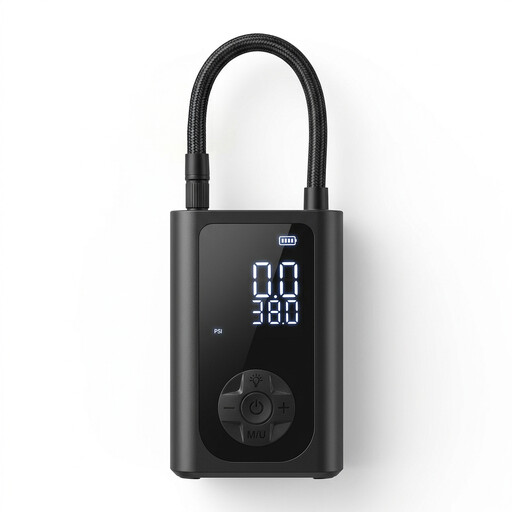
Why it fits the profile: Compact and self-contained with its 4000 mAh battery, it fits right in the glove box. Designed for high pressure (up to 150 PSI), it features preset modes (car, motorbike, bicycle) that simplify top-ups and ensure the correct pressure in any situation.
It's a pure high-pressure compressor, which eliminates any confusion with a mattress pump. Its battery operation completely frees it from the constraint of a cigarette lighter cable.
Its battery-powered autonomy and smart inflation modes with automatic shut-off once the target pressure is reached.
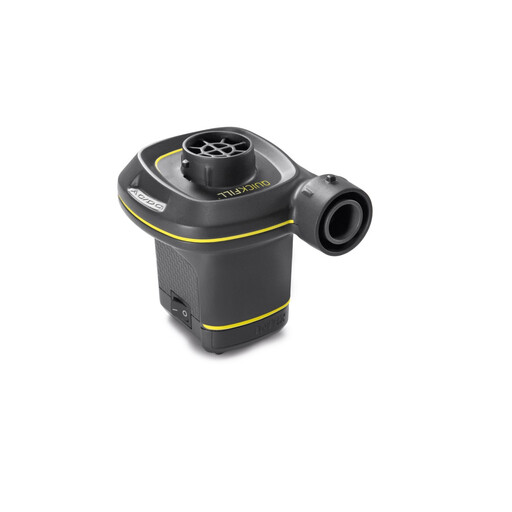
Why it fits the profile: It's the perfect solution for all leisure items. Its dual power supply (230V mains and 12V cigarette lighter) allows it to be used at home for a guest mattress, as well as at the campsite or the beach.
Its dual power supply immediately solves the power source puzzle. As a high-airflow specialist, it doesn't pretend to inflate tyres, which clarifies its role and prevents mistakes.
Its extreme versatility thanks to the dual power supply (mains and cigarette lighter) and its very practical deflation function.
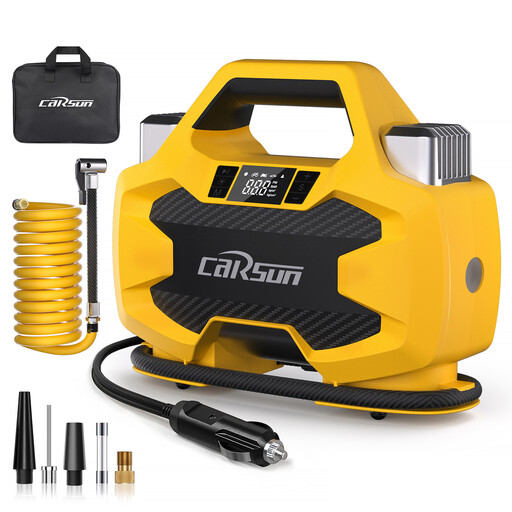
Why it fits the profile: The tyres on SUVs, 4x4s, and camper vans are larger and require more power. This dual-cylinder model is specifically designed to provide the power and airflow needed to inflate these large tyres much faster than a standard compressor.
It directly addresses the problem of standard compressors, which are often undersized and take too long or overheat on large tyres. Its robust design is built for heavy-duty use.
Its superior inflation power, thanks to its dual-cylinder design, which significantly reduces waiting time for high-volume tyres.
None of these models quite right for you? Have a more specific need? Other types of pumps, such as diaphragm models, could be the solution.
What's the difference between a tyre compressor and a mattress pump? It's all about pressure versus airflow. A tyre compressor generates very high pressure (in bars or PSI) to force air into a rigid structure, but with a relatively low airflow. A mattress pump, conversely, pushes a large volume of air at very low pressure to quickly fill a large space. Trying to swap their roles is ineffective at best, and at worst, an excellent way to damage your device.
Is a battery-powered inflator powerful enough for a car tyre? Absolutely. Many modern battery-powered mini compressors are perfectly capable of inflating a car tyre. They can easily reach pressures of 150?PSI (over 10 bars), which is more than enough for any passenger vehicle. Their only limitation is battery life: they are perfect for topping up or re-inflating a single flat tyre, but will struggle to do all four of the vehicle's tyres on a single charge.
How long does it take to inflate a tyre with a portable compressor? This depends heavily on the compressor's power and the tyre's size. For a standard car tyre, topping up the pressure (e.g., going from 2.0 to 2.4 bars) takes only 30 seconds to 2 minutes. Re-inflating a completely flat tyre can take between 5 and 10 minutes with a good portable air compressor. More robust models, like dual-cylinder ones, can cut this time in half.