
Livraison le jour même ou le lendemain

Qualité garantie

Débloquez vos offres de bienvenue: Livraison GRATUITE | Jusqu'à -80 % | 30 jours d'essai gratuits à JoyPlus
Téléchargez l'application
The organic-shaped mirror has become the new statement piece in our homes. With its fluid lines and nature-inspired silhouette, it brings a soft, modern touch, whether placed in an entryway, living room, or bedroom. But be warned: behind its aesthetic appeal lie pitfalls that can turn an impulse buy into a costly disappointment.
As the Head of Product Recommendations at Joybuy, I'm here to help you make an informed decision. Follow this guide to avoid the common traps and identify the criteria that truly matter before you bring home your future asymmetrical mirror.
Enthusiasm for a beautiful shape can quickly make you forget the essentials. Here are three common flaws that compromise a mirror's quality and durability.
To be confident in your investment, focus on a few objective technical points. These are the true indicators of a well-made and durable product.
A clear, distortion-free reflection depends directly on the mirror's rigidity.
The edge treatment of a free-form mirror is an excellent indicator of its manufacturing quality.
Good design should also be practical. Check if the mirror can be installed in multiple orientations (both vertically and horizontally). This flexibility is a real bonus for adapting it to your space, whether it's above a console table, a sofa, or on its own on a large wall. A multiple-hanger system is a sign of thoughtful design.
To move from theory to practice, here are models that perfectly illustrate these criteria and meet different needs.
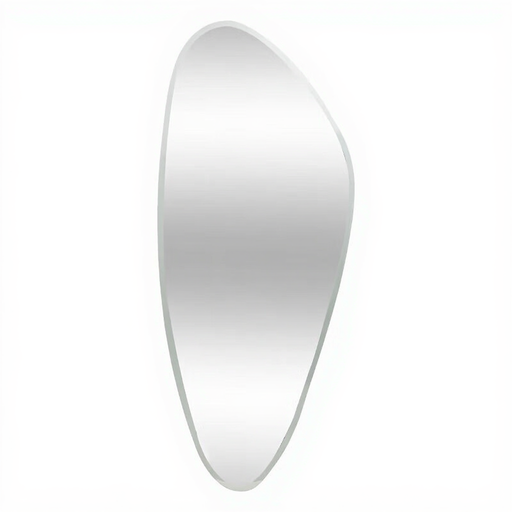
Why we love it: Perfect for dressing up a large wall and creating a dramatic focal point. Its generous dimensions and elongated shape make it the ideal piece for an entryway, hallway, or for vertical installation in a bedroom.
With its 4 mm glass and 6 mm MDF panel, it ensures a flawless reflection. The bevelled edge finish is a hallmark of quality and safety, a far cry from the "sharp" feel of low-end models.
Its ability to be mounted in all four directions offers complete layout freedom. Its weight of 8.3 kg remains reasonable for its size, making installation safe and easy.
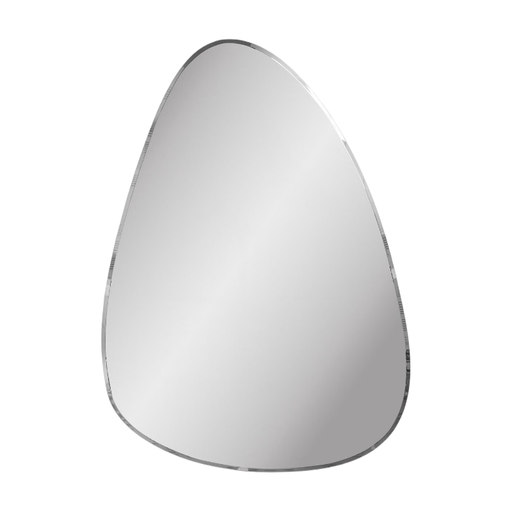
Why we love it: Ideal for those who appreciate details that make a difference. Its versatile size (70x100 cm) fits many spaces, and its faceted edge design adds a sculptural touch without overwhelming the decor.
The faceted edge is a premium finish that eliminates any risk of cuts and adds real aesthetic value. Its frameless design integrates smoothly, while the quality of the glass guarantees a perfect reflection.
Its "folded-plane" (or faceted) design creates unique plays of light that bring the wall to life. The option to mount it vertically or horizontally makes it highly versatile for a living room or bedroom.
If these models aren't exactly what you're looking for, or if you want to explore other types of wall mirrors, discover our complete selection of products, all approved according to our quality criteria.
Safety is paramount. First, identify the type of wall (drywall, brick, concrete...). For a drywall wall, use hollow-wall anchors (like Molly bolts), designed for heavy loads. For a load-bearing wall of concrete or brick, standard wall plugs will suffice. Always check the mirror's weight and the maximum load supported by your anchors. And of course, use a spirit level for perfect alignment!
Not necessarily. A mirror's sturdiness depends less on its frame and more on the glass thickness and edge finish. A frameless mirror with thick glass (4?mm or more) and polished or bevelled edges is perfectly robust and safe. On quality mirrors, the frame serves more of an aesthetic purpose than a structural one.
Like any mirror, an asymmetrical mirror enlarges a space by reflecting light and creating an illusion of depth. Its unconventional shape has an added benefit: it draws the eye and guides it along its curves. A wall immediately becomes less static, with a sense of movement and openness. Placed strategically opposite a window or light source, it will dramatically boost the room's brightness.