
Livraison le jour même ou le lendemain

Qualité garantie

Débloquez vos offres de bienvenue: Livraison GRATUITE | Jusqu'à -80 % | 30 jours d'essai gratuits à JoyPlus
Téléchargez l'application
By the Joybuy Product Recommendation Team, August 26, 2026
Want to put up a shelf, hang a picture frame, or mount a baseboard without pulling out the drill and its endless array of bits? No-drill mounting adhesive is the game-changing solution for a clean, fast, and dust-free installation. But be careful: faced with packaging that screams "extra-strong" or "instant grab," it's easy to make a mistake. And your project could come crashing down... literally.
To avoid getting duped, here are the most common pitfalls to avoid:
For a bond that actually holds up, you need to master a few key concepts.
Choosing the right adhesive is, first and foremost, a matter of common sense and analysing your project. Here are the three essential points to validate before you check out.
This is THE number one criterion, yet it's the one most often overlooked. The material of your wall and the object you're mounting will dictate the type of adhesive to use.
Verifying this compatibility is the foundation of a drill-free wall mounting solution that won't let you down.
Don't be fooled by the "heavy-duty" label. You need to distinguish between two concepts:
For a shelf that will hold your comic book collection, final strength is paramount. For a simple tea towel hook, a good instant grab will do the trick.
Don't expect a standard indoor adhesive to survive the rigours of a bathroom or a patio.
To help you see things more clearly, here is our selection of products for different types of DIYers, taking into account the criteria we've just covered.
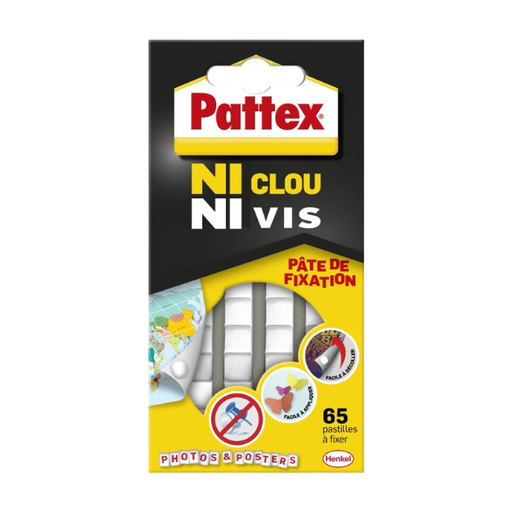
User profile: Perfect for renters or anyone who loves to change their decor on a whim. It allows you to mount very light objects (posters, photos, string lights) commitment-free and, most importantly, without leaving a trace.
This adhesive putty is non-permanent by nature. It perfectly solves the problem of using an overkill adhesive for a temporary job, saving you from a meltdown when it's time to remove everything.
Repositionable and removable without leaving residue. The 65 pre-cut pads are ready to use and incredibly simple.
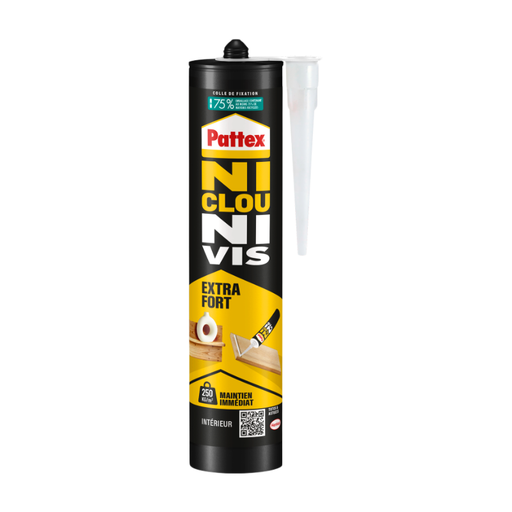
User profile: This is the go-to product for common indoor mounting jobs: baseboards, wood trim, small shelves, electrical conduits... Its sealant-like consistency can even fill minor wall imperfections.
Its spec sheet is crystal clear: for indoor use and requires at least one porous surface. No false promises of versatility; the product precisely meets the most common need: mounting on standard walls (drywall, plaster, brick).
Its solvent-free formula offers a high initial grab that simplifies installation. The result is a strong and durable bond for medium loads indoors.
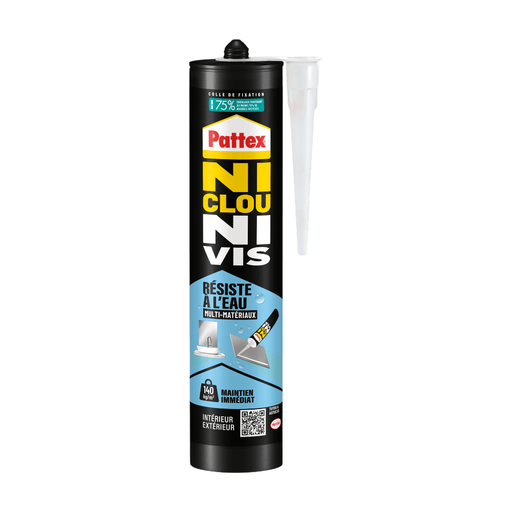
User profile: For those looking for a foolproof solution. Ideal for mounting accessories in the shower, a letterbox outdoors, or for bonding two non-porous materials together.
This product doesn't just make a vague promise: it details its superpowers. It's resistant to water, UV rays, and extreme temperatures. Its polymer technology (Flextec) allows it to tackle almost any material, including non-porous ones.
Its indoor/outdoor versatility and water resistance are its greatest strengths. The 10-minute window to reposition the object is a highly appreciated convenience during installation.
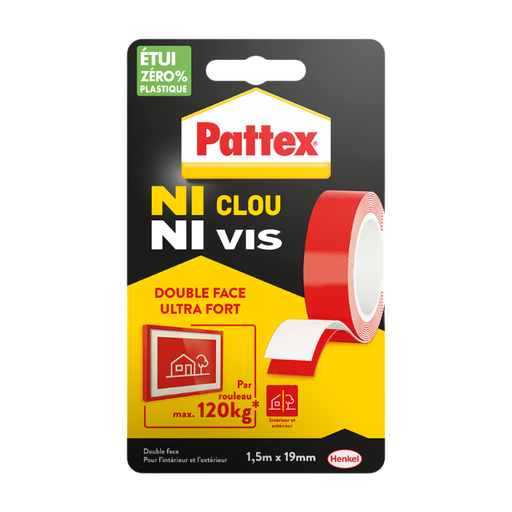
User profile: The perfect alternative to screws for anyone who doesn't want to bother with a cartridge gun. Ideal for mounting flat objects (mirrors, small pictures, bathroom accessories) with a truly instant hold.
This adhesive tape ends the debate between instant grab and final strength: here, the two are (almost) one and the same. The hold is truly instant, and the load capacity (up to 120 kg per roll, under optimal conditions) is clearly stated.
An ultra-simple, clean, and fast application. Its versatility on numerous surfaces (glass, metal, plastic) and its indoor/outdoor use make it a Swiss Army knife of mounting.
Beyond walls, modern adhesives also tackle larger projects, like installing floor coverings. If your work extends to the floor, be aware that specific adhesives exist to ensure a perfect and lasting hold.
We have selected a complete range of products that meet demanding selection criteria and current standards.
It all depends on the product. A sealant adhesive generally reaches its maximum strength after 24 to 48 hours. It is imperative that you read the manufacturer's instructions. Even if the initial grab is good, never apply a load to the mounted object (by placing weight on it, for example) before it is fully cured.
This is a very bad idea. Most mounting adhesives are far too aggressive and are likely to tear the wallpaper, or even a piece of plaster along with it. Furthermore, wallpaper is not a stable surface for a load, even a light one. To mount an object on a wallpapered wall, the best solution is to cleanly cut away the wallpaper at the mounting point to adhere directly to the wall, or to use a removable adhesive putty for very light objects.
For permanent adhesives, the operation is tricky. You often need to soften the adhesive (with a heat gun on a low setting or a specific solvent) before scraping it off with a spatula. Touch-ups with filler and paint are almost inevitable. For removable putties or tapes, you can usually just peel them off or roll them back on themselves. This is why it's so important to choose your product carefully beforehand, based on the desired duration of the mounting.