People avoiding added sugars
You want to choose a recipe with no added sugar while comparing the total sugars listed per 100 g. Anses points out that ‘no added sugars’ does not mean ‘sugar-free’.


When choosing a pasta sauce with sugar content as a priority, compare the ‘of which sugars’ value per 100 g across products for the same use, rather than relying solely on the ‘no added sugars’ claim. This tells you about the recipe, but tomatoes naturally contain sugars. Also check the salt, ingredients, pack size and storage instructions.
You want to choose a recipe with no added sugar while comparing the total sugars listed per 100 g. Anses points out that ‘no added sugars’ does not mean ‘sugar-free’.
You don’t want your search for a sauce with no added sugars to make you overlook the ‘salt’ line. Anses lists sauces and condiments among dietary sources of sodium.
You’re looking for a quantity that suits your meals and checking the instructions for after opening. If you’re shopping in store or using a collection service, also check that the product you’ve chosen is available.
Start by clarifying your goal: avoiding added sugar or comparing total sugar content. A ready-made sauce and a tomato purée to season yourself serve different purposes, too. For each one, check the nutritional information per 100 g.
| Criterion | What to check | Consumers concerned |
|---|---|---|
| Sugars | Compare ‘of which sugars’ per 100 g across sauces for the same use; distinguish this value from the ‘no added sugars’ claim. | I want to avoid mistaking a recipe with no added sugar for one with the lowest total sugar content. Around 50% of consumers prioritise this distinction. |
| Salt | Read the ‘salt’ line per 100 g alongside ‘of which sugars’, without assuming one tells you about the other. | Even when comparing sugars, I don’t want to overlook the amount of salt in the sauce. Around 30% of consumers give this dual check top priority. |
| Pack size and use | Check the quantity, instructions for after opening and availability at your chosen store or collection point. | When meals are spread out, I prefer a container whose contents I can use according to the storage instructions, without relying on a product that might be unavailable. Convenience is the priority for around 20% of consumers. |
To compare the first two lines in practice, Auchan’s product page for an Italians Do It Better Pomodoro sauce labelled ‘no added sugars’ lists 2,9 g of sugars and 0,98 g of salt per 100 g. These values apply to this particular product; they are not a benchmark for all sauces.
This claim doesn’t rule out sugars that occur naturally in the ingredients, particularly tomatoes. On its own, it therefore can’t rank sauces by their total sugar content.
Compare the ‘of which sugars’ value per 100 g across sauces intended for the same use.
A recipe with no added sugars isn’t necessarily low in salt. The nutritional information lets you check these two values separately.
Read ‘of which sugars’ and ‘salt’ per 100 g on every product you’re considering.
A product previously spotted at Carrefour was listed as unavailable. An offer seen on another date doesn’t guarantee that the product will be available when you shop, either.
Before making your shopping list, check the product at the store or collection point where you plan to buy it.
Nutri-Score is an overall indicator; it doesn’t replace the sugar value shown in the nutrition table.
If sugar content is guiding your choice, check the value per 100 g, then look at the other information that matters for your meal.
These products are examples of formats and recipes worth looking at. A brand or retailer name doesn’t tell you the composition of all its sauces.
Panzani offers its Tomates Cuisinées sauce in 210 g, 400 g and 650 g packs.
The range includes a 400 g jar of Tomates Cuisinées sauce, which Barilla says can be served with pasta or used as a base.
The retailer offers a range of tomato- and vegetable-based sauces, including its own brands and products from other manufacturers.
The retailer offers tomato bases and ready-made sauces from its brands, including Turini and Notre Jardin.
A 290 g tomato and basil Pomodoro sauce sold at Auchan carries the ‘no added sugars’ claim.
A 560 g BARESA tomato sauce is among the products featured by Lidl.
These products offer two ways to prepare pasta: choose a tomato sauce or start with tomato purée and add your own ingredients. Compare the labels according to how you plan to use the product, without treating plain purée as a ready-made sauce.
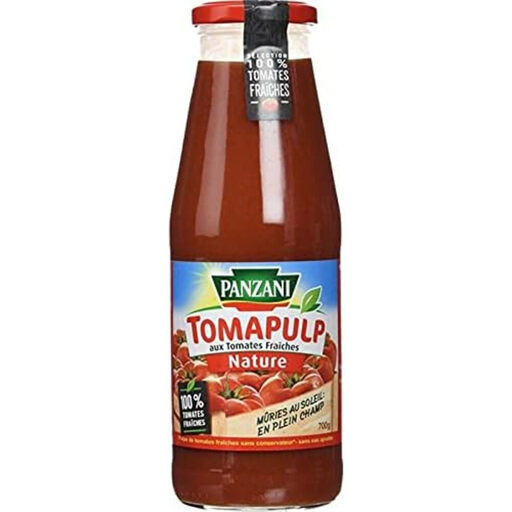 Image unavailable
A tomato sauce to consider if you’d rather not prepare a purée base yourself. The container holds 700 g. Before choosing this size, compare ‘of which sugars’ and ‘salt’ per 100 g, as well as the instructions for after opening.
 Image unavailable
A tomato purée for making your own sauce instead of buying a ready-made one. The container holds 500 g. Bear in mind the ingredients you’ll add and the storage instructions for after opening.
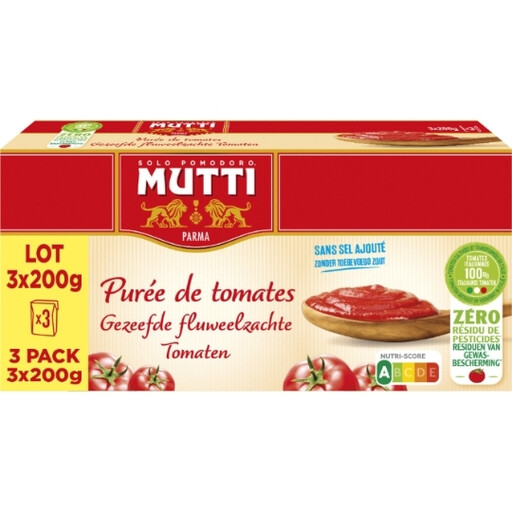 Image unavailable
Another tomato purée to add to your sauces, supplied in three 200 g containers. If salt matters to you, check its value and the ingredients list on the label of the product you buy.
No: the claim doesn’t rule out sugars naturally present in tomatoes. To find out which of the sauces you’re considering has the lowest total sugar content, compare ‘of which sugars’ per 100 g across products for the same use.
Check ‘of which sugars’ and ‘salt’ per 100 g, then read the ingredients list and allergen information for each sauce. If a Nutri-Score is shown, use it as extra information rather than a substitute for these values.
Follow the instructions on the container you buy: storage times vary by product. As an example for this particular product, Auchan’s page for the Italians Do It Better Pomodoro sauce says to keep it in the fridge and use it within four days of opening.
No: it describes one aspect of the recipe, not the full nutritional profile or whether the product is suitable for an individual requirement. Check the full label and, if you’re following advice from a health professional, take it into account when making your choice.