Hosts keeping an eye on added sugars
You’re making pasta for several people and looking for a sauce labelled “no added sugars”, without mistaking this for a complete absence of sugars.


If limiting added sugars is your priority, choose a sauce explicitly labelled “no added sugars”, then compare the “of which sugars” value. This claim does not mean the sauce contains no sugar at all. If flavour is your main consideration, an Italian recipe could also work, once you’ve checked the label. Tomato purée, on the other hand, needs extra preparation.
You’re making pasta for several people and looking for a sauce labelled “no added sugars”, without mistaking this for a complete absence of sugars.
You’re looking for tomato, basil or vegetable flavours for your menu, and want to check the ingredients and nutritional information for your chosen recipe separately.
You’re choosing a pack size to suit the number of guests and checking that the product you want is available at your chosen store.
Choose this if: avoiding added sugars in the sauce matters more than the choice of flavourings. Auchan, for example, lists a Pomodoro sauce from Italians Do It Better with this claim.
Bear in mind: tomatoes can contribute to the “of which sugars” value shown on the label.
Choose this if: basil or another tomato-based recipe is your main consideration when pairing a sauce with pasta. Barilla, for example, offers Basilico and Tomato & Vegetables recipes.
Bear in mind: the recipe name and the stated origin of the tomatoes don’t, on their own, tell you whether it contains added sugars.
Choose this if: you want to compare the recipes and pack sizes available at your store.
Bear in mind: a classic recipe may contain added sugar. The ingredients list for the Turini vegetable sauce listed by E.Leclerc includes sugar.
| What to consider | What to check | Who this matters to |
|---|---|---|
| Added sugars | The exact claim on the sauce and the “of which sugars” value per 100 g. | I want to limit added sugars in the sauce without assuming it contains no sugar at all. Around 42% of consumers would put this distinction at the top of their list. |
| Pairing with the dish | The ingredients that give the recipe its character, such as basil or vegetables. | For my menu, I’m looking first and foremost for a flavour that goes well with pasta and that guests will enjoy. Taste would be the main priority for around 25% of consumers. |
| Ingredients and allergens | The ingredients list and allergens for the specific variant you buy. | If I’m cooking for guests with dietary requirements, the exact ingredients matter more than the recipe name. This would be the top priority for around 17% of consumers. |
| Pack size and availability | The pack’s net weight and whether the product is available at your chosen store. | I need to plan enough for everyone and be able to find the sauce before the meal. Around 16% of consumers would put these practical considerations first. |
A sauce can carry the first claim and still show sugars in its nutritional information.
On the jar you choose, compare the claim with the ingredients list and the “of which sugars” value per 100 g. The DGCCRF distinguishes the conditions for using nutrition claims from the information shown in the nutrition declaration.
A recipe name doesn’t tell you everything that’s in it: the Turini vegetable sauce listed by E.Leclerc includes sugar.
Read the ingredients list for the product you choose rather than relying on the presence of vegetables alone.
A sauce featured in a catalogue won’t necessarily be stocked at your store. Carrefour lists the Heinz garlic and onion sauce, with no salt and no added sugars, that we checked as unavailable.
Check local availability before settling on your choice for the meal.
Its Basilico and Tomato & Vegetables sauces could work well as part of an Italian-inspired pasta menu.
Panzani’s cooked tomato sauce is one of the classic recipes worth comparing.
Carrefour Classic' cooked tomato sauce is a supermarket own-brand recipe sold in a 420 g jar.
The Turini tomato and vegetable sauce listed by E.Leclerc is an example of a vegetable recipe whose ingredients are worth checking individually.
The retailer lists Italian sauces from Italians Do It Better, including Pomodoro and Puttanesca recipes.
These two MUTTI tomato purées make a base for preparing a pasta sauce with your choice of seasonings. They’re not a substitute for a sauce that’s already seasoned. If a “no added sugars” claim is essential, check the label on the product you choose.
 Image unavailable
A tomato base to season yourself if you’d like to make the sauce for your meal from scratch, rather than use a ready-to-serve pasta sauce.
To check for added sugars, look at the claim on the packaging, the ingredients list and the “of which sugars” value per 100 g.
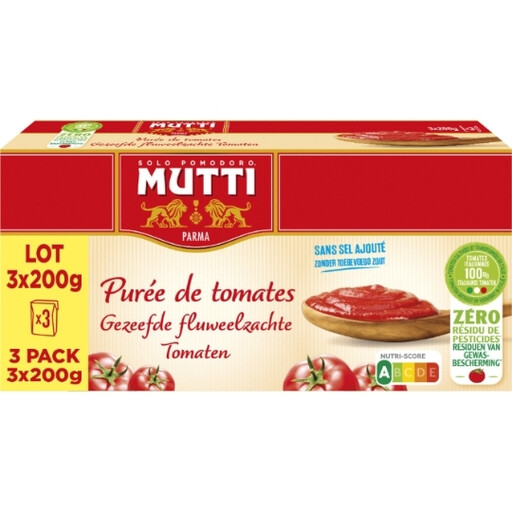 Image unavailable
A three-pack of tomato purée to season and use as a base for pasta sauce; it isn’t a ready-to-serve, seasoned sauce.
Check the ingredients list on the packaging, including whether salt is present, as well as the claim about added sugars and the “of which sugars” value per 100 g.
No. This claim doesn’t mean the total amount of sugars is zero. To compare two sauces, check the “of which sugars” value per 100 g and the ingredients list for the specific product.
Read the ingredients and allergens shown on the product you’re going to serve, as these can vary between recipes. For example, the Carrefour product page we checked for Heinz garlic and onion sauce mentions a flavouring that contains milk. This doesn’t apply to all Heinz sauces.
Follow the instructions for the recipe you’ve chosen. Barilla says its Basilico sauce should be poured over freshly drained pasta. If you’re using tomato purée as a base, you’ll need to prepare your own seasoning.
Don’t rely on this product without checking that it’s available at your store. Carrefour lists the Heinz garlic and onion sauce, with no salt and no added sugars, that we checked as unavailable. Its description doesn’t confirm that you’ll be able to buy it for your evening meal.