
Livraison le jour même ou le lendemain

Qualité garantie

Débloquez vos offres de bienvenue: Livraison GRATUITE | Jusqu'à -80 % | 30 jours d'essai gratuits à JoyPlus
Téléchargez l'application
Whether you're installing baseboards, trim, or flexible seals, a perfect angle cut is the secret to a professional-grade finish. It's what separates an amateur job from a flawless result. The multi-angle miter shears are the ultimate tool for this mission. The problem is, the market is flooded with models that don't always live up to their promises. Knowing how to decipher spec sheets is therefore crucial to avoid bad purchases and subpar finishes.
As a product expert for the DIY section, my mission is to help you see things more clearly. Let's break down the pitfalls to avoid and the real criteria for choosing the tool that will perfectly match your projects.
Too many DIYers get duped and end up with a disappointing tool. Here are the three most common mistakes, often fueled by overly optimistic marketing.
To ensure you get clean, precise cuts, there are three technical points to watch closely.
This is the heart of the matter. Insist on blades made of SK5 steel. This high-carbon steel is renowned for its toughness and its ability to hold a sharp edge for much longer. It's your guarantee for clean cuts in soft materials like PVC, rubber, or softwood strips.
Another non-negotiable point: the ability to replace the blade. A good tool must offer replacement blades. This extends its lifespan and ensures consistent performance, project after project.
Since the whole point of the tool is cutting angles, its mechanism must be flawless. Favour models with an angle scale engraved into the metal, not just painted on. The engraving will never wear off and remains accurate over time.
Also, check the adjustment range. Good miter shears should cover at least 45° to 135° to offer the versatility needed for most finishing work, from standard right angles to more open or closed angles. A locking system that is both simple and sturdy is essential to ensure the angle doesn't move a single millimetre during the cut.
To make repeated cuts without fatigue, an ergonomic handle, ideally covered with a non-slip grip (like PPC or PVC), is essential. It reduces fatigue and ensures a secure hold. The tool's body, made of either aluminium alloy (lighter) or steel (more robust), must be perfectly rigid so it doesn't bend under pressure.
A safety lock mechanism is also a must-have. It keeps the shears closed for storage, which prevents accidents and protects the blade's edge.
To illustrate these criteria in practice, here are our recommendations, tailored to different needs.
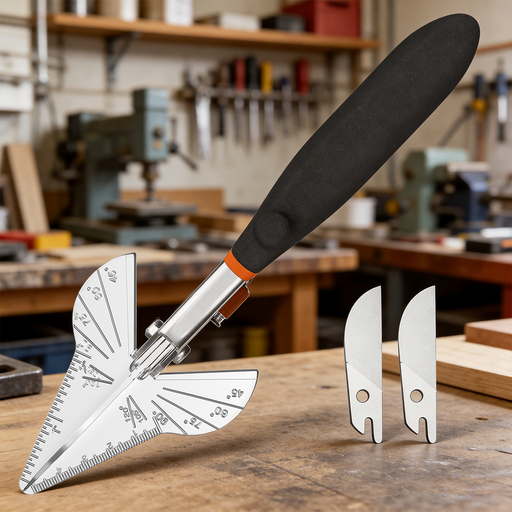
Why we recommend it: Perfect for a one-off finishing project (installing quarter-round, trim, etc.) when you need a reliable tool without breaking the bank. It offers excellent value for money for occasional use.
Its hardened SK5 steel blade and clear angle stops (90°, 75°, 60°, etc.) prevent imprecise cuts and premature blade wear.
Comes with 2 replacement blades, ensuring good longevity for several projects at no extra cost.
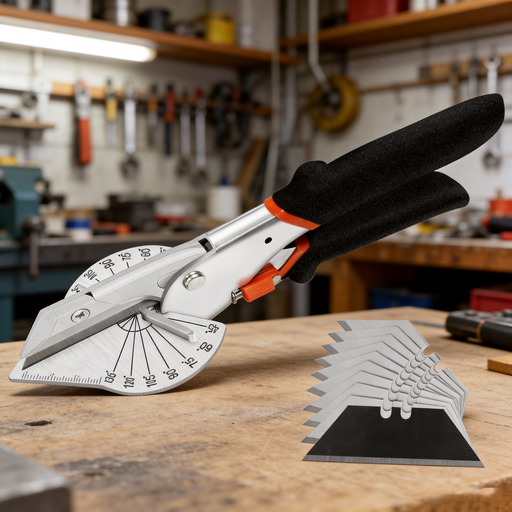
Why we recommend it: Ideal for tradespeople or experienced DIYers who tackle project after project and make heavy use of their PVC gasket cutter. The generous stock of replacement blades lets you work without interruption, never worrying about running out.
It sidesteps pitfall #1 (blade wear) by including a comfortable stock of 10 SK5 steel blades. That's more than enough to ensure perfect cuts for the long haul.
Its ergonomic aluminium alloy handle with a PPC grip and its engraved scale make it a tool that's as comfortable as it is reliable for intensive use.
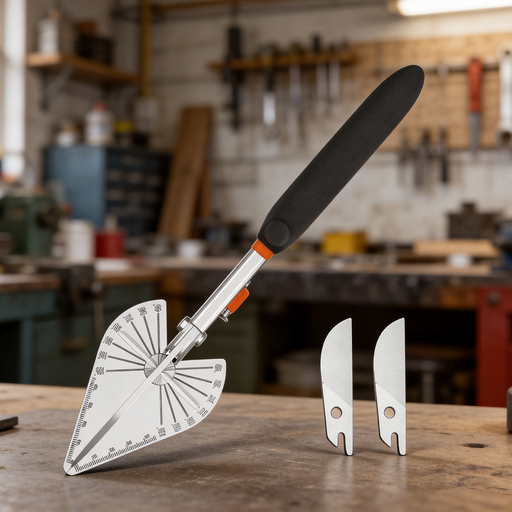
Why we recommend it: Designed for pros or complex jobs that involve cutting wider materials (cable trunking, thick mouldings...). Its extended design increases its cutting capacity.
Its reinforced structure and ultra-precise engraved scale eliminate the risk of an unreliable mechanism. This is crucial when cutting wide pieces, where even the slightest millimetre of error is noticeable.
Extended cutting width (up to 6.8 cm), making it much more versatile than standard models for specific applications.
Explore our full selection of products that meet our quality criteria and safety standards.
No, and that's a hard no. This tool is designed exclusively for soft materials: PVC, softwood (pine, fir), rubber seals, polystyrene mouldings, cable trunking... Trying to cut hardwood, MDF, or metal is guaranteed to break the blade and probably the mechanism.
The process is simple and quick. First, engage the safety lock and put on protective gloves. Locate the screw or screws holding the blade in place. Unscrew them completely with a suitable screwdriver. Carefully remove the old blade, position the new one, checking its alignment, and then screw it back in firmly.
Even if they look similar, their design is radically different. Miter shears use a straight blade that presses the material against a flat base (the anvil), which is often graduated, to ensure a perfectly straight cut at an exact angle. Pruning shears, like the WORKPRO Bypass Secateurs 210mm, work differently: either with two curved blades that cross each other (bypass type) or with a cutting blade against an anvil (anvil type). Their purpose is to snip plant stems. Applying this technique to a piece of trim would only crush the fibres and make a clean, neat joint impossible.