
Livraison le jour même ou le lendemain

Qualité garantie

Débloquez vos offres de bienvenue: Livraison GRATUITE | Jusqu'à -80 % | 30 jours d'essai gratuits à JoyPlus
Téléchargez l'application
Whether you're an artist, illustrator, or fine arts student, your choice of paper is as crucial as your brushes or pencils. The mixed-media paper pad often seems like a silver bullet: a single surface for all your creative impulses. However, this attractive promise often hides pitfalls that can ruin your artwork... and drain your wallet.
Too many so-called "all-purpose" papers fail to deliver. The result: sheets that buckle at the slightest touch of gouache, or a surface that won't grip the pigment from your pastels. To ensure your next purchase is a success, here are the key points to check when choosing a paper that will become a true partner for your creativity.
Marketing often relies on vague promises that mask deal-breaking flaws. Here are the two most common problems artists encounter.
To make the right choice, rely on objective technical specifications rather than marketing slogans. Here are the three pillars of an excellent mixed-media paper.
Paper weight, expressed in grams per square metre (g/m?), measures the paper's thickness and density. For resistance to wet media, it's the number one criterion.
The paper's surface, or its grain, directly impacts the final result. While a perfectly smooth paper is ideal for alcohol markers or technical drawing, a paper with grain will prove far more versatile.
The paper's composition determines its longevity. A high-quality extra-white cellulose paper is an excellent starting point. The essential criterion to check for is the "acid-free" or "pH-neutral" label. Without this, the paper will inevitably yellow over time, altering the colours of your artwork. While most major brands adhere to this standard, be wary of entry-level products.
Rather than an exhaustive list, we've matched user profiles with products that meet our criteria for quality and versatility.
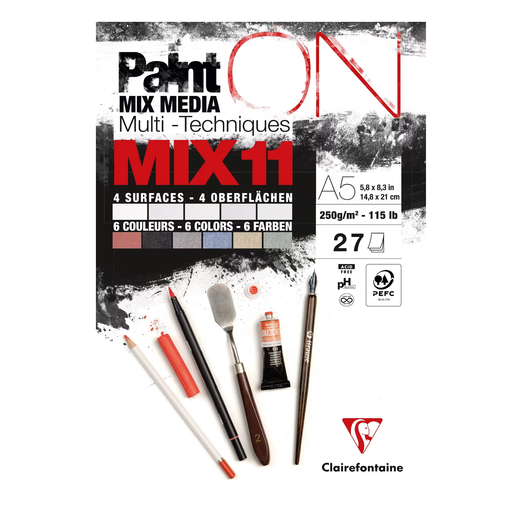
Why this choice? Ideal for students or artists who love to experiment. This assorted pad lets you test 11 different papers (warm tones, cool tones) without having to invest in multiple large pads. The A5 format is practical and economical.
With its consistent 250 g/m? weight, each sheet allows you to experiment with wet media on different shades and textures without fear of the paper buckling.
Its main benefit: it allows you to discover the full richness of the Clairefontaine Paint'ON range (surfaces, shades) in a single pad, helping you identify the perfect paper for each project.
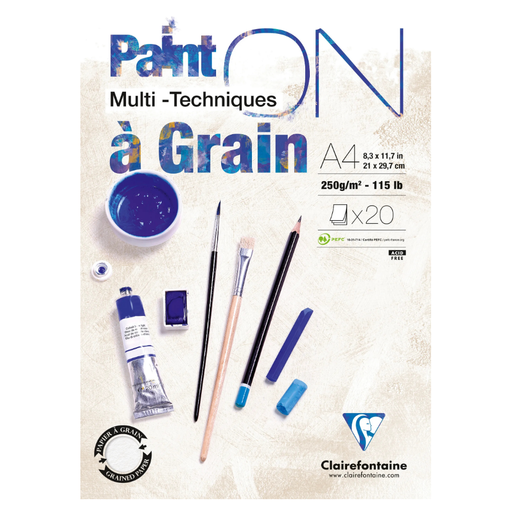
Why this choice? This is the reliable choice for daily use. The standard A4 format, 250 g/m? weight, and its composition make it a dependable surface for everything from preparatory sketches to finished pieces, from pencil to acrylics.
Its 250 g/m? weight guarantees stability against wet media. Its dual-grain surface (one side more pronounced, one side finer) offers a versatility that smooth "do-it-all" papers can't match.
An extra-white 100% cellulose and acid-free paper that ensures excellent colour preservation. Its distinguishing feature: a dual texture for varied renderings.
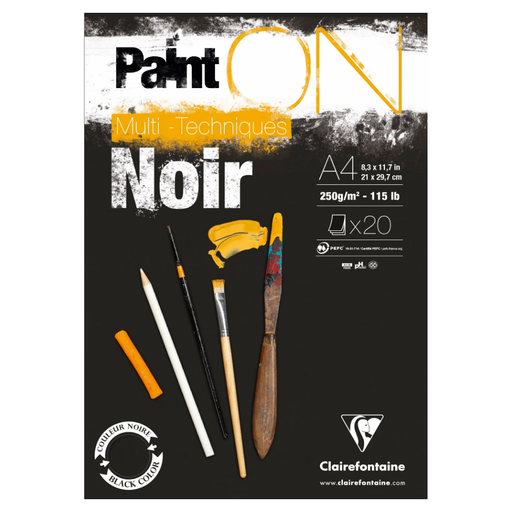
Why this choice? Specifically designed for artists who work with light media (white pencils, metallic inks, opaque gouache) and seek maximum contrast. The deep black makes light pop spectacularly.
Unlike simple black cardstock, this is a true fine art paper. It offers good absorption and allows for corrections (by scraping or lifting), a rare and valuable quality on a dark background.
Its fine grain and deep black shade provide the ideal foundation for creations with high visual impact, whether made with dry or wet media.
Explore our complete selection of papers that meet our standards for quality and durability.
For light washes or a few watercolour touches in a mixed-media piece, a 250 g/m? paper will do the job perfectly. However, for very wet techniques (like wet-on-wet or multiple layers), a dedicated watercolour paper of 300 g/m? (or more) is necessary to prevent the sheet from warping.
The main difference lies in the texture. A mixed-media paper pad typically has a fine grain that allows it to adapt to both dry and wet media. Bristol board, in contrast, is perfectly rigid and ultra-smooth. This makes it ideal for precision drawing with ink, alcohol markers, or for technical drawing, but much less suitable for painterly techniques like gouache or pastel.
To preserve the quality of your sheets, always store your pad flat in a dry place, away from direct sunlight (which can yellow the paper). Keep it in its original packaging or in an artist's portfolio to protect the corners and prevent it from absorbing ambient moisture.