
Livraison le jour même ou le lendemain

Qualité garantie

Débloquez vos offres de bienvenue: Livraison GRATUITE | Jusqu'à -80 % | 30 jours d'essai gratuits à JoyPlus
Téléchargez l'application
When your grounds cover several thousand square metres, mowing can quickly become a recurring chore—especially if your garden includes several areas, a terrace, a pond or slopes. The Joybee K2 robotic lawn mower without boundary wire is designed specifically for owners who want to automate lawn maintenance across areas of up to 3 000 m², without burying or securing wire in the ground.
There are, however, a few points worth checking before placing your order. Autonomous navigation does not necessarily guarantee millimetre-accurate mapping, and a connected app does not mean that all its features will remain accessible without a network connection. Here are the key criteria to examine to avoid buying a mower that is not suited to your garden.
A robotic lawn mower without boundary wire still needs to learn where the lawn ends. Depending on the technology used, you may need to install an antenna, a positioning router or define the various zones virtually through an app.
For the Joybee K2, the technical specifications mention a charging station, an AH router and an RTK signal mast. The initial mapping therefore requires some preparation: install the equipment in an unobstructed area, connect the mower to Wi-Fi, then define the mowing area in the app.
The figure of “3 000 m²” is not enough to describe the actual conditions of use. The layout of the garden, cutting width, battery life and charging time all affect how long maintenance will take.
According to the stated specifications, the K2 has a 22 cm cutting width, around 90 minutes of battery life and a 60 minute charging time. On a garden divided into separate areas or with particularly dense growth, it may therefore need several cycles to cover every section.
Camera-based detection can help the mower avoid certain obstacles, but it does not replace putting away toys, cables, tools and other objects left on the lawn beforehand. Very low obstacles, moving objects and changing light levels can also affect detection.
The Joybee K2 specifications state camera-based obstacle detection between 10 and 100 cm, along with a clearance height of 30 mm. This information helps you check whether the mower will be able to cope with your edging, exposed roots and narrow passageways.
An RTK robotic lawn mower uses a positioning signal to follow a virtual map more accurately. This technology is particularly useful in large gardens and for managing multiple zones from the app. However, it does require the signal device to be placed in an unobstructed location. Very dense trees, high walls and covered areas can interfere with reception.
The Joybee K2 combines RTK and vision for navigation and obstacle detection. Before setting it up, it is best to check the quality of the network available, whether the app is compatible with your smartphone and the exact layout of the different areas to be mown.
When choosing a robotic lawn mower suited to sloping ground, compare the stated figure with the actual layout of your garden. According to its specifications, the Joybee K2 is designed for slopes of up to 45 %, or approximately 25 degrees. This figure does not mean that every sloping surface will be crossed under the same conditions.
Wet grass, loose soil, leaves or uneven edging can reduce traction. Also remember to measure the passages between the different areas: even a mower capable of managing multiple maps may not be able to cross steps or changes in level.
The IPX6 waterproof robotic lawn mower certification indicates resistance to powerful jets of water, but does not mean that the appliance can be submerged. The charging station and connectors must be installed according to the instructions, on a stable and suitably protected surface.
The K2 is advertised with IPX6 protection. After each mowing session, remove any grass collected around the blades and switch the appliance off before carrying out any work. The specifications also recommend keeping children and pets away while it is operating.
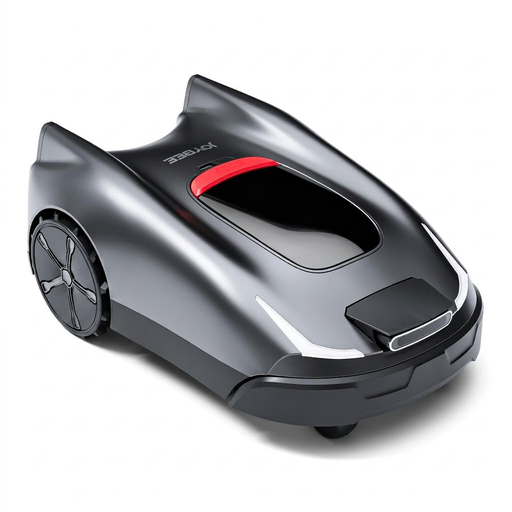
Why this choice suits this profile: Virtual mapping avoids the need to install a boundary wire, while the app lets you monitor the mower remotely. This clearance offer also advertises next-day delivery.
It does more than simply claim to be “wire-free”: the specifications also mention the AH router, RTK mast and the various mapping stages.
Stated coverage of 3 000 m², app control, a 4 000 mAh lithium iron phosphate battery and camera-based obstacle detection.
Why this choice suits this profile: Users looking for connected control can benefit from virtual mapping, location tracking and an anti-theft alert in the app.
The connected features are based on tangible components: Wi-Fi, the app, RTK, vision and virtual zone management.
Stated slope capability of up to 45 %, adjustable cutting height from 25 to 60 mm and a stated noise level of 65 dB.
Why this choice suits this profile: Large gardens with terraces, ponds or separate areas can benefit from virtual zone configuration and integrated obstacle detection.
IPX6 resistance is clearly stated, but it should not be confused with protection against immersion: proper installation and maintenance are still essential.
Automatic return to the station, 22 cm cutting width, stated clearance of 30 mm and an anti-theft alert shown in the app.
Cleaning the blades, checking the wheels and inspecting the station should all form part of routine maintenance. Before carrying out any work, stop the mower and never lift it while it is operating.
The specifications state a capacity of up to 3 000 m². In practice, results will depend on the shape of the garden, the number of zones, slopes, RTK coverage and the frequency of charging cycles.
No, the Joybee K2 is presented as a robotic lawn mower without boundary wire. You will still need to install the signalling device and create the virtual boundaries in the app.
The main costs to consider are electricity consumption for recharging, periodic blade replacement and general maintenance. The appliance’s service life will depend in particular on how frequently it is used, the condition of the ground and whether the maintenance instructions are followed.