
Livraison le jour même ou le lendemain

Qualité garantie

Débloquez vos offres de bienvenue: Livraison GRATUITE | Jusqu'à -80 % | 30 jours d'essai gratuits à JoyPlus
Téléchargez l'application
Would you like to maintain your lawn without laying out several dozen metres of boundary wire? A cable-free robotic lawn mower can make installation much simpler, especially in a garden dotted with flowerbeds, trees, patios or several separate areas. However, bear in mind that the absence of boundary wire does not mean every model is configured in the same way.
Before buying a cable-free robotic lawn mower, check its navigation method, the area it can realistically cover and how it performs on slopes. Here are the key criteria to consider so you can avoid spending money on a model that is unsuitable for your garden.
A capacity of 600, 800 or 1 000 m² generally refers to the maximum lawn area advertised by the manufacturer under ideal conditions. A fragmented, narrow or shaded garden, or one crossed by several pathways, can significantly reduce daily performance.
You should therefore leave some margin between the size of your garden and the figure shown on the specification sheet. For a 500 m² lawn spread across several areas, a model rated for 600 m² may struggle more than a device designed for a larger area.
A robotic lawn mower with RTK navigation uses satellite signals and a reference station to determine its position accurately. Very dense trees, high walls or certain buildings can nevertheless interfere with reception. Camera-based navigation can be affected at night, in foggy weather or when there is insufficient light.
Check the operating conditions and make sure you have a suitable location for the station before placing your order. Some models automatically return to their base when navigation conditions are no longer sufficient.
An AI-enhanced camera or 3D sensor can recognise many objects, but no system removes the need to prepare the lawn. Thin hoses, flat cables, small toys and certain very low objects can still be difficult to detect.
Remove movable items before each cycle and keep children and pets away while the mower is operating. Collision, lift and tilt sensors improve safety, but they do not eliminate the need to follow all the usual precautions.
Without boundary wire, limits are generally defined using digital mapping, RTK positioning, a camera or a combination of several technologies. For a simple garden, a solution based mainly on vision may be sufficient. On a large property or in an area made up of several zones, RTK, LiDAR or hybrid navigation often provide more structured management.
In particular, check:
The advertised battery life should be considered alongside charging time and the robot’s ability to resume mowing automatically after returning to the base. A wider cutting width can reduce the number of passes, but it cannot compensate for navigation that is poorly suited to a complex garden.
For a robotic lawn mower for up to 1 000 m², compare the recommended area, operating time per charge and the option to schedule several mowing slots. The cutting height must also suit your lawn: the models featured here generally cover ranges of around 20 to 90 mm, depending on the reference.
Slope percentages cannot be compared directly with degrees. A slope rated at 45% corresponds to approximately 24°, while a 60% slope is close to 31°. Grip, moisture and the type of ground also have a direct impact on the robot’s traction.
Check the maximum slope in the mowing area, as well as around the edges. Finally, a rating such as IPX5 or IPX6 indicates water resistance under the conditions specified by the manufacturer; it does not mean the charging station can remain exposed to every type of weather without protection.

Why this choice suits this type of user : Designed for small private lawns of up to 150 m², this model offers cable-free installation and autonomous operation, with very little setup required.
Its clearly limited capacity helps you avoid paying for an oversized device. However, you must confirm that your lawn does not exceed 150 m².
Cable-free design, autonomous movement and obstacle detection as stated in the product listing.
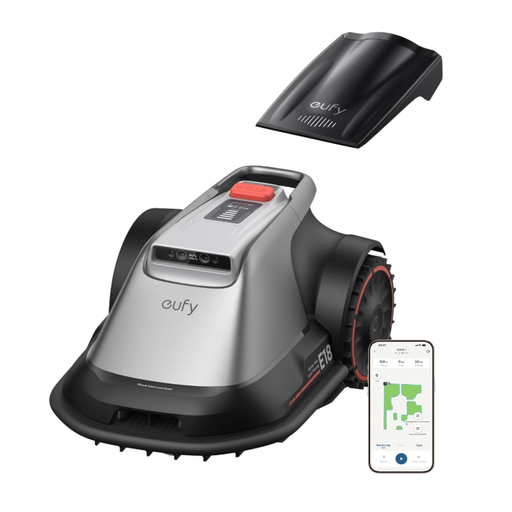
Why this choice suits this type of user : It is aimed at garden owners with areas of up to 1 200 m² who want navigation combining RTK, vision and GNSS, as well as app control.
The listing details the situations that may cause signal loss and the limitations when detecting thin objects. This transparency helps you prepare your garden properly.
Advertised coverage of 1 200 m², maximum slope of 40%, adjustable cutting height from 25 to 75 mm and IPX6 rating.
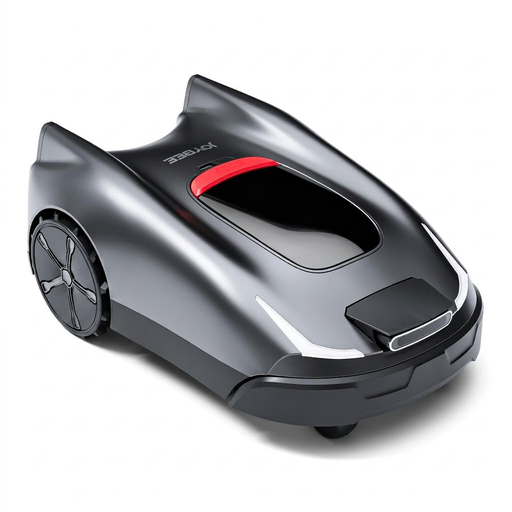
Why this choice suits this type of user : With advertised coverage of up to 3 000 m², multi-zone management and the ability to handle slopes of up to 45%, it is designed for large, complex gardens.
Virtual mapping allows you to separate different areas, but installing the RTK equipment requires a clear location to minimise interference.
22 cm cutting width, advertised battery life of 90 minutes, mobile app, anti-theft alarm and IPX6 protection.
We have put together a complete, real-time updated list of products that meet these demanding selection criteria, as well as European safety requirements.
Even a connected robotic lawn mower requires a few regular checks:
To estimate the cost of use, take into account electricity consumption, blade replacement, battery wear and any connectivity subscription. An autonomous lawn mower used on a large area may run through considerably more cycles than a device intended for a small lawn.
Yes, provided you choose technology suited to the terrain. RTK is particularly useful for creating an accurate map, while a camera- or LiDAR-based system may be preferable when satellite reception is limited. If several lawns are separated from one another, check that the mower supports multiple zones and permitted passages.
Not necessarily to start mowing locally. However, Wi-Fi or Bluetooth may be required to map the garden, schedule cycles and install updates. When available, 4G makes remote monitoring easier, subject to network coverage and the terms of the service.
Battery life depends on the model, slope, grass height and temperature. Product listings often state the operating time per charge, but the robot may also return automatically to its base to recharge before resuming its route. Remember to check the charging time and whether a replacement battery is available.