
Livraison le jour même ou le lendemain

Qualité garantie

Débloquez vos offres de bienvenue: Livraison GRATUITE | Jusqu'à -80 % | 30 jours d'essai gratuits à JoyPlus
Téléchargez l'application
Maintaining a lawn spanning several hundred or even several thousand square metres without giving up every weekend becomes much easier with a boundary-wire-free robotic lawn mower. Modern models combine RTK, cameras and mobile apps to create virtual mowing zones.
This technology does not remove the need to plan the installation carefully. “Wire-free” does not mean the robot will be ready to use within minutes, nor that it will perform the same way on every type of terrain. Here are the key points to consider before you buy.
A boundary-wire-free automatic lawn mower will generally need to learn the garden’s boundaries through its app. You must therefore install the station, signal module or RTK antenna correctly. Very dense trees, high walls or a covered location can interfere with reception.
A model that can manage multiple zones is particularly useful for separating the front lawn, back garden or several areas connected by a passageway. However, check how many maps can be saved and how the robot moves from one zone to another.
The gradient shown in a technical specification often applies to a very specific situation. It can vary depending on the mowing area, ground grip, grass moisture and the presence of a boundary. For example, a robotic lawn mower for sloping terrain may handle a steep incline in the middle of the lawn, but be far less comfortable near its boundary.
On hilly ground, assess the maximum operating gradient, obstacle-clearing ability and the robot’s performance on wet ground separately.
A robotic lawn mower with a camera can detect certain obstacles, but it does not remove the need to clear toys, cables, tools and fallen branches from the lawn. Detection also depends on the size, colour and position of each object.
An anti-collision robotic lawn mower should be regarded as a navigation aid, not a guarantee against every impact. Children and pets should be kept away from the appliance while it is operating.
Do not choose a 3000 m² robotic lawn mower simply because this area is included in its name. Also consider battery life, charging time, cutting width and the robot’s ability to resume mowing automatically after recharging.
The Joybee K2 claims a working area of up to 3000 m², a cutting width of 22 cm, approximately 90 minutes of battery life and a stated charging time of 60 minutes. These figures give an indication of its mowing rate, but the layout of your garden will have a direct impact on the total mowing time.
RTK relies on a positioning signal that is much more precise than conventional satellite navigation, provided the station and module are installed correctly. The camera can complement this navigation by detecting obstacles along the route.
For a connected robotic lawn mower, check which functions are actually available in the app: map creation, no-go zones, scheduling, location tracking, notifications and resuming after charging. An app-controlled robotic lawn mower should also remain usable when the Wi-Fi or mobile connection is less reliable.
The Joybee K2’s IPX6 rating indicates protection against powerful water jets under the conditions specified by this classification. It does not mean that the station or the entire system can be submerged. The ISWARD GX model, meanwhile, claims IPX5 protection for the robot and IPX4 for its charging station.
Also check for lift, tilt and obstacle sensors, as well as automatic blade shut-off if intervention is required. Before carrying out any maintenance, switch off the machine and never touch the blades while they may still be moving.
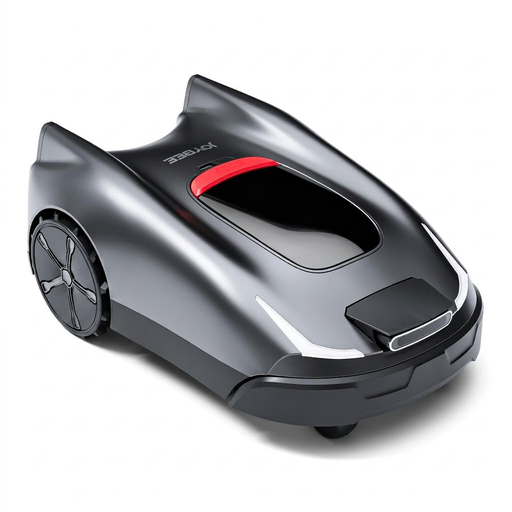
Why this choice suits this profile : This model combines RTK navigation, vision, app control and virtual mapping in a single appliance. Its stated 3000 m² coverage is suitable for owners who want to avoid installing a boundary wire.
The product details list the accessories included, notably the station, AH router and RTK mast. You will still need to install the complete system in an open area to minimise signal problems.
22 cm cutting width, adjustable height from 25 to 60 mm, stated gradients of up to 45 % and IPX6 rating for the robot.
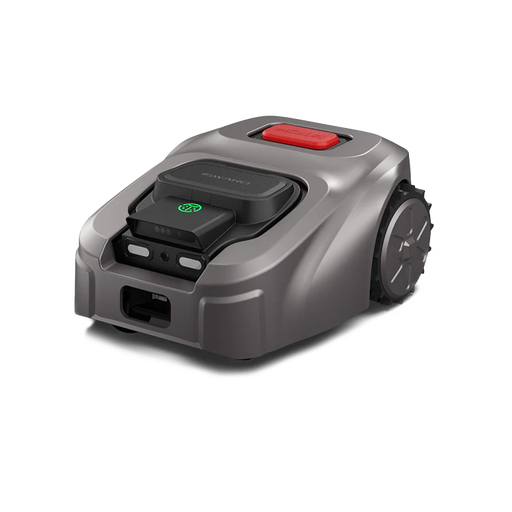
Why this choice suits this profile : This model provides detailed information about its sensors, LiFePO4 battery and savable maps. It is aimed at users who want to compare navigation functions and battery life in detail.
The stated gradient reaches 57 % within the zone, but only 10 % at its boundary. This distinction prevents overly broad conclusions based on the technical specifications.
Recommended area of 2500 m², approximately 160 minutes of mowing per charge, 20 savable maps and vision, rain and tilt sensors.
Why this choice suits this profile : Owners of gardens with ponds, patios or slopes can benefit from multi-zone management and obstacle detection, while monitoring the robot remotely through the app.
The specifications distinguish between camera-based detection, lift shut-off and the anti-theft alarm. These functions enhance monitoring, but do not remove the need to make the lawn safe.
Cutting height from 25 to 60 mm, obstacle clearance of up to 30 mm, operation stated for gradients of up to 45 % and an IPX6 housing.
We have put together a complete, real-time selection of products that meet these demanding criteria and European safety requirements.
A connection makes it easier to create maps, adjust settings and receive notifications remotely. Offline operation depends on the model. Check the manual to distinguish between functions available locally and those requiring the app or a network.
It depends on how often it is used, maintenance, exposure to the weather and replacement of the blades or battery. An appliance used over a large area should be cleaned regularly and stored according to the manufacturer’s recommendations during periods of inactivity.
The IP rating provides information about the housing’s protection under specific conditions, but does not guarantee unrestricted use in heavy rain. Use the rain sensor or delay function when available, and avoid immersing the station or power supply unit.