
Livraison le jour même ou le lendemain

Qualité garantie

Débloquez vos offres de bienvenue: Livraison GRATUITE | Jusqu'à -80 % | 30 jours d'essai gratuits à JoyPlus
Téléchargez l'application
A non-stick frying pan compatible with induction can make everyday meals easier, but not all models meet the same standards. An unsuitable base, a fragile coating or overly demanding care routine can quickly turn a practical purchase into wasted money.
Before comparing a frying pan, wok or sauté pan, it is therefore worth looking beyond claims such as “reinforced non-stick” or “all hobs”. Here are the criteria that really matter for a French kitchen fitted with an induction hob.
A non-stick frying pan described as suitable for “all hobs” is not automatically compatible with induction. This technology requires a base containing a magnetic material, usually indicated by the term induction, IH or a dedicated symbol.
For example, the Tefal Ingenio Easy Plus set is compatible with gas, electric and ceramic hobs, but its product details specify that it is not suitable for induction. It is therefore not suitable for a kitchen with an induction hob, even though its stackable design and removable handle are particularly practical.
A PFOA-free frying pan may meet a specific marketing claim, but this information alone says nothing about scratch resistance, the thickness of the base or the product’s lifespan. You should consult the manufacturer’s detailed information, particularly the recommended utensils and operating temperatures.
Products described as made without the intentional addition of PFOA, PFOS, lead or cadmium should not be confused with a general health promise. Cooking with little oil also depends on the temperature, the recipe and the condition of the coating.
A non-stick coating may be advertised as dishwasher-safe, while still having a better chance of lasting if washed by hand. Abrasive sponges, metal utensils and overheating an empty frying pan are often more damaging than the number of cooking cycles.
By contrast, a carbon steel frying pan has no added non-stick coating. It needs seasoning, careful drying and the application of a thin layer of oil after cleaning. This is a different approach, suited to users who are prepared to adopt a proper care routine.
For an induction hob, check that there is a magnetic base covering a sufficiently large area. A frying pan compatible with induction can also be used on a gas, electric or ceramic hob, but the reverse is not always true.
The cookware’s design also affects how evenly it cooks. Cast aluminium is often appreciated for its manageable weight and good heat distribution, while carbon steel and iron retain more heat. A thickness of 3 mm, as found on some de Buyer frying pans, provides useful thermal inertia for searing food, at the cost of a higher weight.
The stated diameter generally refers to the upper rim. A 28 cm frying pan may therefore have a smaller cooking surface, depending on the shape of its base. For a family, a 28 cm wok or deep sauté pan provides more room for vegetables, pasta and dishes with sauces.
A sauté pan with a lid is even more versatile: it can be used for simmering, reducing a sauce or retaining moisture in food. The tempered glass lid supplied with the SENSARTE model lets you monitor cooking without having to lift it.
To protect a non-stick coating, choose utensils made from wood, silicone or nylon. Low to medium heat is generally recommended to reduce thermal stress. A surface without an artificial coating, such as that of a carbon steel frying pan, changes with seasoning: it gradually darkens and requires more care.
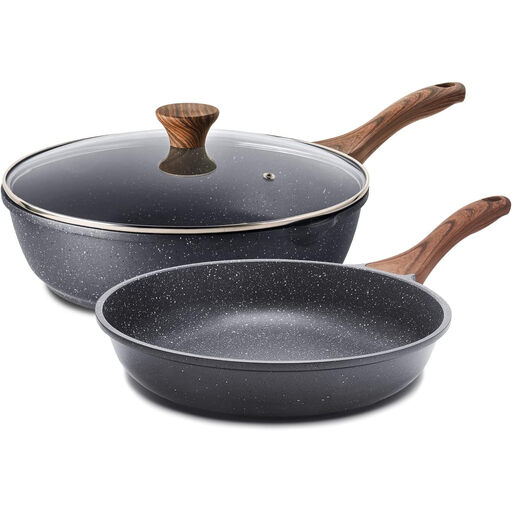
Why this choice suits this profile : This set includes a 24 cm frying pan and a deep 4.7-litre sauté pan with a lid, covering everything from simple meals to family-sized dishes.
Its stainless steel magnetic base is stated to be compatible with induction, gas and electric hobs. The manufacturer also states that it is made without the intentional addition of PFOA and recommends hand washing to protect the coating.
Cast aluminium, granite-effect non-stick coating and a tempered glass lid for the sauté pan.
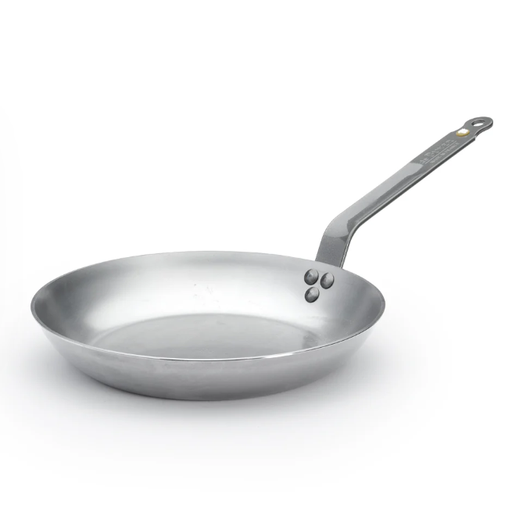
Why this choice suits this profile : This frying pan is designed for people looking for a surface without an artificial coating who are happy to season it and carry out regular maintenance.
The product details state a composition of 99 % iron and 1 % carbon, with no added non-stick coating. Gradual seasoning takes the place of a ready-to-use coating.
28 cm diameter, induction compatibility and durability suited to searing, browning and high-heat cooking.
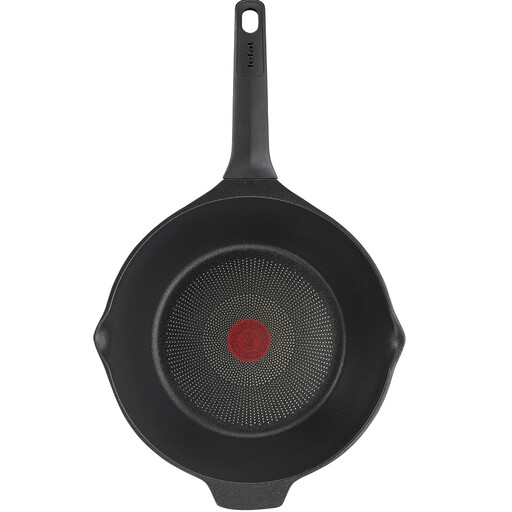
Why this choice suits this profile : Its high sides are ideal for stir-fried vegetables, noodles, rice and any dish that needs stirring without spilling food everywhere.
The product details mention compatibility with induction, gas, electric and ceramic hobs. It is also dishwasher-safe, although hand washing remains preferable for protecting the coating.
Cast aluminium, 28 cm diameter, Thermo-Signal indicator and a coating stated to be PFOA-free.
We have put together a complete, real-time updated list of products that fully meet these strict selection criteria and European safety regulations.
With a non-stick surface, use moderate heat, avoid leaving the cookware empty on the hob for a long time and choose silicone or wooden spatulas. Allow the frying pan to cool before washing it to reduce thermal shock.
A carbon steel frying pan is best cleaned with hot water and a soft brush. Dry it immediately, then apply a light film of oil. Dishwashers and prolonged soaking encourage oxidation.
In both cases, replace the cookware if the base is warped, the coating starts to come away or the handle becomes unstable. Its lifespan depends as much on the quality of its construction as on how the frying pan is used every day.
Place a magnet underneath the base: if it sticks, the frying pan may be compatible, but this test does not replace the manufacturer’s information. Also look for the terms induction, IH or the symbol for an induction hob.
A diameter of 24 to 28 cm is generally suitable for meals for one to three people. For a family or larger dishes, a 28 cm wok or deep sauté pan provides more space. However, make sure that the diameter of the base matches the heating zone on your hob.
Yes, a non-stick coating makes it easier to cook with a small amount of oil, particularly eggs, vegetables and crêpes. However, the result still depends on the temperature, the recipe and the condition of the surface. A carbon steel frying pan can also naturally become less sticky after being properly seasoned and maintained.