
Livraison le jour même ou le lendemain

Qualité garantie

Débloquez vos offres de bienvenue: Livraison GRATUITE | Jusqu'à -80 % | 30 jours d'essai gratuits à JoyPlus
Téléchargez l'application
The wok holds the promise of fast, healthy, and flavourful cooking. Crisp vegetables seared in an instant, restaurant-style stir-fried noodles, fragrant curries simmering gently… its versatility is the stuff of dreams. But that dream can quickly turn into a nightmare when it comes to using it on an induction hob. Too many buyers end up disappointed with a wok that heats poorly, constantly sticks, or has a coating that wears out in just a few weeks.
As a product expert at Joybuy, my mission is to help you cut through the noise. Forget the marketing jargon; we're going to focus on what's essential. Here's a breakdown of the pitfalls to avoid and the criteria that truly matter when choosing an induction wok that lives up to your expectations.
The "All-Hob Compatible" Myth: Don't be fooled; the "induction compatible" label is no guarantee of performance. A wok with a base that's too thin or slightly warped will only make partial contact with the hob. The result? Slow, uneven heating and the inability to reach the high temperatures needed to sear food properly. True induction performance relies on a winning trio: a flat, thick, and perfectly magnetic base.
Non-Stick Coatings That Can't Take the Heat: Wok cooking is all about thermal shock—rapid and intense temperature spikes. However, many low-end non-stick coatings, while convenient at first, can't handle this treatment. They degrade quickly, lose their non-stick properties, flake off, and ultimately render the wok useless. A good non-stick wok must be specifically designed to withstand high temperatures.
To make the right choice, three technical features should be put under the microscope. They determine the quality, performance, and lifespan of your future wok.
The choice of material directly impacts heating speed, heat retention, and maintenance.
On an induction hob, the rule is simple: the wok's base must be flat and ferromagnetic. This is the non-negotiable condition for perfect contact with the hob, ensuring powerful and even energy transfer. A thick base is also a sign of quality: it retains heat better and resists warping from repeated thermal shocks.
Here are a few options that meet different needs, taking into account performance and durability criteria.
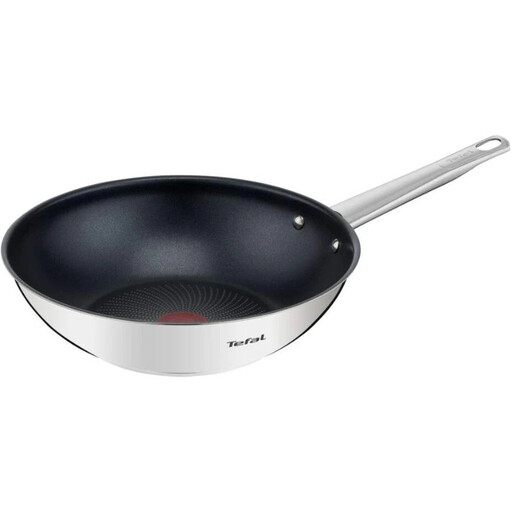
Why we love it: No seasoning required, express cleaning, and technology that forgives beginner mistakes... It's the perfect wok to get started without any hassle.
Its thick base ensures even heat distribution on induction. Most importantly, its Thermo-Signal indicator alerts you before it overheats, thereby protecting the coating's lifespan.
Its durable titanium non-stick coating and its temperature indicator to ensure perfect results every time. Dishwasher safe.
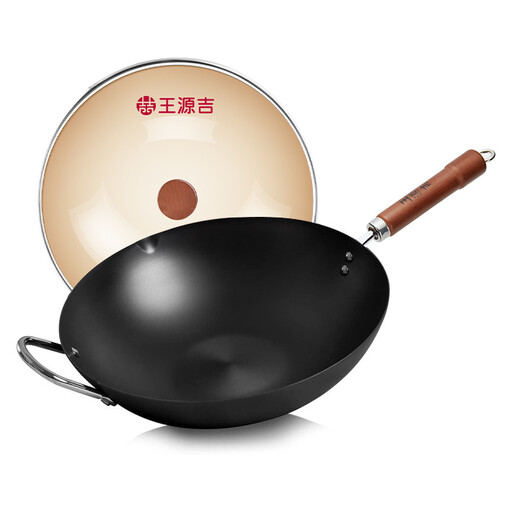
Why we love it: For fans of the famous "wok hei" (that characteristic smoky flavour) who want to recapture an authentic cooking experience. Its light weight allows you to toss ingredients like a pro, and its lifespan is practically infinite with proper care.
Simple: it has no chemical coating. Its non-stick property is 100% natural, created by seasoning, and it improves over time. Its flat base is optimised for induction.
Pure carbon steel for lightning-fast heating and a seasoning that builds a lifelong patina. Comes with its lid in glass.

Why we love it: Its large 30 cm size is perfect for family meals. It combines the robustness of stainless steel with the ease of a modern coating, making it just as comfortable searing as it is simmering, boiling, or frying.
Its tri-ply construction eliminates hot spots by ensuring perfectly even heat. Cleverly, its honeycomb-textured interior protects the coating from scratches caused by utensils.
Its tri-ply design for uniform heat and its ceramic coating protected by an anti-scratch texture. A true large-format workhorse.
If the authenticity of traditional steel appeals to you, discover our complete selection of woks that meet our criteria for performance and safety.
Seasoning is the key step to creating that famous non-stick patina. Wash the new wok to remove the protective wax. Dry it completely and heat it on high until the metal turns a bluish colour. Lower the heat, pour in a thin layer of vegetable oil (sunflower, rapeseed, etc.), and spread it over the entire inner surface with a paper towel (be careful, it's hot!). Heat on medium for a few minutes, until the oil starts to smoke slightly. Let it cool, wipe away the excess oil with a clean paper towel, and you're done! Your wok is now seasoned.
On an induction hob, a flat-bottomed wok isn't just an option—it's a requirement! The traditional round bottom is designed for gas stoves, where the flames "lick" and envelop the sides of the wok. On a flat glass-ceramic surface, only a flat bottom can ensure the direct contact needed for efficient and even heat transfer.
For a family of 3 to 5 people, a wok that is 30 cm to 32 cm in diameter is the ideal size. It's the perfect size to have enough space to toss ingredients without them crowding (which would cause them to steam instead of sear), while still being easy to handle on a standard hob.