
Same-day & Next-day Delivery

Quality Guaranteed

Unlock Your Welcome Offers: FREE Delivery | Up to 80% OFF | Free 30-day JoyPlus trial
Download the APP
The carbon steel pan is making a strong comeback in our kitchens. Prized for its lightning-fast heating, rock-solid durability, and a non-stick patina that only gets better with time, it's winning over cooking enthusiasts who crave authenticity. But be warned: with an overwhelming number of options on the market, marketing traps are common, and disappointment can be just around the corner. My role, as Head of Product Recommendations at Joybuy, is to equip you to make the right choice.
Here are the three most common mistakes to avoid when you buy:
To make an informed choice, focus on objective technical specifications rather than marketing claims. Here are the three points you must absolutely check.
The thickness of the steel is crucial. A quality pan, whether it's a classic frying pan or a carbon steel sauté pan, should have a thickness between 2 and 3?mm.
Ensure the model is compatible with your heat source. The label "all stovetops, including induction" is a good indicator, but the devil is in the details. For induction and ceramic glass cooktops, the pan's base must be perfectly flat to ensure optimal contact and detection by the stovetop. A base that is slightly concave when cold but flattens out with heat is a sign of good design. For a carbon steel wok, a flat-bottomed model is essential for home use without a support ring.
The key advantage of carbon steel is its lack of chemical coatings. The non-stick surface is created naturally through the seasoning process: the polymerization of thin layers of oil under heat. This black patina that forms over time is the sign of a well-maintained pan. It is durable, can be restored indefinitely, and is safe to use with metal utensils. Brands like de Buyer with its Mineral B line are benchmarks in the field, using high-purity steel.
Rather than an exhaustive list, here are targeted options for different types of cooks, taking into account performance and durability criteria.
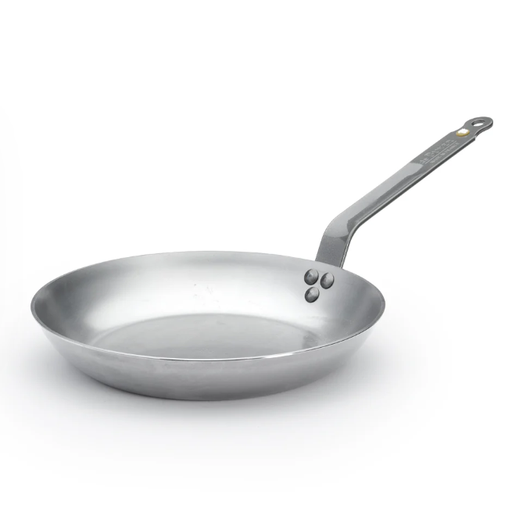
Why it's the perfect match: Ideal for those who love the authentic French cooking experience. Perfect for searing meats, fish, or browning potatoes, this pan is a true cooking instrument that can be passed down through generations.
This model doesn't claim to be ready-to-use. de Buyer is transparent about the need to remove the beeswax and season the pan. Its weight is an asset for thermal stability, not a flaw.
Made in France from 99% iron. Develops an exceptional natural non-stick patina over time. Compatible with all stovetops, including induction.
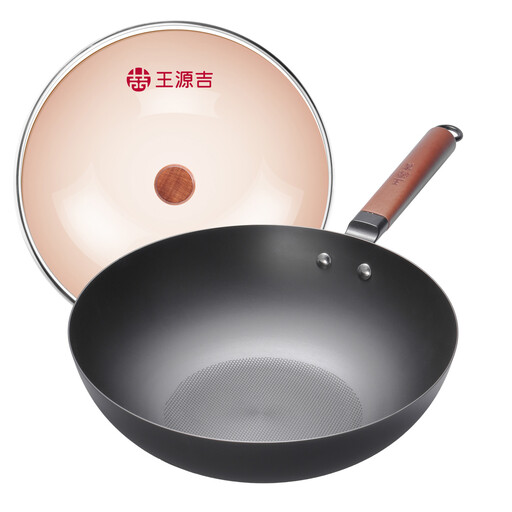
Why it's the perfect match: Perfect for wok cooking, which demands intense heat. Its flat bottom makes it compatible with modern stovetops, and its relative light weight makes it easy to toss ingredients, a signature of Asian cuisine.
This carbon steel wok addresses the fear of rust with a nitriding surface treatment, which makes it more resistant. It strikes a good balance between being lightweight for maneuverability and robust enough to prevent warping.
Nitrided surface for better rust resistance. Flat bottom compatible with all heat sources, including induction. Honeycomb texture to aid the non-stick effect.
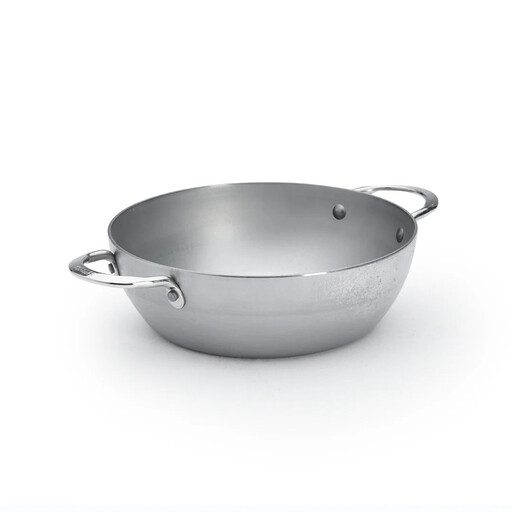
Why it's the perfect match: Its large size and two handles make it perfect for cooking in large quantities. It's a versatile sauté pan for simmered dishes, fried foods, or sautéed vegetables for the whole family. Easy to carry from the stove to the table.
Its two handles solve the weight issue, which is often a drawback on large-diameter pans. This makes a robust, high-performance pan much easier to handle, even when full.
Large capacity and dual-handle design for safe, balanced handling. Ideal for large-volume dishes and table service. The manufacturing quality and expertise of de Buyer.
We have selected other products that meet our strict criteria for quality and performance.
Don't panic—it's not serious and is very easy to fix. The rust is superficial. To remove it, scrub the area with an abrasive sponge (like steel wool), a little water, and white vinegar. Rinse thoroughly, dry it immediately over heat, and then re-season it by applying a thin layer of oil.
Yes, not only is it normal, it's a great sign! The black color indicates that the patina (the seasoning) is forming correctly. The blacker and more uniform your pan becomes, the better its non-stick properties will be. It's visual proof that your uncoated pan is improving with time.
Not at all! Seasoning a carbon steel pan is a very simple process. After cleaning the new pan to remove its protective coating, just pour in a thin layer of oil and heat it over medium heat until it starts to smoke lightly. Let it cool, wipe away the excess oil with a paper towel, and your pan is ready. Repeat this process the first few times you use it to build up the patina. Daily maintenance is just as simple: just dry it well and wipe it with an oiled paper towel before storing.