
Livraison le jour même ou le lendemain

Qualité garantie

Débloquez vos offres de bienvenue: Livraison GRATUITE | Jusqu'à -80 % | 30 jours d'essai gratuits à JoyPlus
Téléchargez l'application
A well-organised garage, cellar, or workshop is the secret to any successful project. However, finding the ideal storage solution can often feel like a daunting task. Faced with an avalanche of options, it's easy to be swayed by marketing promises that fail to stand up to the test of time—or weight. As a product expert at Joybuy, my mission is to help you decipher technical specs and identify the criteria that truly matter. The goal: to make an informed and, above all, lasting choice.
Before you dive in, let's review the most common pitfalls that can turn a good investment into a costly disappointment.
storage shelf should adapt to your needs, not the other way around. Models with fixed shelves or a complex bolt-and-nut assembly lock you into one configuration, severely limiting your flexibility to organise items of various sizes, from archive boxes to bulky gardening equipment.To ensure you're investing in a garage storage solution that will live up to its promises, focus on these non-negotiable technical features.
Forget the advertised total capacity and look at just one thing: the load capacity per shelf. This is the most useful metric for day-to-day use. A good metal garage shelf should offer between 150 and 175?kg per level. This robustness depends on two key elements: the thickness of the steel frame and the presence of reinforcement crossbars under each MDF (medium-density fibreboard) shelf. These crossbars are crucial, as they prevent the board from sagging in the middle, where pressure is greatest.
The stability of a heavy-duty shelving unit depends on the quality of its design. Opt for frames made of powder-coated or galvanised steel, which are far more resistant to corrosion—an essential feature for a cellar and workshop shelf. The inclusion of an anti-tip kit with the shelf is another safety guarantee that should not be overlooked. It allows you to securely fasten the unit to the wall, preventing any risk of it falling over—a crucial detail if children are around or if you are storing valuable items.
The smartest storage systems are the ones that grow with you. A modular shelf is therefore a major asset. Look for models with an interlocking (boltless and screwless) assembly system, which ensures quick, tool-free setup. The real advantage of this modularity is the ability to convert one tall shelving unit into two workbenches or low storage units of the same height. This versatility is perfect for creating a functional workspace while optimising storage.
To see how these criteria apply in practice, here are our recommendations for different user profiles.
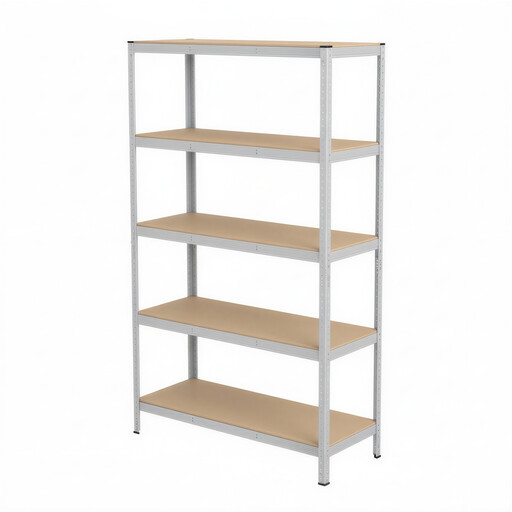
Why we recommend it: Perfect for a serious first-time garage or cellar organisation. It offers a total capacity of 750 kg, ideal for storing tools, archives, and seasonal equipment with a minimal footprint.
The capacity is clearly stated per shelf (150 kg), which avoids the ambiguity of "total load". Its steel frame and included anti-tip kit meet stability requirements.
Excellent capacity-to-footprint ratio. Its interlocking assembly is a breeze, and it easily converts into a workbench.
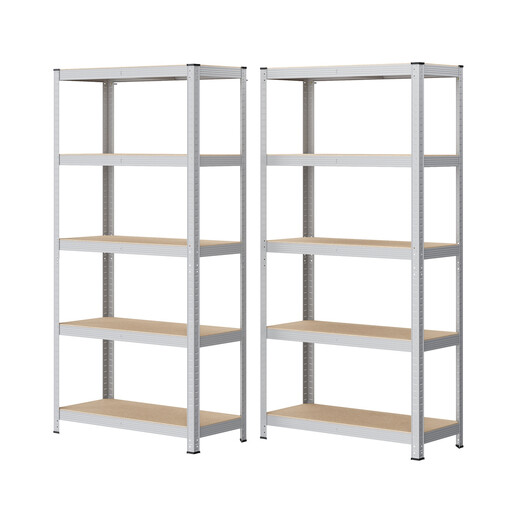
Why we recommend it: Designed for tradespeople or expert DIYers looking to fully equip a workshop. This set of two shelves offers considerable storage capacity (875 kg per unit) and allows you to build a cohesive, scalable organisation system.
This set ensures a uniform and scalable setup, saving you from mixing and matching models of varying quality. The 175 kg capacity per shelf is a guarantee of foolproof sturdiness.
A very high load capacity and a set format, perfect for outfitting a large space completely and uniformly.
We have selected a full range of products for you that meet our strict selection criteria and safety standards.
The longevity of a heavy-duty shelf depends mainly on the quality of its materials and how it's used. A model made from powder-coated or galvanised steel will resist rust much better in a damp environment like a cellar. By strictly respecting the load limits per shelf and avoiding impacts, a well-made shelving unit can last for more than ten years.
Yes, this is a step we strongly recommend for any tall shelving unit, especially if it will be holding heavy loads. Most quality models include an anti-tip kit for this purpose. Installation only takes a few minutes and eliminates the risk of tipping, ensuring the safety of those around you and protecting your equipment.
For optimal stability, the golden rule is simple: always place the heaviest and bulkiest items on the bottom shelves. This lowers the unit's centre of gravity and makes it much more stable. Also, remember to distribute the load evenly across the entire surface of each shelf, rather than concentrating it in the centre, to prevent it from warping over time.